
Wind is the load case that governs most aluminium curtain wall and cladding packages, yet it is frequently reduced to a single pressure figure in a tender document. That figure hides the engineering that actually decides whether a facade performs: the suction concentrated at corners and edges, the pressure coefficients that grow as the effective wind area shrinks, the deflection limit that keeps a gasket in compression, and the bracket and anchor capacity that holds the panel against uplift. This guide walks through the full chain for specifiers, facade engineers and importers — from how wind acts on a clad envelope, through the design pressure calculation to EN 1991-1-4 and ASCE 7-22, into espesor del panel, fixings and bracket selection, then testing and the documentation a supplier should be able to produce before fabrication is released.
How Wind Loads Act on Curtain Wall and Cladding Systems
S1
Wind Pressure Fundamentals on a Curtain Wall Envelope
Wind acting on a building generates a pressure field that is anything but uniform. The reference quantity is the stagnation pressure — the dynamic pressure of the approaching flow, expressed in EN 1991-1-4 as q = 0.5 · ρ · vb² (with ρ ≈ 1.25 kg/m³ for air). A 45 m/s basic wind velocity yields a stagnation pressure on the order of 1.27 kN/m², before any shape or exposure factors are applied. Every facade design starts from this number and then distorts it through pressure coefficients.
The windward face sits under positive pressure as the flow decelerates against it, typically corresponding to net pressure coefficients in the range of +0.7 to +0.9 for a rectangular tower of moderate aspect ratio. The leeward face behaves in the opposite sense: flow separation at the windward vertical edges leaves a low-pressure wake, producing negative pressure (suction) of roughly −0.5 to −0.7. On a tall building the windward and leeward loads act in the same direction — both push the facade inward — so the total design load is the algebraic sum, not the windward value alone. For a building with an internal pressure coefficient cpi of ±0.2 (permeability through doors, louvres, and unsealed joints), the worst-case net pressure on a partly permeable envelope can rise by 20–30% over the sealed-envelope case.
Suction dominates the structural design of cladding far more often than pressure does. The critical zones sit at the corners and along the edges, where separation bubbles and vortex shedding concentrate the flow.
Why Corners and Edges Govern Panel and Fixing Design
Codes do not model facade pressure as a single average. EN 1991-1-4 divides each face into zones A, B, C, D and E, and ASCE 7-22 uses virtually identical corner, edge, and interior zones. The corner zone (A) and edge strip (B) carry local suction coefficients that can reach −1.8 to −2.5, compared with −1.0 to −1.4 in the field of the wall. In cyclonic regions these values are amplified further by the peak-gust factor.
Three consequences follow:
- Panel design. A 1.5 m × 3.0 m aluminium composite or insulated glass unit in a corner zone may see 2–3× the pressure of the same panel mid-wall. Glass thickness, stiffener layout, and composite panel skin bonding are all sized by the corner zone, not the average.
- Fixing design. Suction pulls panels away from the frame. Retaining clips, structural silicone bite, and pressure-plate bolts are sized in tension, and the corner-zone uplift governs the screw spacing and pull-out capacity of the sub-frame.
- Mullion and transom bending. Mullions spanning between floors see the highest tributary suction at building corners, where the member both spans and cantilevers at the edge return.
Aerodynamic Effects in the Built Environment
Isolated-building coefficients are a starting point, not the answer. Real sites modify the flow substantially:
- Shielding. Upwind buildings reduce the effective pressure on a facade — but shielding is unreliable for ultimate limit states, and codes commonly permit only partial reduction. A building that is unshielded in its first year of life may become shielded, or the reverse, as the surrounding urban fabric changes.
- Funnelling and channel effects. Narrow gaps between towers accelerate flow through the gap. Local peak pressures on the flanking surfaces can exceed isolated-building values by a factor of 1.3–1.8, with strong vortex shedding driving dynamic amplification.
- Topographic speed-up. On hills, ridges, and cliffs the wind speed increases with height above local ground. A 60 m ridge can produce a 20–40% speed increase at terrace level, translating to a 40–100% increase in pressure since pressure scales with velocity squared. Coastal sites add the roughness change from sea to land, which raises the gust factor at the shoreline.
- Turbulence and buffeting. Urban boundary layers are turbulent; gust buffeting imposes cyclic loading on panels, gaskets, and anchors. Fatigue-sensitive fixings and low-stiffness panel systems must be checked for dynamic response, particularly where vortex shedding occurs on tall slender towers or at re-entrant corners.
From Wind Pressure to Structural Demand
Once net pressures are known, the cladding design chain resolves into discrete checks:
- Panel bending: glass, aluminium sheet, or composite skin bending stress and deflection under tributary pressure.
- Mullion and transom spans: bending stress and deflection over the governing span between anchors or between transoms.
- Brackets and anchors: pull-out, shear, and edge distance in concrete or steel substrate. Post-installed anchors are often the weak link under alternating suction.
- Movement joints and gaskets: compression set, sealant strain, and air infiltration under repeated deflection cycling.
cURL Too many subrequests by single Worker invocation. To configure this limit, refer to https://developers.cloudflare.com/workers/wrangler/configuration/#limits cURL Too many subrequests by single Worker invocation. To configure this limit, refer to https://developers.cloudflare.com/workers/wrangler/configuration/#limits
cURL Too many subrequests by single Worker invocation. To configure this limit, refer to https://developers.cloudflare.com/workers/wrangler/configuration/#limits
cURL Too many subrequests by single Worker invocation. To configure this limit, refer to https://developers.cloudflare.com/workers/wrangler/configuration/#limits
- cURL Too many subrequests by single Worker invocation. To configure this limit, refer to https://developers.cloudflare.com/workers/wrangler/configuration/#limits cURL Too many subrequests by single Worker invocation. To configure this limit, refer to https://developers.cloudflare.com/workers/wrangler/configuration/#limits
- cURL Too many subrequests by single Worker invocation. To configure this limit, refer to https://developers.cloudflare.com/workers/wrangler/configuration/#limits cURL Too many subrequests by single Worker invocation. To configure this limit, refer to https://developers.cloudflare.com/workers/wrangler/configuration/#limits
cURL Too many subrequests by single Worker invocation. To configure this limit, refer to https://developers.cloudflare.com/workers/wrangler/configuration/#limits
cURL Too many subrequests by single Worker invocation. To configure this limit, refer to https://developers.cloudflare.com/workers/wrangler/configuration/#limits
| cURL Too many subrequests by single Worker invocation. To configure this limit, refer to https://developers.cloudflare.com/workers/wrangler/configuration/#limits | cURL Too many subrequests by single Worker invocation. To configure this limit, refer to https://developers.cloudflare.com/workers/wrangler/configuration/#limits | cURL Too many subrequests by single Worker invocation. To configure this limit, refer to https://developers.cloudflare.com/workers/wrangler/configuration/#limits | cURL Too many subrequests by single Worker invocation. To configure this limit, refer to https://developers.cloudflare.com/workers/wrangler/configuration/#limits |
|---|---|---|---|
| cURL Too many subrequests by single Worker invocation. To configure this limit, refer to https://developers.cloudflare.com/workers/wrangler/configuration/#limits | Positive (inward) | Negative (outward suction) | Strong negative (outward suction) |
| Typical cpe range | +0.7 to +0.9 | −0.5 to −0.7 | −1.8 to −2.5 (zone A/B) |
| Relative magnitude | Reference case | ≈ 0.7× windward | ≈ 2–3× windward |
| Primary structural demand | Panel bending, mullion compression, inward push on anchors | Panel uplift, clip tension, mullion reversal | Panel uplift, retaining clip pull-out, anchor tension, local member bending |
| Governing limit state | ULS strength; SLS deflection of spans | ULS anchor pull-out; SLS gasket compression | ULS pull-out and local buckling; SLS watertightness under cycling |
| Design action | Size panels and transoms | Size clips and negative-pressure fixings | Size sub-frame, corner mullions, and anchor spacing in tension |
The practical takeaway: a curtain wall sized only on average windward pressure will under-design its corners and its fixings. The wind load case that governs a facade is almost always the local suction at the building edge, combined with the deflection that suction imposes on the gasket line.

Calculating Design Wind Pressure for Facade Panels
The Core Calculation Chain
Every curtain wall wind load calculation, regardless of jurisdiction, follows the same logical chain. The variables change name and the factors change value, but the sequence is fixed:
- Basic wind velocity vb — the fundamental wind speed for the site, read from the national annex or code map. In EN 1991-1-4 this is vb = cdir × cseason × vb,0, where vb,0 is the fundamental value from the national annex map, typically expressed as a 10-minute mean at 10 m height in terrain category II, with a return period of 50 years.
- Reference velocity pressure qb = ½ρvb². Using ρ = 1.25 kg/m³, a 26 m/s basic velocity gives qb cURL Too many subrequests by single Worker invocation. To configure this limit, refer to https://developers.cloudflare.com/workers/wrangler/configuration/#limits
- cURL Too many subrequests by single Worker invocation. To configure this limit, refer to https://developers.cloudflare.com/workers/wrangler/configuration/#limitsecURL Too many subrequests by single Worker invocation. To configure this limit, refer to https://developers.cloudflare.com/workers/wrangler/configuration/#limits cURL Too many subrequests by single Worker invocation. To configure this limit, refer to https://developers.cloudflare.com/workers/wrangler/configuration/#limitsecURL Too many subrequests by single Worker invocation. To configure this limit, refer to https://developers.cloudflare.com/workers/wrangler/configuration/#limitsvcURL Too many subrequests by single Worker invocation. To configure this limit, refer to https://developers.cloudflare.com/workers/wrangler/configuration/#limitsrcURL Too many subrequests by single Worker invocation. To configure this limit, refer to https://developers.cloudflare.com/workers/wrangler/configuration/#limitsr cURL Too many subrequests by single Worker invocation. To configure this limit, refer to https://developers.cloudflare.com/workers/wrangler/configuration/#limitsv cURL Too many subrequests by single Worker invocation. To configure this limit, refer to https://developers.cloudflare.com/workers/wrangler/configuration/#limits
- cURL Too many subrequests by single Worker invocation. To configure this limit, refer to https://developers.cloudflare.com/workers/wrangler/configuration/#limitspcURL Too many subrequests by single Worker invocation. To configure this limit, refer to https://developers.cloudflare.com/workers/wrangler/configuration/#limits = cecURL Too many subrequests by single Worker invocation. To configure this limit, refer to https://developers.cloudflare.com/workers/wrangler/configuration/#limitsbcURL Too many subrequests by single Worker invocation. To configure this limit, refer to https://developers.cloudflare.com/workers/wrangler/configuration/#limitsecURL Too many subrequests by single Worker invocation. To configure this limit, refer to https://developers.cloudflare.com/workers/wrangler/configuration/#limits
- cURL Too many subrequests by single Worker invocation. To configure this limit, refer to https://developers.cloudflare.com/workers/wrangler/configuration/#limitspe,c10 — the external pressure coefficient for 10 m² reference area (the “c10” suffix), modified for the actual tributary area of the element being designed.
- Net design pressure w = qp(z) × (cpe + cpi), where cpi is the internal pressure coefficient. For maximum suction on the cladding, the windward external face is in suction and internal pressure is positive, so the two add rather than cancel.
Which Standard Governs, and What Each Contributes
Facade engineers work across several wind codes, and curtain wall projects sourced internationally frequently require checks against more than one.
- EN 1991-1-4 (Eurocode 1, Part 1-4) — the primary European wind action standard. It defines the qb → qp chain, the terrain categories 0 through IV, the cpe,10 and cpe,1 coefficients for walls and roofs, and the structural factor cscd. It deliberately leaves the numerical value of vb,0 to national annexes.
- BS EN 1991-1-4 and national annexes — the UK National Annex sets vb,0 = 23 to 27 m/s depending on region. Other national annexes (German, Dutch, French) each publish their own vb,0 maps, terrain roughness parameters z0 and zmin, and in some cases altitude and directional factors. You cannot design a European facade without knowing which national annex applies.
- ASCE 7-22, Chapters 26 to 30 — the US framework. It uses a velocity pressure qz = 0.613 KzKztKdV² (SI form, in Pa), with exposure categories B, C and D, topographic factor Kzt, and ground elevation factor Ke. Chapter 30 governs components and cladding, using GCp values read from figures that are explicitly plotted against effective wind area. For small panels, GCp rises sharply.
- AS/NZS 1170.2 — the Australian/New Zealand standard, mandatory in cyclonic regions where regional wind speeds Mz,cat are multiplied by climate change multipliers Mc, and cladding design pressures are further increased by local pressure factors Kl cURL Too many subrequests by single Worker invocation. To configure this limit, refer to https://developers.cloudflare.com/workers/wrangler/configuration/#limits
- cURL Too many subrequests by single Worker invocation. To configure this limit, refer to https://developers.cloudflare.com/workers/wrangler/configuration/#limits cURL Too many subrequests by single Worker invocation. To configure this limit, refer to https://developers.cloudflare.com/workers/wrangler/configuration/#limits0 cURL Too many subrequests by single Worker invocation. To configure this limit, refer to https://developers.cloudflare.com/workers/wrangler/configuration/#limitss cURL Too many subrequests by single Worker invocation. To configure this limit, refer to https://developers.cloudflare.com/workers/wrangler/configuration/#limitsz cURL Too many subrequests by single Worker invocation. To configure this limit, refer to https://developers.cloudflare.com/workers/wrangler/configuration/#limitspe and cecURL Too many subrequests by single Worker invocation. To configure this limit, refer to https://developers.cloudflare.com/workers/wrangler/configuration/#limits
cURL Too many subrequests by single Worker invocation. To configure this limit, refer to https://developers.cloudflare.com/workers/wrangler/configuration/#limits
cURL Too many subrequests by single Worker invocation. To configure this limit, refer to https://developers.cloudflare.com/workers/wrangler/configuration/#limits
cURL Too many subrequests by single Worker invocation. To configure this limit, refer to https://developers.cloudflare.com/workers/wrangler/configuration/#limitspe,10 cURL Too many subrequests by single Worker invocation. To configure this limit, refer to https://developers.cloudflare.com/workers/wrangler/configuration/#limits
cURL Too many subrequests by single Worker invocation. To configure this limit, refer to https://developers.cloudflare.com/workers/wrangler/configuration/#limits
- cURL Too many subrequests by single Worker invocation. To configure this limit, refer to https://developers.cloudflare.com/workers/wrangler/configuration/#limits cURL Too many subrequests by single Worker invocation. To configure this limit, refer to https://developers.cloudflare.com/workers/wrangler/configuration/#limits
- Mullion and transom — tributary area is the span × half the distance to the adjacent mullion on each side. Intermediate coefficients.
- Facade as a whole / main structural frame — very large effective area, coefficients approach the cpe,10 values. Not the controlling case for cladding elements.
A common error in tender-stage facades is designing mullions to the whole-facade pressure and panels to the same value. In practice the panel and its immediate fixings see the highest pressure on the elevation, and this is where local pressure factors compound the problem.
Terrain and Exposure: The Trend, Not the Number
Wind speed increases with height above ground, and it increases faster over open terrain than over rough terrain. Terrain categories run from open sea and smooth coastline through open country, suburban and urban, each with its own roughness length z0 and minimum height zmin.
The trend to hold in mind:
- A coastal site with open-water fetch reaches full wind speed at lower height and produces the highest ce(z) for a given height. Design pressures on a 60 m coastal tower can be 30 to 60 percent higher than the same tower in dense urban surroundings.
- Suburban terrain is the common default. A 60 m building in suburban terrain typically sees ce(z) around 2.0 to 2.6 depending on the code and the national annex.
- Urban terrain with tall surrounding buildings reduces the exposure factor but introduces channeling and downwash effects between buildings that the code coefficients do not fully capture. Wind tunnel testing is warranted for tall or complex urban projects.
- An escarpment, ridge, cliff or embankment creates a speed-up effect. EN 1991-1-4 handles this with the factor co(z) applied to the velocity; ASCE 7 handles it with the topographic factor Kzt. On a site close to the crest, Kzt or co² can push design pressures up by 10 to 25 percent or more. This is site-specific and must be assessed, not assumed.
Internal Pressure cpi: Sealed Versus Permeable
A truly sealed curtain wall envelope has negligible internal pressure. Ribbon windows, ventilated pantalla de lluvia cladding, louvred plant zones, openable windows and unsealed construction gaps all introduce permeability, and where wind pressure on one face exceeds another, the internal pressure rises.
- Sealed facade — cpi is typically taken as 0 or a small value (±0.2). In most sealed curtain wall designs, internal pressure is ignored for the panel itself.
- Permeable facade — EN 1991-1-4 uses cpi = +0.2 or −0.3 depending on the openings on the windward and leeward faces. Where a dominant opening exists on the windward face (a broken window, an open roller door, a permanently open louvre), the internal pressure coefficient can approach cpe for the windward wall, effectively doubling the net pressure on a panel or fixing.
- Dominant opening scenario — this is a design case, not a coincidence. Where an opening larger than 30 percent of the wall area is likely, the internal pressure should be taken equal to the external pressure at the opening. This governs the design of fixings and anchors near that opening, and it must be flagged in the calculation sheet.
For maximum suction on the cladding, cpi is added to cpe, not subtracted. Getting the sign convention backwards understates the design pressure and is a recurring source of facade failures during storm events.
Local Pressure Factors for Cladding Attachments
Coefficients from the main tables apply to broad areas. Attachments within an edge or corner zone attract higher local pressures because the pressure field is most intense there and because a single bracket failure propagates a larger area of cladding. Two approaches are commonly used:
- AS/NZS 1170.2 cURL Too many subrequests by single Worker invocation. To configure this limit, refer to https://developers.cloudflare.com/workers/wrangler/configuration/#limitsl cURL Too many subrequests by single Worker invocation. To configure this limit, refer to https://developers.cloudflare.com/workers/wrangler/configuration/#limits
- cURL Too many subrequests by single Worker invocation. To configure this limit, refer to https://developers.cloudflare.com/workers/wrangler/configuration/#limits cURL Too many subrequests by single Worker invocation. To configure this limit, refer to https://developers.cloudflare.com/workers/wrangler/configuration/#limitspe,1 cURL Too many subrequests by single Worker invocation. To configure this limit, refer to https://developers.cloudflare.com/workers/wrangler/configuration/#limitsp cURL Too many subrequests by single Worker invocation. To configure this limit, refer to https://developers.cloudflare.com/workers/wrangler/configuration/#limits
cURL Too many subrequests by single Worker invocation. To configure this limit, refer to https://developers.cloudflare.com/workers/wrangler/configuration/#limits
cURL Too many subrequests by single Worker invocation. To configure this limit, refer to https://developers.cloudflare.com/workers/wrangler/configuration/#limits
cURL Too many subrequests by single Worker invocation. To configure this limit, refer to https://developers.cloudflare.com/workers/wrangler/configuration/#limits cURL Too many subrequests by single Worker invocation. To configure this limit, refer to https://developers.cloudflare.com/workers/wrangler/configuration/#limits cURL Too many subrequests by single Worker invocation. To configure this limit, refer to https://developers.cloudflare.com/workers/wrangler/configuration/#limits
| cURL Too many subrequests by single Worker invocation. To configure this limit, refer to https://developers.cloudflare.com/workers/wrangler/configuration/#limits | Parámetro | cURL Too many subrequests by single Worker invocation. To configure this limit, refer to https://developers.cloudflare.com/workers/wrangler/configuration/#limits | Notas |
|---|---|---|---|
| 1 | cURL Too many subrequests by single Worker invocation. To configure this limit, refer to https://developers.cloudflare.com/workers/wrangler/configuration/#limitsb | cURL Too many subrequests by single Worker invocation. To configure this limit, refer to https://developers.cloudflare.com/workers/wrangler/configuration/#limits | cURL Too many subrequests by single Worker invocation. To configure this limit, refer to https://developers.cloudflare.com/workers/wrangler/configuration/#limits |
| 2 | cURL Too many subrequests by single Worker invocation. To configure this limit, refer to https://developers.cloudflare.com/workers/wrangler/configuration/#limits | cURL Too many subrequests by single Worker invocation. To configure this limit, refer to https://developers.cloudflare.com/workers/wrangler/configuration/#limits | cURL Too many subrequests by single Worker invocation. To configure this limit, refer to https://developers.cloudflare.com/workers/wrangler/configuration/#limits |
| 3 | cURL Too many subrequests by single Worker invocation. To configure this limit, refer to https://developers.cloudflare.com/workers/wrangler/configuration/#limitsb = ½ρvb² | 0.42 kPa | ½ × 1.25 × 26² = 423 Pa |
| 4 | Exposure factor, ce(z) at z = 60 m | 2.3 | Illustrative suburban terrain, 60 m height |
| 5 | Peak velocity pressure, qp = cecURL Too many subrequests by single Worker invocation. To configure this limit, refer to https://developers.cloudflare.com/workers/wrangler/configuration/#limitsb | 0.97 kPa | 2.3 × 0.42 |
| 6 | External coefficient, cpe,c10 (corner zone) | −1.8 | Suction, corner zone, local effective area |
| 7 | Internal coefficient, cpi | +0.2 | Permeable facade, windward leakage |
| 8 | Net pressure, w = qp × (cpe + cpi) | −1.94 kPa | 0.97 × (−1.8 + 0.2) |
| 9 | Local pressure factor (attachment, corner) | 1.4 | Illustrative factor for brackets within the corner zone |
| 10 | Design pressure for bracket | −2.72 kPa | 1.94 × 1.4 |
The step from 1.94 kPa at the panel face to 2.72 kPa at the bracket is among the most under-appreciated transitions in facade design. Bonded or mechanically fixed brackets in a corner zone carry a design pressure roughly 40 percent higher than the panel they support.
Documentation and the Manufacturer Interface
A wind load calculation sheet for a curtain wall package should be a standalone, auditable document. It typically contains:
- Project location, building height, terrain category, and the governing code and national annex stated explicitly.
- The basic wind velocity and its source reference (clause and table from the national annex).
- The full qb → qp chain with intermediate values tabulated, not summarised.
- A pressure zone diagram — a facade elevation dimensioned with the corner, edge and field zones and the pressure applicable to each.
- A table of design pressures by element: panel, mullion, transom, bracket, anchor, and any dominant-opening scenario pressures.
- Assumptions on internal pressure, permeability, and whether a dominant opening case has been applied.
- Dead load, live load, thermal and seismic combinations where these interact with wind, and the load combination factors used.
Before the manufacturer can design brackets and anchors, the engineer must issue, in writing:
- Net design pressures in kPa for each zone — panel, mullion, transom, bracket, and anchor, as separate values.
- The governing load combination (for example 1.0 × wind for serviceability, 1.5 × wind or the applicable code factor for ultimate strength).
- Whether the design is based on permissible stress or load and resistance factor methodology, and the corresponding material safety factors.
- cURL Too many subrequests by single Worker invocation. To configure this limit, refer to https://developers.cloudflare.com/workers/wrangler/configuration/#limits
- cURL Too many subrequests by single Worker invocation. To configure this limit, refer to https://developers.cloudflare.com/workers/wrangler/configuration/#limits
cURL Too many subrequests by single Worker invocation. To configure this limit, refer to https://developers.cloudflare.com/workers/wrangler/configuration/#limits

cURL Too many subrequests by single Worker invocation. To configure this limit, refer to https://developers.cloudflare.com/workers/wrangler/configuration/#limits
cURL Too many subrequests by single Worker invocation. To configure this limit, refer to https://developers.cloudflare.com/workers/wrangler/configuration/#limits
cURL Too many subrequests by single Worker invocation. To configure this limit, refer to https://developers.cloudflare.com/workers/wrangler/configuration/#limits cURL Too many subrequests by single Worker invocation. To configure this limit, refer to https://developers.cloudflare.com/workers/wrangler/configuration/#limitscURL Too many subrequests by single Worker invocation. To configure this limit, refer to https://developers.cloudflare.com/workers/wrangler/configuration/#limits
cURL Too many subrequests by single Worker invocation. To configure this limit, refer to https://developers.cloudflare.com/workers/wrangler/configuration/#limits
- cURL Too many subrequests by single Worker invocation. To configure this limit, refer to https://developers.cloudflare.com/workers/wrangler/configuration/#limits cURL Too many subrequests by single Worker invocation. To configure this limit, refer to https://developers.cloudflare.com/workers/wrangler/configuration/#limits
- cURL Too many subrequests by single Worker invocation. To configure this limit, refer to https://developers.cloudflare.com/workers/wrangler/configuration/#limits cURL Too many subrequests by single Worker invocation. To configure this limit, refer to https://developers.cloudflare.com/workers/wrangler/configuration/#limits
- cURL Too many subrequests by single Worker invocation. To configure this limit, refer to https://developers.cloudflare.com/workers/wrangler/configuration/#limits cURL Too many subrequests by single Worker invocation. To configure this limit, refer to https://developers.cloudflare.com/workers/wrangler/configuration/#limits
cURL Too many subrequests by single Worker invocation. To configure this limit, refer to https://developers.cloudflare.com/workers/wrangler/configuration/#limits
| cURL Too many subrequests by single Worker invocation. To configure this limit, refer to https://developers.cloudflare.com/workers/wrangler/configuration/#limits | cURL Too many subrequests by single Worker invocation. To configure this limit, refer to https://developers.cloudflare.com/workers/wrangler/configuration/#limits | cURL Too many subrequests by single Worker invocation. To configure this limit, refer to https://developers.cloudflare.com/workers/wrangler/configuration/#limits |
|---|---|---|
| cURL Too many subrequests by single Worker invocation. To configure this limit, refer to https://developers.cloudflare.com/workers/wrangler/configuration/#limits | cURL Too many subrequests by single Worker invocation. To configure this limit, refer to https://developers.cloudflare.com/workers/wrangler/configuration/#limits | cURL Too many subrequests by single Worker invocation. To configure this limit, refer to https://developers.cloudflare.com/workers/wrangler/configuration/#limits |
| 1.0 – 1.5 | 2.0 – 2.5 mm | Ribs required above ~900 mm span; 2.5 mm for single-span trays |
| 1.5 – 2.5 | 2.5 – 3.0 mm | Ribs at 400–600 mm centres, or 3.0 mm plain with spans ≤ 1000 mm |
| 2.5 – 4.0 | 3.0 – 4.0 mm | 4.0 mm cassettes usually uneconomic — prefer 3.0 mm plus a ribbed sub-frame |
| > 4.0 (high-rise, corner zones) | 4.0 mm or composite build-up | Ribbed cassette with double return, or switch to composite panel with engineered sub-frame |
Typical guidance for preliminary sizing only. Confirm with project-specific structural engineering to EN 1999-1-1 and the governing national annex.
Allowable Stress, Deflection and Alloy Temper
Design to EN 1999-1-1 uses partial factors on resistance rather than a simple allowable stress. For non-weldable sheet alloys in the H14/H16 tempers, the 0.2 % proof strength is typically 110–145 N/mm²; for 6061-T6 extrusion it is around 240 N/mm², and for 5754-H22 sheet around 130–160 N/mm². The partial factor γM1 is normally 1.10, and γM2 of 1.25 applies in the heat-affected zone of welds — which is why welded mullion splices are avoided wherever possible.
Temper matters as much as alloy. 3003-H14 (work-hardened) and 3004-H34 are the workhorses for painted and anodised cassette faces: good formability, predictable strength. 5005 and 5754 offer better corrosion resistance at slightly lower strength. 6061-T6 is used for structural extrusions and brackets where stiffness governs. Annealed (O temper) material should never be specified for exposed panels — its proof strength is roughly one third of the H14 condition and it will yield under design wind.
Deflection limits are usually set by the facade specification, not the code: L/90 to L/120 for aluminium cladding panels, and L/175 to L/250 for mullions and transoms, with tighter limits (L/360) where brittle glazing or sealant joints are involved. These limits are serviceability criteria and must be checked independently of the strength check.
Mullion, Transom and Thermally Broken Profiles
Mullion and transom depth is selected by moment of inertia, not by section area. Required stiffness scales with pressure × span³ / (deflection limit × E), so a long span demands a disproportionate increase in section depth. Practical outcomes:
- Spans up to 3.0 m: 60–80 mm deep mullion, typically I ≈ 40–80 cm⁴.
- Spans 3.0–4.5 m: 100–130 mm deep, I ≈ 120–250 cm⁴.
- Spans beyond 4.5 m: 150–200 mm deep, often a two-part or reinforced profile.
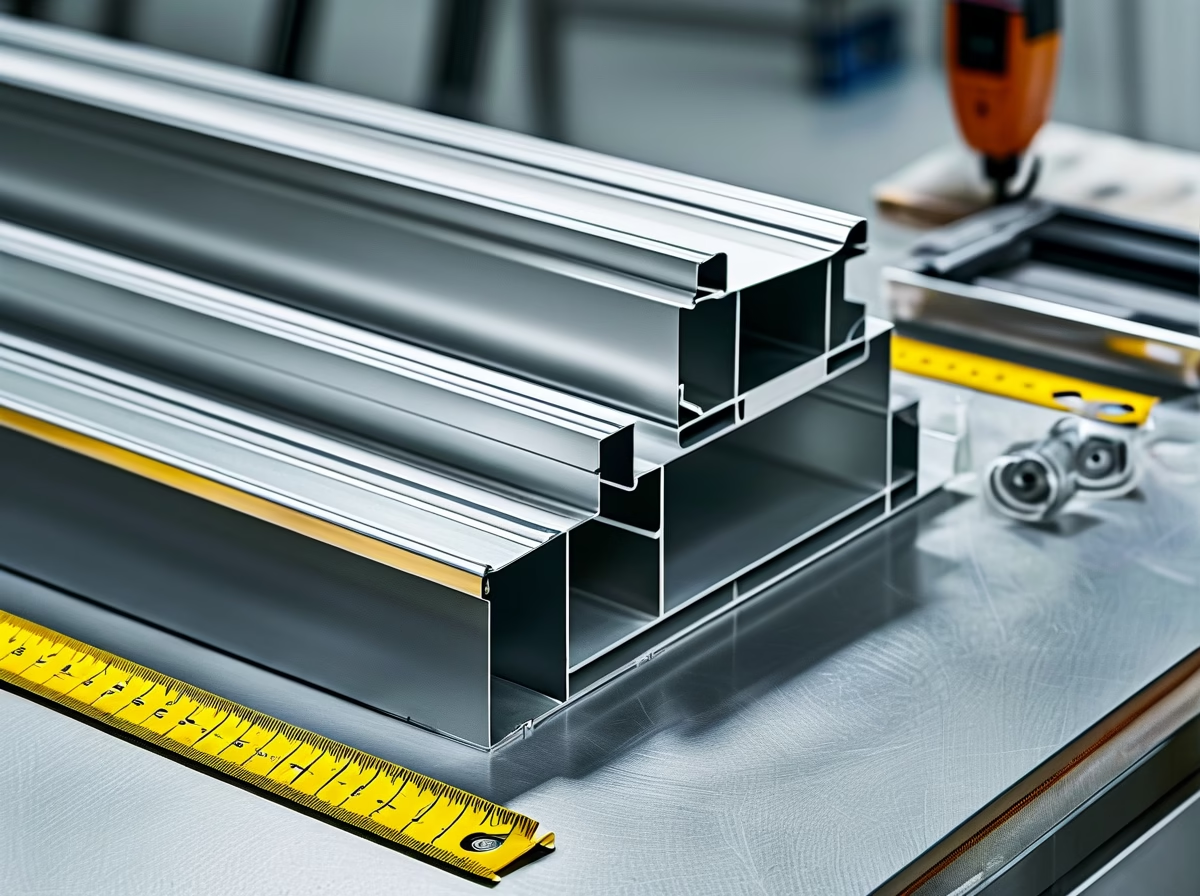
Thermally broken profiles carry a structural penalty: the polyamide or PU isolator is weaker than the aluminium it replaces, and the manufacturer’s published moments of inertia for the coupled section are typically 30–50 % lower than the geometric sum of both halves, depending on whether the strip is a full shear-transfer type or a non-structural cap. Always design against the coupled-section values supplied by the extruder, and never assume the two aluminium halves act compositely unless the profile is certified as such.
Fixings, Brackets and Anchors
Bracket type follows the substrate:
- Helping-hand brackets cURL Too many subrequests by single Worker invocation. To configure this limit, refer to https://developers.cloudflare.com/workers/wrangler/configuration/#limits
- cURL Too many subrequests by single Worker invocation. To configure this limit, refer to https://developers.cloudflare.com/workers/wrangler/configuration/#limits cURL Too many subrequests by single Worker invocation. To configure this limit, refer to https://developers.cloudflare.com/workers/wrangler/configuration/#limits
- cURL Too many subrequests by single Worker invocation. To configure this limit, refer to https://developers.cloudflare.com/workers/wrangler/configuration/#limits cURL Too many subrequests by single Worker invocation. To configure this limit, refer to https://developers.cloudflare.com/workers/wrangler/configuration/#limits
cURL Too many subrequests by single Worker invocation. To configure this limit, refer to https://developers.cloudflare.com/workers/wrangler/configuration/#limits cURL Too many subrequests by single Worker invocation. To configure this limit, refer to https://developers.cloudflare.com/workers/wrangler/configuration/#limits cURL Too many subrequests by single Worker invocation. To configure this limit, refer to https://developers.cloudflare.com/workers/wrangler/configuration/#limits carga de viento cURL Too many subrequests by single Worker invocation. To configure this limit, refer to https://developers.cloudflare.com/workers/wrangler/configuration/#limits cURL Too many subrequests by single Worker invocation. To configure this limit, refer to https://developers.cloudflare.com/workers/wrangler/configuration/#limits cURL Too many subrequests by single Worker invocation. To configure this limit, refer to https://developers.cloudflare.com/workers/wrangler/configuration/#limits
cURL Too many subrequests by single Worker invocation. To configure this limit, refer to https://developers.cloudflare.com/workers/wrangler/configuration/#limits cURL Too many subrequests by single Worker invocation. To configure this limit, refer to https://developers.cloudflare.com/workers/wrangler/configuration/#limits cURL Too many subrequests by single Worker invocation. To configure this limit, refer to https://developers.cloudflare.com/workers/wrangler/configuration/#limits
cURL Too many subrequests by single Worker invocation. To configure this limit, refer to https://developers.cloudflare.com/workers/wrangler/configuration/#limits
cURL Too many subrequests by single Worker invocation. To configure this limit, refer to https://developers.cloudflare.com/workers/wrangler/configuration/#limits cURL Too many subrequests by single Worker invocation. To configure this limit, refer to https://developers.cloudflare.com/workers/wrangler/configuration/#limitscURL Too many subrequests by single Worker invocation. To configure this limit, refer to https://developers.cloudflare.com/workers/wrangler/configuration/#limits
cURL Too many subrequests by single Worker invocation. To configure this limit, refer to https://developers.cloudflare.com/workers/wrangler/configuration/#limits cURL Too many subrequests by single Worker invocation. To configure this limit, refer to https://developers.cloudflare.com/workers/wrangler/configuration/#limits cURL Too many subrequests by single Worker invocation. To configure this limit, refer to https://developers.cloudflare.com/workers/wrangler/configuration/#limits cURL Too many subrequests by single Worker invocation. To configure this limit, refer to https://developers.cloudflare.com/workers/wrangler/configuration/#limits for coastal, marine and de-icing-salt exposure; A4 resists pitting and crevice corrosion far better in chloride environments. Aluminium-to-aluminium joints still need isolating to prevent abrasion and fretting.
Specifier’s Checklist for the Supplier
- Design pressure: net (positive and negative) in kN/m², with the governing ultimate and serviceability values stated separately.
- Deflection limit: panel L/90–L/120, mullion L/175–L/250 — confirm the exact specified value.
- Panel size and support condition: module dimensions, clear spans, single or continuous support.
- Alloy and temper: for example 3003-H14, 5754-H22, 6061-T6, with certificates of conformity.
- Finish system: PVDF (typically ≥ 70 % Kynar resin) coating thickness, or anodising class such as 20 µm AA20, with salt-spray and weathering test data.
- Fixing type: bracket, anchor and fastener schedule, including material grades (A2/A4) and isolation details.
- Test evidence: structural pull-out test reports, air and water infiltration to EN 12153 / EN 12154, wind resistance to EN 12179, and any seismic or fatigue testing.
Testing, Compliance and Documentation for Wind Resistance
The Standard Test Sequence for Curtain Wall Performance
Curtain wall systems are validated through a defined sequence of laboratory tests, each isolating a different failure mode. The sequence matters: air infiltration and watertightness are assessed before structural performance, because a system that leaks at low pressure will leak worse once it has been loaded. Testing a specimen that has already been cycled to design wind load and back again can mask leakage paths that only open under deflection.
The core tests are:
- Infiltración de aire — EN 12153 (European) or ASTM E283 (North American). Measures the volume of air passing through the assembly at a defined pressure differential. This verifies gasket compression, seal continuity and the effectiveness of the drainage and pressure-equalisation design. It also has an energy implication: uncontrolled infiltration bypasses the thermal performance the system was specified to achieve.
- Watertightness under static pressure — EN 12154 or ASTM E331. Water is sprayed onto the specimen while a pressure differential is applied, simulating wind-driven rain. The test proves the drainage paths, baffles and weeps function as designed.
- Watertightness under dynamic pressure — AAMA 501.1. The specimen is sprayed while a calibrated propeller applies cyclic pressure pulses. This is a fundamentally harsher test than the static version.
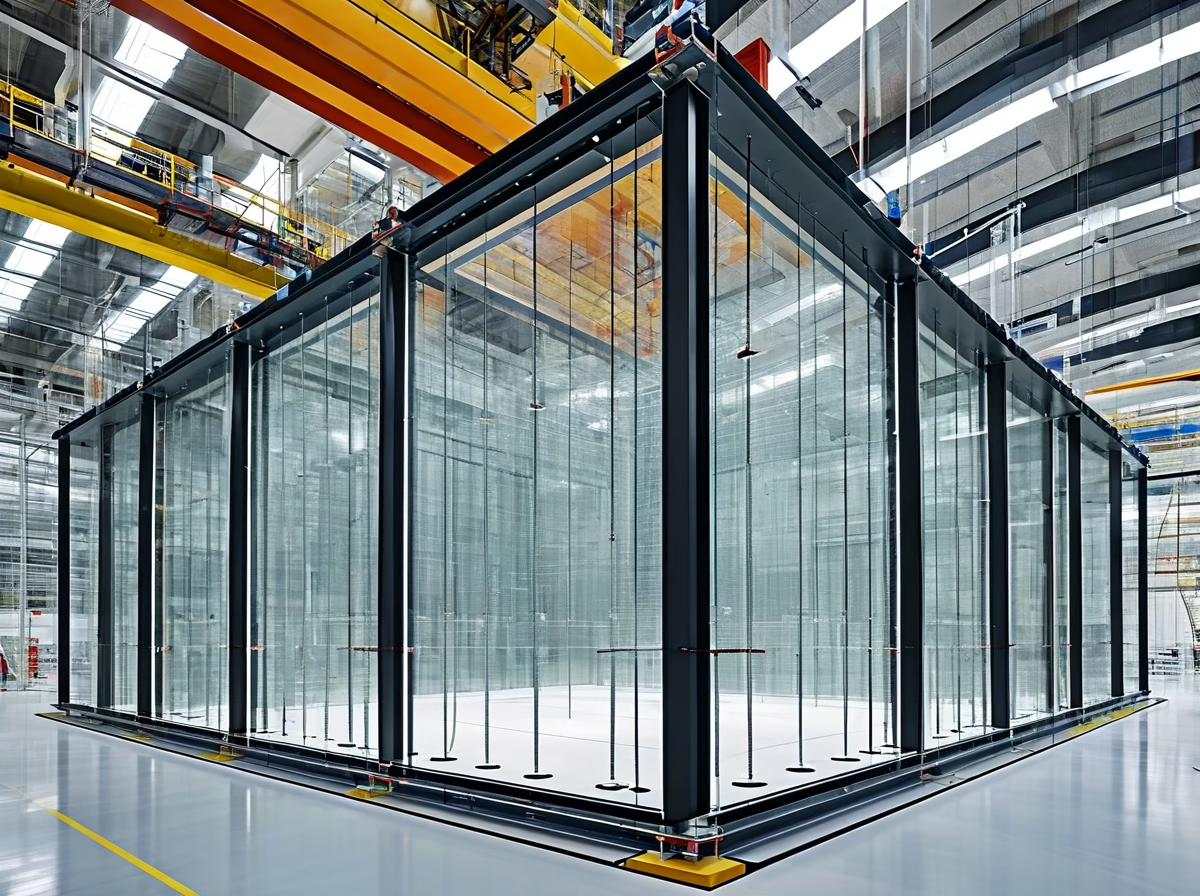
- Structural performance / wind resistance — EN 12179 or ASTM E330. The specimen is loaded in increments up to the design pressure, then to a defined safety overload (typically 1.5× design pressure). Deflections are measured and compared against the specified limits, usually L/175 or L/240 for framing members, and tighter for glass edges. After the overload, the specimen must show no permanent deformation, no failure of anchors or interlocks, and no glass breakage.
- Safety and interlock testing — verifies that glazing retains in its rebate, that pressure plates and cover caps do not disengage, and that opening vents remain captive under load. This is where a system that performs well in the serviceability checks can fail, because interlocks engage only at or near ultimate load.
For opening elements, the sequence is supplemented with EN 12210 for resistance to wind load of the operable unit, and EN 12155 for its watertightness.
Why Watertightness Is Tested Below Structural Design Pressure
Watertightness is deliberately tested at a fraction of the structural design wind load. A facade is designed structurally for a peak gust pressure that represents the ultimate limit state, but the same facade must remain weathertight at ordinary storm pressures, which are far lower. A specimen tested only at full design pressure would tell you almost nothing about how it behaves during the vast majority of its life, spent at serviceability-level pressures and intermittent driving rain.
The result is the pressure ladder: watertightness is commonly specified and reported at multiple rungs, for example 0.25×, 0.5× and 1.0× of the structural design pressure. Each rung answers a different question. If the system holds at 0.25× but fails at 0.5×, the drainage system is being overwhelmed at a pressure level the building will see regularly. If it holds at 1.0×, it survives the extreme event.
For specifiers, the practical consequence is that a watertightness rating must be read together with the design pressure it was measured at. A statement such as “watertight to 1200 Pa” is not meaningful without the reference pressure and the test method. Always require the test report to state the method, the applied pressure differential, the duration and the spray rate.
Dynamic vs Static Water Testing
AAMA 501.1 applies pressure pulses (positive and negative) simultaneously with the spray, using a propeller to generate a fluctuating pressure field across the specimen. Static testing, by EN 12154 or ASTM E331, applies a steady differential.
cURL Too many subrequests by single Worker invocation. To configure this limit, refer to https://developers.cloudflare.com/workers/wrangler/configuration/#limits
cURL Too many subrequests by single Worker invocation. To configure this limit, refer to https://developers.cloudflare.com/workers/wrangler/configuration/#limits
cURL Too many subrequests by single Worker invocation. To configure this limit, refer to https://developers.cloudflare.com/workers/wrangler/configuration/#limits
- cURL Too many subrequests by single Worker invocation. To configure this limit, refer to https://developers.cloudflare.com/workers/wrangler/configuration/#limits cURL Too many subrequests by single Worker invocation. To configure this limit, refer to https://developers.cloudflare.com/workers/wrangler/configuration/#limits
- cURL Too many subrequests by single Worker invocation. To configure this limit, refer to https://developers.cloudflare.com/workers/wrangler/configuration/#limits cURL Too many subrequests by single Worker invocation. To configure this limit, refer to https://developers.cloudflare.com/workers/wrangler/configuration/#limits
- cURL Too many subrequests by single Worker invocation. To configure this limit, refer to https://developers.cloudflare.com/workers/wrangler/configuration/#limits cURL Too many subrequests by single Worker invocation. To configure this limit, refer to https://developers.cloudflare.com/workers/wrangler/configuration/#limits
cURL Too many subrequests by single Worker invocation. To configure this limit, refer to https://developers.cloudflare.com/workers/wrangler/configuration/#limits
cURL Too many subrequests by single Worker invocation. To configure this limit, refer to https://developers.cloudflare.com/workers/wrangler/configuration/#limits cURL Too many subrequests by single Worker invocation. To configure this limit, refer to https://developers.cloudflare.com/workers/wrangler/configuration/#limits cURL Too many subrequests by single Worker invocation. To configure this limit, refer to https://developers.cloudflare.com/workers/wrangler/configuration/#limits cURL Too many subrequests by single Worker invocation. To configure this limit, refer to https://developers.cloudflare.com/workers/wrangler/configuration/#limits y cURL Too many subrequests by single Worker invocation. To configure this limit, refer to https://developers.cloudflare.com/workers/wrangler/configuration/#limits cURL Too many subrequests by single Worker invocation. To configure this limit, refer to https://developers.cloudflare.com/workers/wrangler/configuration/#limits cURL Too many subrequests by single Worker invocation. To configure this limit, refer to https://developers.cloudflare.com/workers/wrangler/configuration/#limits cURL Too many subrequests by single Worker invocation. To configure this limit, refer to https://developers.cloudflare.com/workers/wrangler/configuration/#limits cURL Too many subrequests by single Worker invocation. To configure this limit, refer to https://developers.cloudflare.com/workers/wrangler/configuration/#limits cURL Too many subrequests by single Worker invocation. To configure this limit, refer to https://developers.cloudflare.com/workers/wrangler/configuration/#limits cURL Too many subrequests by single Worker invocation. To configure this limit, refer to https://developers.cloudflare.com/workers/wrangler/configuration/#limits cURL Too many subrequests by single Worker invocation. To configure this limit, refer to https://developers.cloudflare.com/workers/wrangler/configuration/#limits ILAC mutual recognition arrangement.
Always check the test methods on the laboratory’s accredited scope. A laboratory accredited for air permeability is not automatically accredited for dynamic water testing or structural performance. A report from a manufacturer’s internal test rig, even if technically competent, is not third-party verification.
Factory Production Control and Manufacturer Documentation
A specification should require the manufacturer’s factory production control documentation as a routine deliverable, not on request:
- Mill certificates for aluminium ingot and extrusion, identifying the heat number, alloy (typically 6060, 6063 or 6061 for curtain wall extrusions) and temper (T4, T5, T6).
- Mechanical property test results — tensile strength, yield strength and elongation — against the relevant standard such as EN 755 for extruded profiles.
- Coating documentation — powder or anodised coating thickness measured to the relevant standard, adhesion test results (cross-hatch or impact per EN ISO 2409 / ASTM D3359), and colour and gloss consistency.
- Accelerated weathering and corrosion results — salt spray to ASTM B117 / EN ISO 9227 and, for marine environments, cyclic corrosion results per EN 12280.
- Traceability linking finished profiles and finished assemblies back to the raw material heats.
Site Verification on the Installed Facade
Laboratory performance does not guarantee site performance. A practical verification regime ought to include:
- On-site water test on an installed section of facade, using a spray rack or calibrated nozzle assembly (AAMA 501.2, or a project-specified method) to confirm that gaskets, sealant and interfaces perform as tested. This is typically done on one or more representative bays and repeated where remedial work has occurred.
- Anchor pull tests on a sample of installed anchors and brackets to confirm the embedment, substrate condition and fixing capacity assumed in the structural calculations.
- Visual and QA inspection — systematic checks of gasket continuity, sealant depth and adhesion, transom and mullion alignment, weep and baffle placement, and pressure plate engagement, documented against the approved shop drawings.
The Documentation Package to Require Before Releasing the Package
Before a facade package is released for fabrication and installation, a specifier should require:
- Full-scale and/or component test reports from an accredited third-party laboratory, stating the methods used and the applied pressures.
- Structural calculations for mullions, transoms, anchors and brackets, with the design wind pressures, deflection limits and load combinations clearly stated.
- The supplier’s QA plan, factory production control procedures and inspection and test plan for the project.
- Coating and material certificates, including durability class and warranty coverage.
- Warranty terms with defined exclusions, particularly around water penetration, coating performance and adhesion.
- Confirmation of fire performance where relevant — for example EN 13501 classification of the assembly, and CE or UKCA marking where the product falls under the Construction Products Regulation.
Compliance Is Not the Same as Performance
Passing a wind resistance test demonstrates that a specific specimen met a specific performance specification. It does not, by itself, deliver code compliance. Fire classification and reaction-to-fire performance, structural design codes, and product marking regimes such as CE marking under the CPR or UKCA marking in Great Britain are separate requirements with their own evidence. A wind test report is one input to the compliance file, not a substitute for it. Specifiers should confirm that the product’s Declaration of Performance and applicable classification documents are in place alongside the performance test data.
Getting an Accurate Wind Load Design and Quote from Your Supplier
What to Send Your Supplier Before Anyone Can Verify the Design
A curtain wall panel is not a catalogue item. Its thickness, stiffener depth, bracket size and anchor count all follow from the wind pressure acting on it, and that pressure is a property of your project — not of the product. Until the manufacturer has the wind load case, any structural statement it makes is an assumption. Send the following in one package, ideally before requesting pricing.
- Project location and country — city and site, plus the country whose code governs. Coastal, urban, valley and open-country sites at the same nominal wind speed behave differently.
- cURL Too many subrequests by single Worker invocation. To configure this limit, refer to https://developers.cloudflare.com/workers/wrangler/configuration/#limits cURL Too many subrequests by single Worker invocation. To configure this limit, refer to https://developers.cloudflare.com/workers/wrangler/configuration/#limits
- cURL Too many subrequests by single Worker invocation. To configure this limit, refer to https://developers.cloudflare.com/workers/wrangler/configuration/#limits cURL Too many subrequests by single Worker invocation. To configure this limit, refer to https://developers.cloudflare.com/workers/wrangler/configuration/#limits
- cURL Too many subrequests by single Worker invocation. To configure this limit, refer to https://developers.cloudflare.com/workers/wrangler/configuration/#limits cURL Too many subrequests by single Worker invocation. To configure this limit, refer to https://developers.cloudflare.com/workers/wrangler/configuration/#limits
- cURL Too many subrequests by single Worker invocation. To configure this limit, refer to https://developers.cloudflare.com/workers/wrangler/configuration/#limits cURL Too many subrequests by single Worker invocation. To configure this limit, refer to https://developers.cloudflare.com/workers/wrangler/configuration/#limits
- cURL Too many subrequests by single Worker invocation. To configure this limit, refer to https://developers.cloudflare.com/workers/wrangler/configuration/#limits cURL Too many subrequests by single Worker invocation. To configure this limit, refer to https://developers.cloudflare.com/workers/wrangler/configuration/#limits panel, cURL Too many subrequests by single Worker invocation. To configure this limit, refer to https://developers.cloudflare.com/workers/wrangler/configuration/#limits, cURL Too many subrequests by single Worker invocation. To configure this limit, refer to https://developers.cloudflare.com/workers/wrangler/configuration/#limits, cURL Too many subrequests by single Worker invocation. To configure this limit, refer to https://developers.cloudflare.com/workers/wrangler/configuration/#limits y cURL Too many subrequests by single Worker invocation. To configure this limit, refer to https://developers.cloudflare.com/workers/wrangler/configuration/#limitscURL Too many subrequests by single Worker invocation. To configure this limit, refer to https://developers.cloudflare.com/workers/wrangler/configuration/#limits
- cURL Too many subrequests by single Worker invocation. To configure this limit, refer to https://developers.cloudflare.com/workers/wrangler/configuration/#limits cURL Too many subrequests by single Worker invocation. To configure this limit, refer to https://developers.cloudflare.com/workers/wrangler/configuration/#limits
- cURL Too many subrequests by single Worker invocation. To configure this limit, refer to https://developers.cloudflare.com/workers/wrangler/configuration/#limits cURL Too many subrequests by single Worker invocation. To configure this limit, refer to https://developers.cloudflare.com/workers/wrangler/configuration/#limits
- cURL Too many subrequests by single Worker invocation. To configure this limit, refer to https://developers.cloudflare.com/workers/wrangler/configuration/#limits cURL Too many subrequests by single Worker invocation. To configure this limit, refer to https://developers.cloudflare.com/workers/wrangler/configuration/#limits
- cURL Too many subrequests by single Worker invocation. To configure this limit, refer to https://developers.cloudflare.com/workers/wrangler/configuration/#limits — if the specification names one, say so; if not, ask the supplier to propose and justify it.
- Finish system — anodised, powder coated or PVDF, with thickness class. Coating and pretreatment affect edge detailing and handling rather than strength, but they change the drawing package.
- Live load and inter-storey drift — required maintenance or access loading, and the design drift ratio the frame must accommodate without distress or loss of weather seal.
- Seismic category, if applicable — the category or design acceleration, which governs connection ductility and movement joints rather than panel strength.
- Target test evidence — which tests and which standard you expect: air permeability, watertightness, wind resistance (structural and safety), inter-storey drift, and seismic. State whether it is a project mock-up or a system test report.
Why “Give Me a Price Per m²” Cannot Be Answered Accurately
A price per square metre is a price for a design, and the wind load case is that design. Change the pressure zone from a low-rise inland site to a tall coastal building and the aluminium profile depth, the bracket gauge, the anchor diameter and the anchor count can all change — sometimes the whole framing family changes. A supplier who quotes from a square-metre rate with no load data has done one of two things, and neither is good for you.
Either the quote carries an unpriced risk: the supplier builds in a worst-case allowance your project never needed, and you pay for structure you do not require. Or the quantity is priced on a light assumption and the real design emerges during drawing approval, at which point the honest supplier asks for a variation and the dishonest one reduces a bracket to hold the number. The second outcome is the dangerous one, because it does not surface as a cost — it surfaces as a deflecting mullion, a leaking corner or a failed mock-up.
Either way, the comparison you thought you were making between three suppliers was never a like-for-like comparison. The correct move is to issue the load case first, then ask each supplier to price the same design basis and state the assumptions it used.
What a Competent Manufacturer Does With the Load Case
Given the package above, the engineering response should be traceable:
- Internal structural check to EN 1999-1-1 or the governing code for the project, calculating panel bending and deflection, mullion and transom stress and deflection, and bracket reactions.
- Alloy and temper selection — typically a 6xxx-series extrusion in a temper suited to the required strength and the bending method, with the choice justified against the calculated demand rather than habit.
- Bracket capacity verification against the anchor schedule, including edge distance, substrate type (concrete, steel, or a specific embedment) and the interaction between wind suction, dead load and any eccentricity.
- A written submission drawing showing the elevation with the pressure zone diagram overlaid, member sizes, bracket details and anchor positions, so the design intent can be checked against the engineer’s numbers.
- A pre-production or mock-up sample, built to the approved drawing and tested where the specification requires it, before full production is released.
Regional Sourcing Nuances
Buyers comparing suppliers across regions should expect different documentation expectations, even for the same technical performance.
| Buyer region | Typical expectation |
|---|---|
| Europe | EN-standard test evidence and CE marking under the relevant harmonised standard, or UKCA for the UK market; full EN 1991-1-4 / EN 1999-1-1 design documentation |
| América del Norte | AAMA-based test evidence and ASCE 7 load derivation, with imperial module conventions and adoption of the local building code in the relevant state or province |
| Middle East and Southeast Asia | Often a hybrid: BS or EN design standards applied alongside local authority requirements, with test evidence accepted from recognised third-party laboratories |
Two practical frictions recur. Metric and imperial module conventions do not translate cleanly — a nominal 1,500 mm module is not a 5 ft module, and glass and frame sizes have to be re-based rather than converted. And the recognisable test evidence differs: a report that satisfies a European reviewer may not be the report a North American reviewer expects, even when both demonstrate the same structural capability. Ask early which evidence will be accepted, so the testing is scoped once.
The Sequence, So You Can Programme It
Ordering a bespoke curtain wall follows roughly this chain: engineering review and design confirmation, prototype or pre-production sample, a test slot at a third-party laboratory where testing is specified, then release to production. Each step depends on the previous one and each requires your approval before it can close — drawing approval in particular is a common cause of slippage, because the supplier cannot cut metal until the drawing is returned.
Build the programme around the sequence rather than around a single total figure. Establish who approves the submission drawing and how quickly, book the laboratory slot as soon as the prototype is confirmed, and remember that a change to the wind load case or zone pressures after prototype release resets the design work. The earlier the load case is fixed, the less of this chain has to be repeated.
cURL Too many subrequests by single Worker invocation. To configure this limit, refer to https://developers.cloudflare.com/workers/wrangler/configuration/#limits
- cURL Too many subrequests by single Worker invocation. To configure this limit, refer to https://developers.cloudflare.com/workers/wrangler/configuration/#limits
- cURL Too many subrequests by single Worker invocation. To configure this limit, refer to https://developers.cloudflare.com/workers/wrangler/configuration/#limits
- cURL Too many subrequests by single Worker invocation. To configure this limit, refer to https://developers.cloudflare.com/workers/wrangler/configuration/#limits
- cURL Too many subrequests by single Worker invocation. To configure this limit, refer to https://developers.cloudflare.com/workers/wrangler/configuration/#limits
- cURL Too many subrequests by single Worker invocation. To configure this limit, refer to https://developers.cloudflare.com/workers/wrangler/configuration/#limits
- cURL Too many subrequests by single Worker invocation. To configure this limit, refer to https://developers.cloudflare.com/workers/wrangler/configuration/#limits

 Español
  English
  Français
  Bahasa Indonesia
  Deutsch
  Italiano
  العربية
  Español de México
  Nederlands
  香港中文
香港中文