
Architects and facade specifiers increasingly turn to perforated aluminum panels not just for their striking geometry, but for what they can do to a building’s acoustic environment. Near a highway, railway line, or busy commercial street, the facade is the single largest filter between outdoor noise and the people inside. This article looks at how perforated aluminum curtain walls improve acoustic performance — the sound absorption, the backing assemblies, the practical specs on a datasheet, and how to balance echo control with ventilation and aesthetics in a real project.
How Aluminum Curtain Wall Facades Affect Building Acoustics

The facade is a building’s primary acoustic filter, and a glazed aluminum curtain wall is in many ways the most demanding case a specifier will face. A typical unitized or stick-built system is thin, lightweight, and heavily glazed — exactly the characteristics that work against sound insulation. Because the performance of the envelope depends on every joint, gasket, and pressure-equalized cavity, understanding how curtain wall facades transmit sound is the first step toward delivering a quieter interior without compromising aesthetics or daylighting.
One important distinction to keep in mind: curtain wall construction trades raw panel mass for system sophistication. Where a traditional masonry wall achieves sound blocking through sheer weight, a well-detailed aluminum curtain wall must achieve comparable results through careful control of the airborne sound paths that cross the assembly. This is why a curtain wall’s acoustic rating rarely reflects the glass alone — it reflects the entire system as built.
Sound Transmission Paths in a Curtain Wall Assembly
Noise reaching a building’s interior travels along three principal routes, and the acoustic performance of aluminum curtain walls depends on how the specifier addresses each one. The first is direct airborne sound, which strikes the exterior glass or metal panels and is re-radiated to the interior. The second is the flanking path, where sound bypasses the primary barrier through mullions, transoms, thermal breaks, pressure-equalized cavities, and the junction between the curtain wall and the adjacent floor slab. The third is outdoor-to-indoor noise — traffic, rail, and mechanical plant — that couples into the structure and re-emits on the occupied side.
STC and the Role of the Cladding Panel
The industry metric for rating this performance is the Sound Transmission Class (STC). The higher an assembly’s STC, the more effectively it resists speech and mid-frequency noise. A single monolithic glazed lite might rate roughly STC 30–35, whereas a pair of properly insulated glass panes with an air cavity can push a system toward STC 40 or higher. The metal cladding panels themselves contribute at the low end of the spectrum, but their real value lies in sealing and dissipation: a rigid, well-supported panel coupled through damped gaskets converts sound energy to heat more effectively than a panel that flexes and re-radiates.
The choice of panel configuration and substrate makes a measurable difference in perceived noise reduction. Consider the comparison below:
| Panel / Substrate Configuration | Typical STC Range | Characteristic Behavior |
|---|---|---|
| Single-layer flat aluminum panel, thin gauge | STC 25–30 | Panel flexes and re-radiates; limited absorption |
| Stiffened composite / honeycomb panel | STC 30–35 | Higher stiffness lowers panel resonance; better mid-range blocking |
| Double-glazed insulated unit with air cavity | STC 38–45 | Air gap and thin glazing dissonance improve isolation |
| Insulated back-pan with porous infill layer | STC 40+ (system-dependent) | Absorptive infill damps cavity resonances and flanking |
Critically, a stiffer or thicker panel only helps if the substrate behind it can dissipate energy. A perforated or porous back-pan, for example, couples the cavity to an absorptive layer and visibly reduces the “hollow ring” of a sealed metal bay — a detail that matters when the facade sits beside a busy street or rail corridor.
Flanking Paths and Detailing Checklist
Acoustic performance of aluminum curtain walls is almost always lost in the joints rather than the panels. Sealing the envelope and interrupting structural coupling yields more improvement per dollar than upgrading the glazing alone. When reviewing a curtain wall design for acoustic risk, work through this checklist:
- Verify that gaskets and weather seals are continuous at every mullion splice and at the slab edge, not just at the glass pocket.
- Include a damped, continuous thermal-break profile to prevent sound from tracking through the metal frame.
- Seal and insulate the slab-edge cavity between floors to stop cross-floor flanking.
- Specify adequately stiff cladding panels mounted on damped supports so they do not act as secondary re-radiating membranes.
- Consider an absorptive infill in pressure-equalized cavities to kill parasitic resonance.
Selecting the right system is only half the battle. Aluminum Curtain Wall products that pair rigid, well-sealed cladding with a properly drained and insulated cavity consistently outperform their nominal STC, because the whole assembly — not just the vision glass — participates in blocking noise. For specifiers who need a defensible acoustic figure on the datasheet, request the full assembly’s STC and laboratory test report from Aluminum Curtain Wall so the claimed rating reflects the actual system, including mullions, splices, and slab junctions.
Perforated Aluminum Panels and Sound Absorption: How Perforation Ratio and Hole Pattern Matter
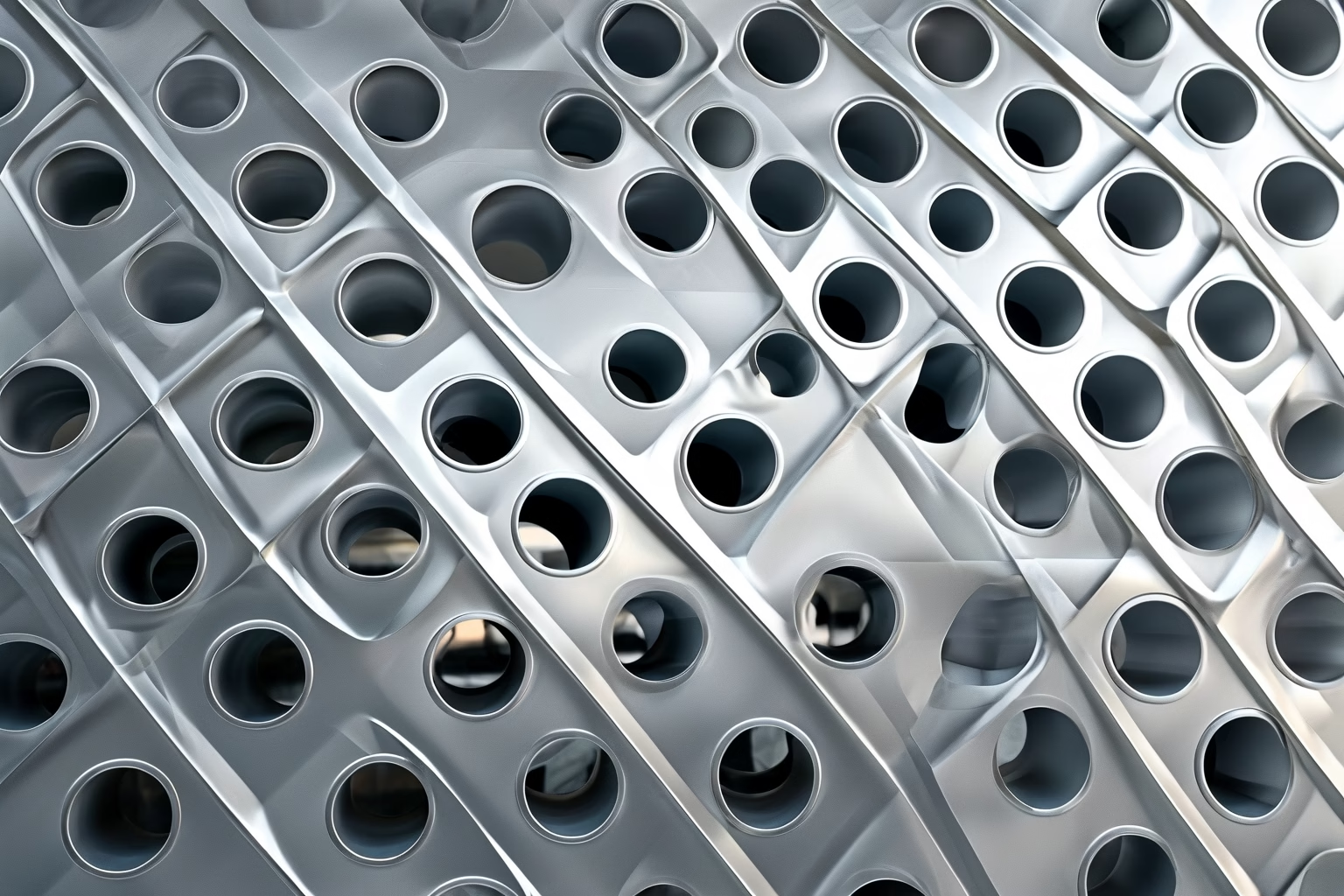
In facade engineering, the perforated aluminum rainscreen is more than a decorative veil — it is an active acoustic component. Whether you are specifying for a transit hub, an office tower, or a mixed-use podium الحائط الساتر الألومنيوم system, the sound-absorbing behavior of the panel is determined almost entirely by two design variables: the perforation ratio (the percentage of open area) and the hole pattern cURL Too many subrequests by single Worker invocation. To configure this limit, refer to https://developers.cloudflare.com/workers/wrangler/configuration/#limits
cURL Too many subrequests by single Worker invocation. To configure this limit, refer to https://developers.cloudflare.com/workers/wrangler/configuration/#limits
cURL Too many subrequests by single Worker invocation. To configure this limit, refer to https://developers.cloudflare.com/workers/wrangler/configuration/#limits
- cURL Too many subrequests by single Worker invocation. To configure this limit, refer to https://developers.cloudflare.com/workers/wrangler/configuration/#limits cURL Too many subrequests by single Worker invocation. To configure this limit, refer to https://developers.cloudflare.com/workers/wrangler/configuration/#limits
- cURL Too many subrequests by single Worker invocation. To configure this limit, refer to https://developers.cloudflare.com/workers/wrangler/configuration/#limits cURL Too many subrequests by single Worker invocation. To configure this limit, refer to https://developers.cloudflare.com/workers/wrangler/configuration/#limits
- cURL Too many subrequests by single Worker invocation. To configure this limit, refer to https://developers.cloudflare.com/workers/wrangler/configuration/#limits cURL Too many subrequests by single Worker invocation. To configure this limit, refer to https://developers.cloudflare.com/workers/wrangler/configuration/#limits
cURL Too many subrequests by single Worker invocation. To configure this limit, refer to https://developers.cloudflare.com/workers/wrangler/configuration/#limits
cURL Too many subrequests by single Worker invocation. To configure this limit, refer to https://developers.cloudflare.com/workers/wrangler/configuration/#limits
cURL Too many subrequests by single Worker invocation. To configure this limit, refer to https://developers.cloudflare.com/workers/wrangler/configuration/#limits cURL Too many subrequests by single Worker invocation. To configure this limit, refer to https://developers.cloudflare.com/workers/wrangler/configuration/#limits cURL Too many subrequests by single Worker invocation. To configure this limit, refer to https://developers.cloudflare.com/workers/wrangler/configuration/#limits cURL Too many subrequests by single Worker invocation. To configure this limit, refer to https://developers.cloudflare.com/workers/wrangler/configuration/#limits cURL Too many subrequests by single Worker invocation. To configure this limit, refer to https://developers.cloudflare.com/workers/wrangler/configuration/#limits
cURL Too many subrequests by single Worker invocation. To configure this limit, refer to https://developers.cloudflare.com/workers/wrangler/configuration/#limits
cURL Too many subrequests by single Worker invocation. To configure this limit, refer to https://developers.cloudflare.com/workers/wrangler/configuration/#limits
cURL Too many subrequests by single Worker invocation. To configure this limit, refer to https://developers.cloudflare.com/workers/wrangler/configuration/#limits cURL Too many subrequests by single Worker invocation. To configure this limit, refer to https://developers.cloudflare.com/workers/wrangler/configuration/#limitscURL Too many subrequests by single Worker invocation. To configure this limit, refer to https://developers.cloudflare.com/workers/wrangler/configuration/#limits الحائط الساتر الألومنيوم construction.
Micro-perforated panel (MPP) behavior extends the same principle: when holes are smaller than roughly 1 mm and spaced closely together, the panel provides high, wideband absorption without draped fiber or foam, keeping the assembly clean and recyclable. For most architectural installations, a hybrid approach works best — a moderately perforated panel with a mineral or polyester core behind it captures both resonant and porous absorption mechanisms across the speech and mid-frequency bands.
Quick Reference: Selecting Perforation Parameters
| المعلمة | Typical Range* | Acoustic Effect |
|---|---|---|
| Open area ratio | 15–25% | Primary driver of absorption capacity |
| Hole diameter | 1.5–10 mm | Smaller holes shift peak absorption higher in frequency |
| Hole spacing (pitch) | 2.5–3x diameter | Tighter spacing improves absorption bandwidth |
| Cavity/panel air gap | 50–200 mm | Deeper cavity lowers resonant frequency |
*Values are practical starting points; final sizing should be validated with impedance-tube or reverberation-room testing for the specific panel and cavity combination.
When specifying an acoustic perforated panel, the money steps are straightforward: hold the open area in the 15–25% comfort band, choose hole diameter and spacing to target your dominant noise frequencies, and couple the panel with an air cavity (and, where needed, a backing core). Verified against lab data, these choices let a lean perforated الحائط الساتر الألومنيوم deliver real, measurable sound absorption without giving up the material’s light weight, durability, or recyclability.
Acoustic Backing and Absorption Media Behind Perforated Panels
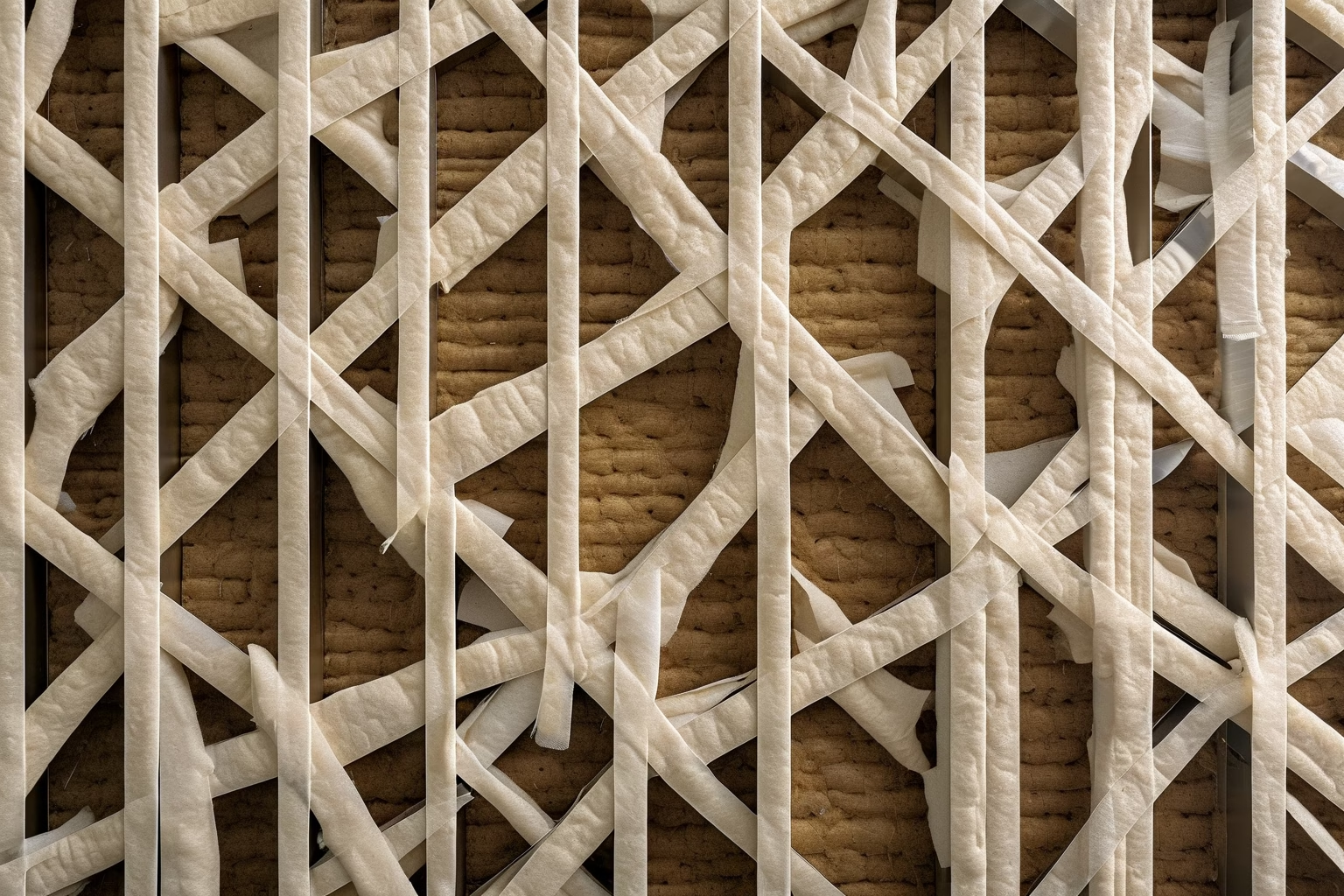
A perforated aluminum panel is only half of an acoustic solution. On its own, a perforated screen reflects as much sound as it absorbs — the openings allow pressure waves to pass through, but without something to dissipate that energy, little is gained. True absorption happens in the space behind the panel, where sound-absorbing media convert acoustic energy into heat. For architects and facade specifiers targeting the acoustic performance of aluminum curtain walls, the choice of backing material and cavity design is where performance is actually won or lost.
Choosing the Right Absorption Media
The backing layer sits directly behind the perforated sheet and is selected to match the sound spectrum that needs controlling. Each medium behaves differently across frequency bands:
- Acoustic non-woven fabric / acoustic fleece — lightweight, thin, and cost-effective. Ideal for high-frequency absorption (speech, HVAC hiss) and commonly bonded directly to the rear face of the panel in a factory-applied lamination.
- Mineral wool / stone wool boards — the workhorse for mid- and low-frequency control. Dense, porous, and fire-safe (Euroclass A1/A2), they are the standard behind curtain wall infill panels exposed to traffic or rail noise.
- Foam liners — closed- or open-cell polyurethane used where weight and profile depth are constrained. Open-cell foam absorbs mid-to-high frequencies; closed-cell foam reads more as a noise barrier than an absorber and is best paired with an open-cell layer.
How Cavity Depth and Density Set the Absorption Band
The system behaves as a tuned porous absorber: the perforated panel acts as a resistive front, and the backing media act as the damping element. Two parameters govern where absorption peaks:
- Cavity air depth — a deeper air space between the panel and the media (or the media and the solid backing wall) shifts peak absorption toward lower frequencies. Typical curtain wall cavities run 50–150 mm; increasing depth is the most reliable way to pull performance down to the 125–250 Hz range where road noise dominates.
- Media density and thickness — higher-density mineral wool (40–80 kg/m³) raises low-frequency absorption but can reflect mid-band energy; thinner, lighter fleece optimizes high-frequency work. Many premium curtain walls stack a fleece scrim on 60 kg/m³ stone wool to widen the effective band.
Practical Considerations: Exterior vs. Interior Facades
cURL Too many subrequests by single Worker invocation. To configure this limit, refer to https://developers.cloudflare.com/workers/wrangler/configuration/#limits
| cURL Too many subrequests by single Worker invocation. To configure this limit, refer to https://developers.cloudflare.com/workers/wrangler/configuration/#limits | cURL Too many subrequests by single Worker invocation. To configure this limit, refer to https://developers.cloudflare.com/workers/wrangler/configuration/#limits | cURL Too many subrequests by single Worker invocation. To configure this limit, refer to https://developers.cloudflare.com/workers/wrangler/configuration/#limits |
|---|---|---|
| cURL Too many subrequests by single Worker invocation. To configure this limit, refer to https://developers.cloudflare.com/workers/wrangler/configuration/#limits | cURL Too many subrequests by single Worker invocation. To configure this limit, refer to https://developers.cloudflare.com/workers/wrangler/configuration/#limits | cURL Too many subrequests by single Worker invocation. To configure this limit, refer to https://developers.cloudflare.com/workers/wrangler/configuration/#limits |
| تصنيف الحريق | cURL Too many subrequests by single Worker invocation. To configure this limit, refer to https://developers.cloudflare.com/workers/wrangler/configuration/#limits | cURL Too many subrequests by single Worker invocation. To configure this limit, refer to https://developers.cloudflare.com/workers/wrangler/configuration/#limits |
| مقاومة الطقس | cURL Too many subrequests by single Worker invocation. To configure this limit, refer to https://developers.cloudflare.com/workers/wrangler/configuration/#limits | cURL Too many subrequests by single Worker invocation. To configure this limit, refer to https://developers.cloudflare.com/workers/wrangler/configuration/#limits |
| cURL Too many subrequests by single Worker invocation. To configure this limit, refer to https://developers.cloudflare.com/workers/wrangler/configuration/#limits | cURL Too many subrequests by single Worker invocation. To configure this limit, refer to https://developers.cloudflare.com/workers/wrangler/configuration/#limits | cURL Too many subrequests by single Worker invocation. To configure this limit, refer to https://developers.cloudflare.com/workers/wrangler/configuration/#limits |
cURL Too many subrequests by single Worker invocation. To configure this limit, refer to https://developers.cloudflare.com/workers/wrangler/configuration/#limits
cURL Too many subrequests by single Worker invocation. To configure this limit, refer to https://developers.cloudflare.com/workers/wrangler/configuration/#limits acoustic performance of aluminum curtain walls cURL Too many subrequests by single Worker invocation. To configure this limit, refer to https://developers.cloudflare.com/workers/wrangler/configuration/#limits
cURL Too many subrequests by single Worker invocation. To configure this limit, refer to https://developers.cloudflare.com/workers/wrangler/configuration/#limits
cURL Too many subrequests by single Worker invocation. To configure this limit, refer to https://developers.cloudflare.com/workers/wrangler/configuration/#limits
cURL Too many subrequests by single Worker invocation. To configure this limit, refer to https://developers.cloudflare.com/workers/wrangler/configuration/#limits
cURL Too many subrequests by single Worker invocation. To configure this limit, refer to https://developers.cloudflare.com/workers/wrangler/configuration/#limits cURL Too many subrequests by single Worker invocation. To configure this limit, refer to https://developers.cloudflare.com/workers/wrangler/configuration/#limits cURL Too many subrequests by single Worker invocation. To configure this limit, refer to https://developers.cloudflare.com/workers/wrangler/configuration/#limits
Sound Transmission Class (STC): How Much Sound Is Blocked
STC rates a wall assembly’s ability to reduce airborne sound passing from one side to the other, measured per ASTM E90 and reported as a single-figure classification in dB. The higher the STC, the better the isolation. For exterior facades facing road or rail noise, an effective aluminum curtain wall assembly should target an STC of roughly 40–50 depending on the site’s ambient noise exposure. Because perforated panels are inherently more acoustically transparent, meeting a demanding STC usually depends on the glazing, the backing layers, the insulation density, and the continuity of the framing — not the perforated skin alone. Be skeptical of any single datasheet number: always confirm that the STC listed was modeled on the full assembly you intend to build.
Reverberation Time and Why It Matters
Reverberation time (RT60) is the time in seconds for a sound to decay by 60 dB after the source stops, and it governs speech clarity inside large spaces such as atriums, lobbies, and transit concourses. Perforated aluminum ceilings and facade liners are a common tool for shaving excess reverberation and cutting the hard, “tinny” reflections that monolithic aluminum faces produce. Higher NRC paneling directly translates into lower RT60 for the same space volume, so panels with high absorption are specified where echo and intelligibility are a concern.
Practical Spec Checklist for Perforated Aluminum Acoustics
- Target open area (perforation ratio): Specify 20–30% open area for a balanced combination of absorption and structural stiffness. Beyond roughly 35% the sheet loses structural capacity while adding little acoustic value.
- Cavity depth: Deeper cavities tune the absorber to lower frequencies. Provide a minimum 50 mm rear cavity; budget 100–150 mm where low-frequency traffic noise dominates.
- Backing and insulation: Require an acoustic blanket or low-backing membrane behind the perforated sheet and state its density (typically 24–48 kg/m³).
- Laboratory data, not marketing:**
For specifiers, demanding a full lab report is the difference between a real acoustic performance and a sales pitch. Insist on these verifications:
| Metric | المعيار | Typical target |
|---|---|---|
| Noise Reduction Coefficient (NRC) | ASTM C423 | 0.70–0.95 for perforated panel assemblies |
| Sound Transmission Class (STC) | ASTM E90 | 40–50 for exterior curtain wall assemblies |
| Reverberation time (RT60) | ISO 3382 / ASTM E2235 | Result depends on room volume and NRC |
When reviewing proposals, ask for certified test reports for the exact perforation profile, sheet thickness, and panel depth you are purchasing. Because acoustic performance of aluminum curtain walls changes with framing detailing, request interior corner conditions and full-size sample panels for mock-up testing on the actual project rather than trusting generic catalog figures. A qualified manufacturer such as Aluminum Curtain Wall can supply test-backed NRC and STC data, coordinate panel-to-framing continuity to limit sound flanking, and produce sample panels so your mock-up validates the numbers before fabrication begins. Spec the metrics, require the reports, and verify with samples — that sequence turns a loud facade into a controlled, code-acceptable assembly.
Balancing Acoustics, Ventilation, and Aesthetics in Perforated Facade Systems

Too often, acoustic, ventilation, and aesthetic requirements are treated as competing demands on a building envelope — as if improving one always means sacrificing another. Perforated aluminum facade systems break that assumption. With a correctly engineered perforation pattern, cavity depth, and backing layer, a single facade system can quietly absorb sound, drive passive ventilation and moisture drainage, and deliver a visually striking architectural statement at the same time. For specifiers chasing efficiency and performance density, that double — and even triple — duty is where the real value of perforated metal lies.
Making the Perforated Facade Do Multiple Jobs
A perforated screen is rarely a standalone “solar shade” or acoustic panel anymore. It is a multifunctional building element. In a typical rainscreen or ventilated facade configuration, the perforated outer skin serves four roles simultaneously:
- Acoustic absorption: the perforation acts as a Helmholtz or quarter-wave resonator when paired with an insulation or membrane backing and a defined air cavity, absorbing mid- and high-frequency noise from traffic, rail, and mechanical plant.
- Natural ventilation: an open or slotted pattern lets the cavity breathe, allowing warm air to rise and escape via stack effect, reducing solar heat gain and cooling load.
- Rainscreen drainage and equalization: cURL Too many subrequests by single Worker invocation. To configure this limit, refer to https://developers.cloudflare.com/workers/wrangler/configuration/#limits
- cURL Too many subrequests by single Worker invocation. To configure this limit, refer to https://developers.cloudflare.com/workers/wrangler/configuration/#limits cURL Too many subrequests by single Worker invocation. To configure this limit, refer to https://developers.cloudflare.com/workers/wrangler/configuration/#limits
cURL Too many subrequests by single Worker invocation. To configure this limit, refer to https://developers.cloudflare.com/workers/wrangler/configuration/#limits
cURL Too many subrequests by single Worker invocation. To configure this limit, refer to https://developers.cloudflare.com/workers/wrangler/configuration/#limits
cURL Too many subrequests by single Worker invocation. To configure this limit, refer to https://developers.cloudflare.com/workers/wrangler/configuration/#limits
cURL Too many subrequests by single Worker invocation. To configure this limit, refer to https://developers.cloudflare.com/workers/wrangler/configuration/#limits
cURL Too many subrequests by single Worker invocation. To configure this limit, refer to https://developers.cloudflare.com/workers/wrangler/configuration/#limits
- cURL Too many subrequests by single Worker invocation. To configure this limit, refer to https://developers.cloudflare.com/workers/wrangler/configuration/#limits
- cURL Too many subrequests by single Worker invocation. To configure this limit, refer to https://developers.cloudflare.com/workers/wrangler/configuration/#limits
- cURL Too many subrequests by single Worker invocation. To configure this limit, refer to https://developers.cloudflare.com/workers/wrangler/configuration/#limits
- cURL Too many subrequests by single Worker invocation. To configure this limit, refer to https://developers.cloudflare.com/workers/wrangler/configuration/#limits
- cURL Too many subrequests by single Worker invocation. To configure this limit, refer to https://developers.cloudflare.com/workers/wrangler/configuration/#limits
cURL Too many subrequests by single Worker invocation. To configure this limit, refer to https://developers.cloudflare.com/workers/wrangler/configuration/#limits
cURL Too many subrequests by single Worker invocation. To configure this limit, refer to https://developers.cloudflare.com/workers/wrangler/configuration/#limits حائط ساتر من الألومنيومcURL Too many subrequests by single Worker invocation. To configure this limit, refer to https://developers.cloudflare.com/workers/wrangler/configuration/#limits cURL Too many subrequests by single Worker invocation. To configure this limit, refer to https://developers.cloudflare.com/workers/wrangler/configuration/#limits
 العربية
  English
  Français
  Bahasa Indonesia
  Deutsch
  Italiano
  Español
  Español de México
  Nederlands
  香港中文
香港中文