
Most aluminum facade decisions get made twice. The first is on the elevation drawing, where the architect sets a joint grid, a colour and a panel size. The second is in the submittal, when someone works out that the panel chosen for that grid cannot be folded to the radius on the plan, or that the core does not carry the fire class the building was approved under.
This guide sits in the gap between those two moments: the panel families sold as aluminum facade panels, the alloys and cores behind them, the coatings that decide how the facade looks in year fifteen, and the selection rules that keep a drawing buildable. Code requirements come with the document they sit in; working ranges from fabrication practice are labelled as ranges.
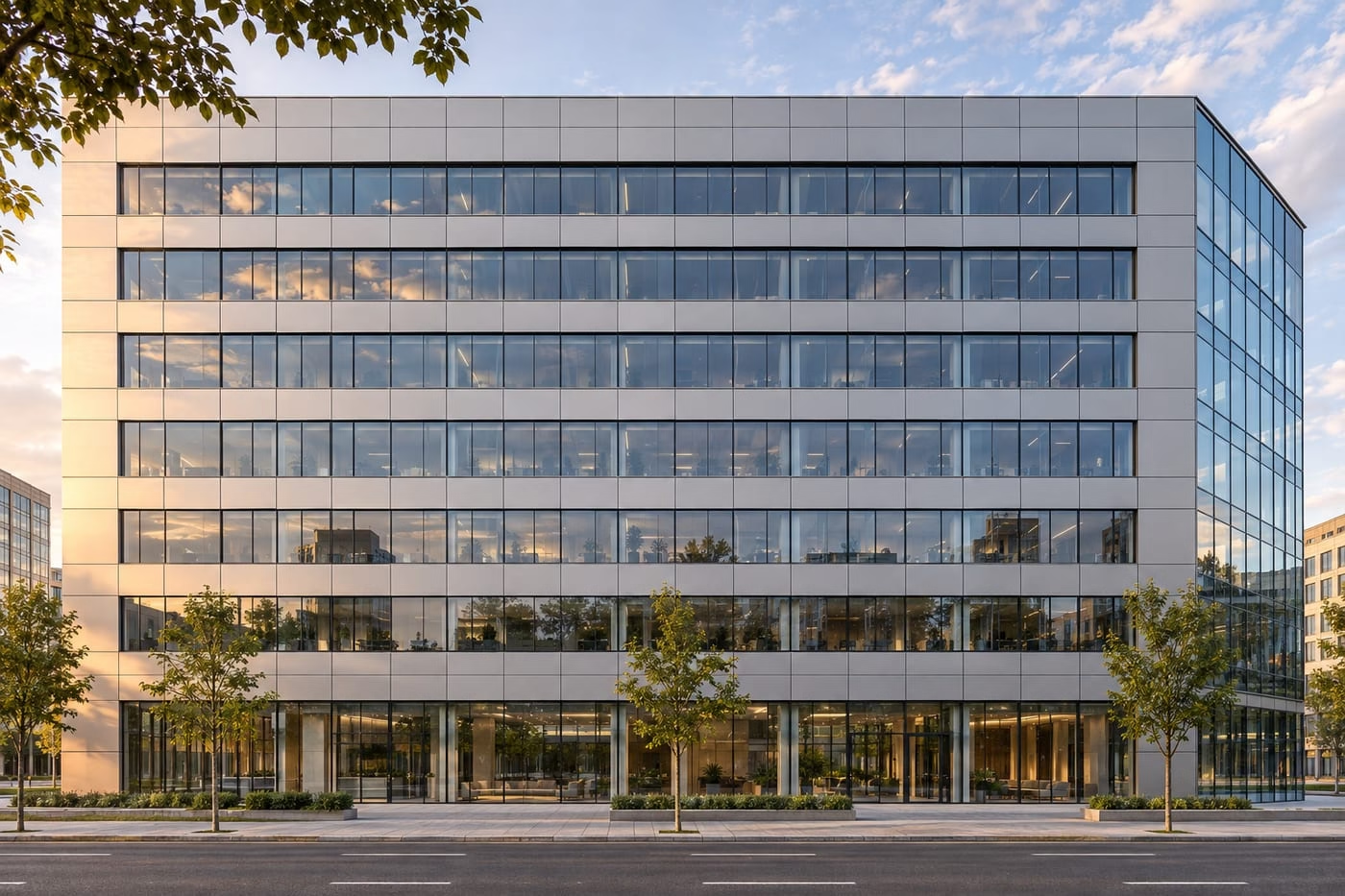
What Are Aluminum Facade Panels?
Definition of Aluminum Facade Panels
Factory-finished aluminium components, mechanically fixed to a subframe, forming the outer skin of an external wall. The category is defined by function rather than construction: single-sheet plate, bonded sandwich, perforated sheet, expanded mesh, profiled sheet and extruded profile all belong to it.
The term is wider than most product pages admit. Aluminum cladding panels, aluminum exterior wall panels and architectural aluminum panels name the same family in different markets, and pannelli compositi in alluminio are one member of it. Treating the umbrella term as a synonym for composite produces real mistakes: a buyer who asks for “aluminium cladding” and receives a 4 mm polyethylene-core composite has bought one product when the elevation may have been drawn for solid plate.
Curtain wall is a different thing. That is a framing system, usually with glass infill, spanning floor to floor. Panels often serve as spandrel infill inside it, but a facade built only from panels is normally a rainscreen or cassette system fixed back to a structural wall.
How Aluminum Facade Panels Work in Building Envelopes
A panel on its own is a rainscreen in name only. Performance comes from the assembly behind it: panel, drained and ventilated cavity, insulation, water-resistive and air barrier, structural wall, in that order.
The panel carries wind suction and its own dead load, nothing more. Load runs from the face through a cleat into a vertical rail, then through a bracket into the structure, and the bracket absorbs substrate tolerance and provides the thermal break.
The cavity runs 25 mm to 50 mm deep, open at the head, drained at the base, and compartmented at floor lines. Compartmentation is what allows pressure equalisation: without it, a pressure difference across the facade pulls water inward through every open joint instead of letting the cavity drain. Open joints, no cavity barriers and no drainage path is not a ventilated rainscreen, whatever the datasheet claims.
Key Benefits of Aluminum Facade Panels
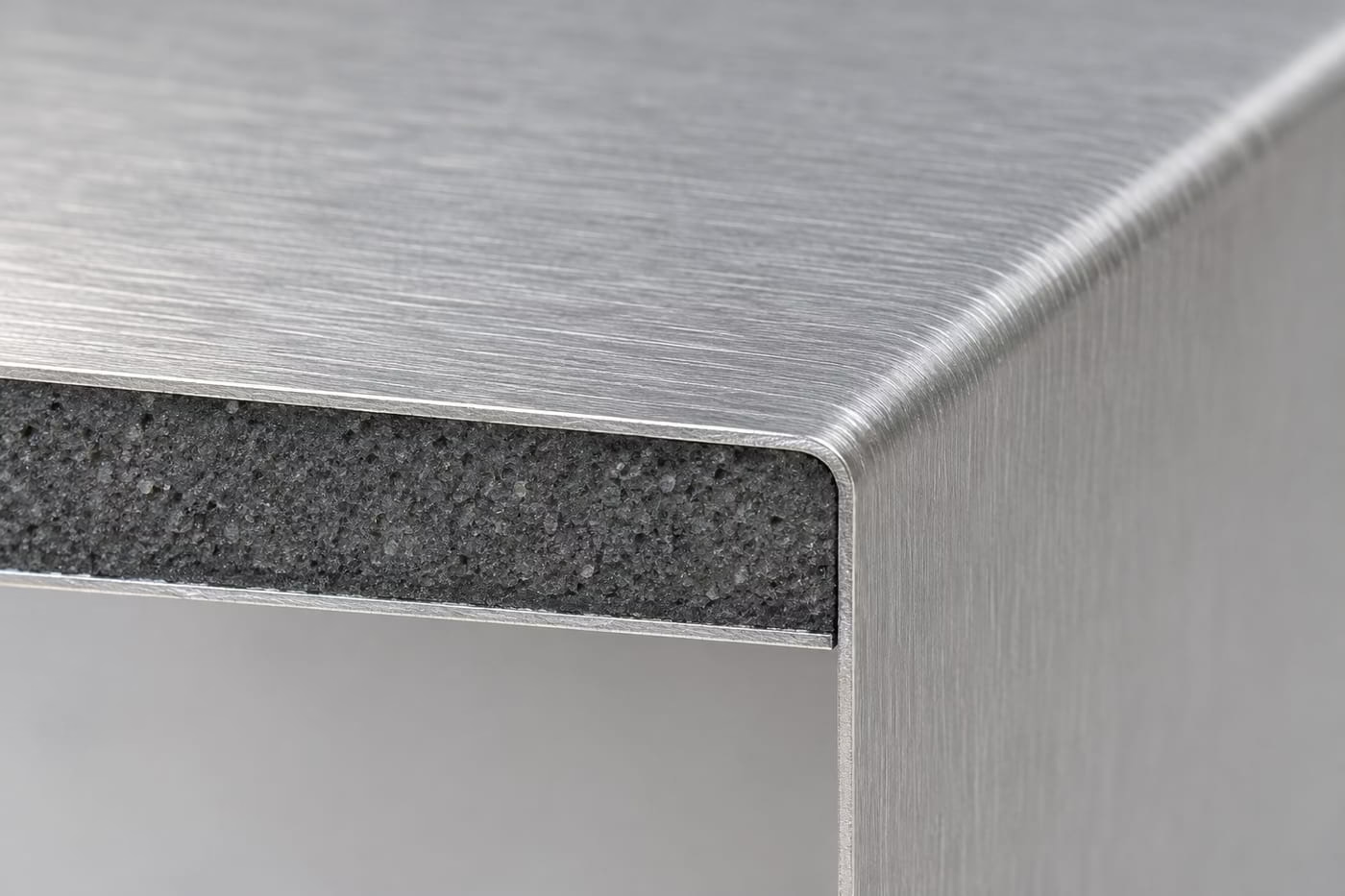
Lightweight construction. Aluminium runs at 2.70 g/cm³ against 7.85 g/cm³ for steel. A 3 mm solid panel weighs about 8.1 kg/m²; a 4 mm composite with 0.5 mm skins lands near 5.5 kg/m² on a polyethylene core and 7.2 kg/m² on a mineral core. On retrofit, that gap often decides whether the existing frame can take the load at all.
Figure basis: Weights calculated from nominal densities of 2.70 g/cm³ for aluminium, 0.94 g/cm³ for LDPE core and 1.5 g/cm³ for mineral core. Stiffeners, fixings and coating excluded.
Corrosion resistance, with a caveat. The passive oxide layer forms within minutes and lets 3003 or 5052 sit outdoors inland for years. It is not permission to skip coating at the coast, where chloride breaks the film down locally and pits the surface.
Design flexibility. Sheet folds, rolls and perforates; extrusion reaches tolerances sheet cannot. The limit is tooling.
Weather resistance, which belongs to the coating rather than the metal.
Low maintenance. Washing every 6 to 12 months in urban air, more often at the coast. Skipping it damages the coating rather than the panel, because dirt holds moisture against the surface.
Recyclability. Aluminium remelts without losing its alloy family, so recycled content claims are common. Actual content depends on the smelter, so ask.
What Are the Different Types of Aluminum Facade Panels?
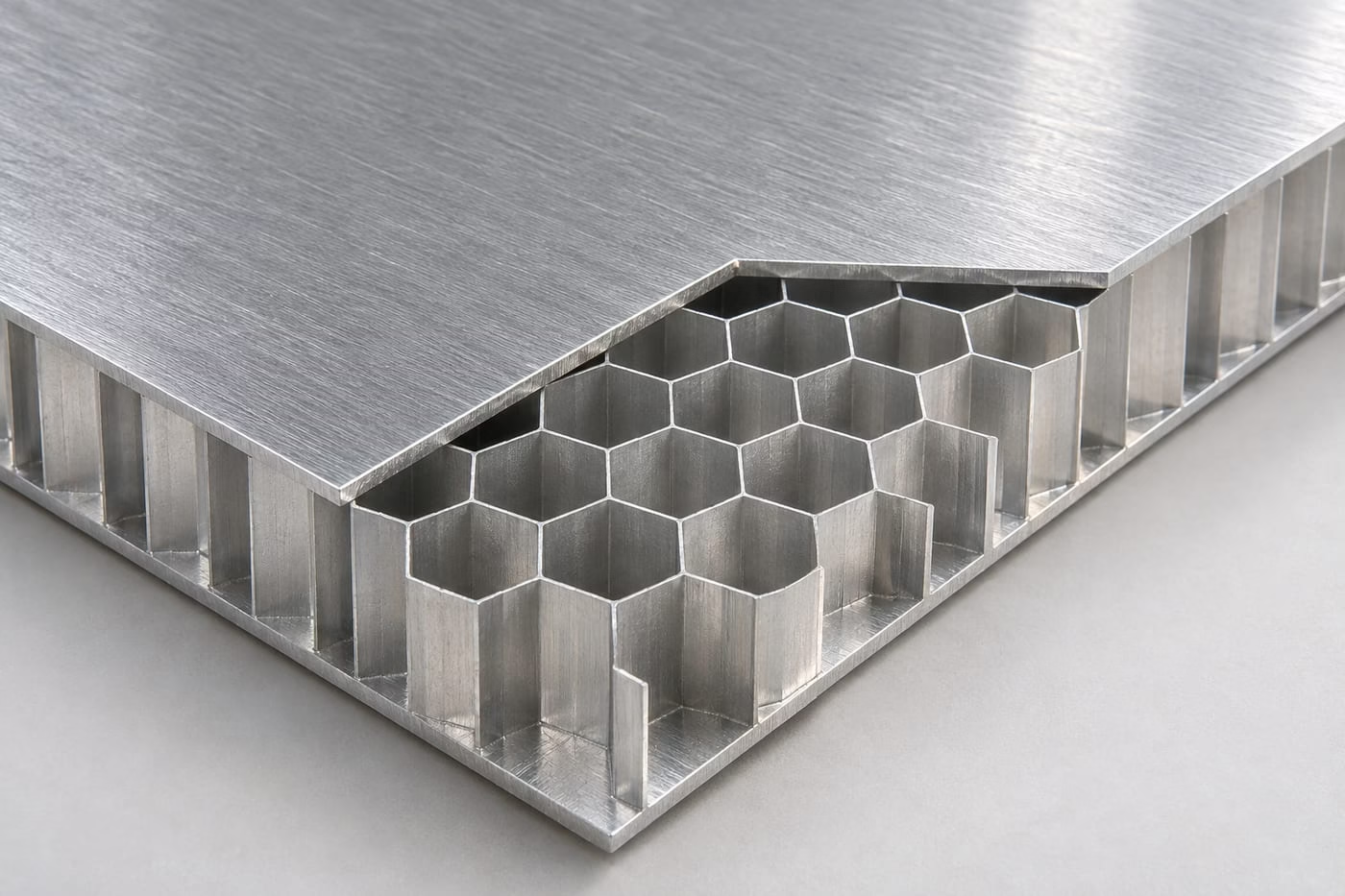
Seven families cover almost everything sold under this name. They differ in how they get their stiffness, and that difference explains most of the cost and application gap between them.
1. Solid Aluminum Facade Panels
A single sheet, normally 2.0 mm to 3.0 mm, in 3003 H14 or 5052 H32, routed, folded to a 20 mm to 25 mm return, corner-welded or cleated, and stiffened with bonded channels. Strength comes from the folded edge and the stiffeners, not the sheet: a 3 mm flat panel spanning 1.5 m without one will oil-can in sun.
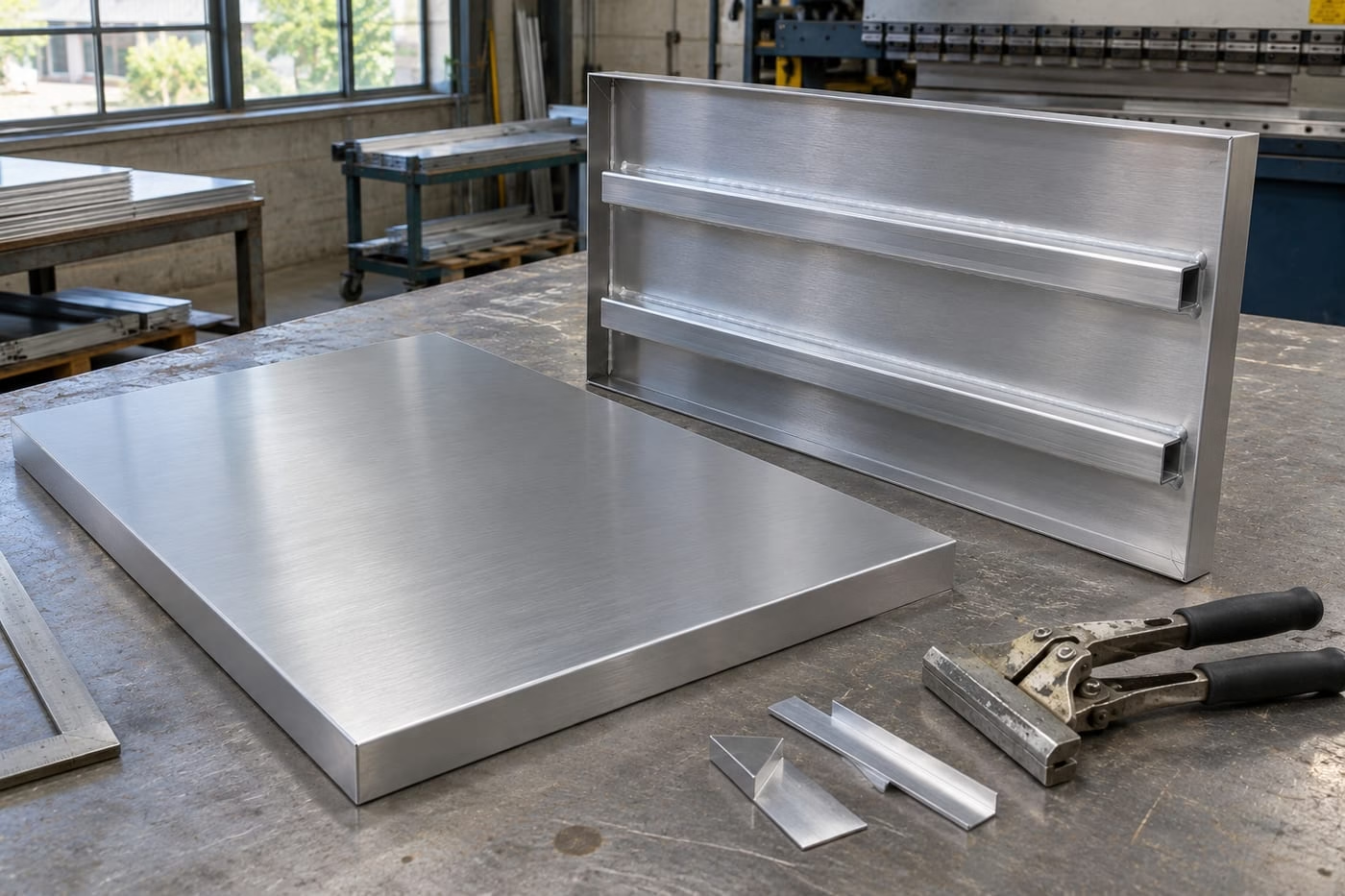
The limits are honest. Large panels get heavy, 5052 needs 5356 filler when welded and refuses tight radii, and double curvature means stretch forming. Column covers, canopies and ground floors take solid aluminum plate because it survives impact that would perforate a composite.
cURL Too many subrequests by single Worker invocation. To configure this limit, refer to https://developers.cloudflare.com/workers/wrangler/configuration/#limits
cURL Too many subrequests by single Worker invocation. To configure this limit, refer to https://developers.cloudflare.com/workers/wrangler/configuration/#limits
cURL Too many subrequests by single Worker invocation. To configure this limit, refer to https://developers.cloudflare.com/workers/wrangler/configuration/#limits
cURL Too many subrequests by single Worker invocation. To configure this limit, refer to https://developers.cloudflare.com/workers/wrangler/configuration/#limits
cURL Too many subrequests by single Worker invocation. To configure this limit, refer to https://developers.cloudflare.com/workers/wrangler/configuration/#limits
cURL Too many subrequests by single Worker invocation. To configure this limit, refer to https://developers.cloudflare.com/workers/wrangler/configuration/#limits
cURL Too many subrequests by single Worker invocation. To configure this limit, refer to https://developers.cloudflare.com/workers/wrangler/configuration/#limits
cURL Too many subrequests by single Worker invocation. To configure this limit, refer to https://developers.cloudflare.com/workers/wrangler/configuration/#limits
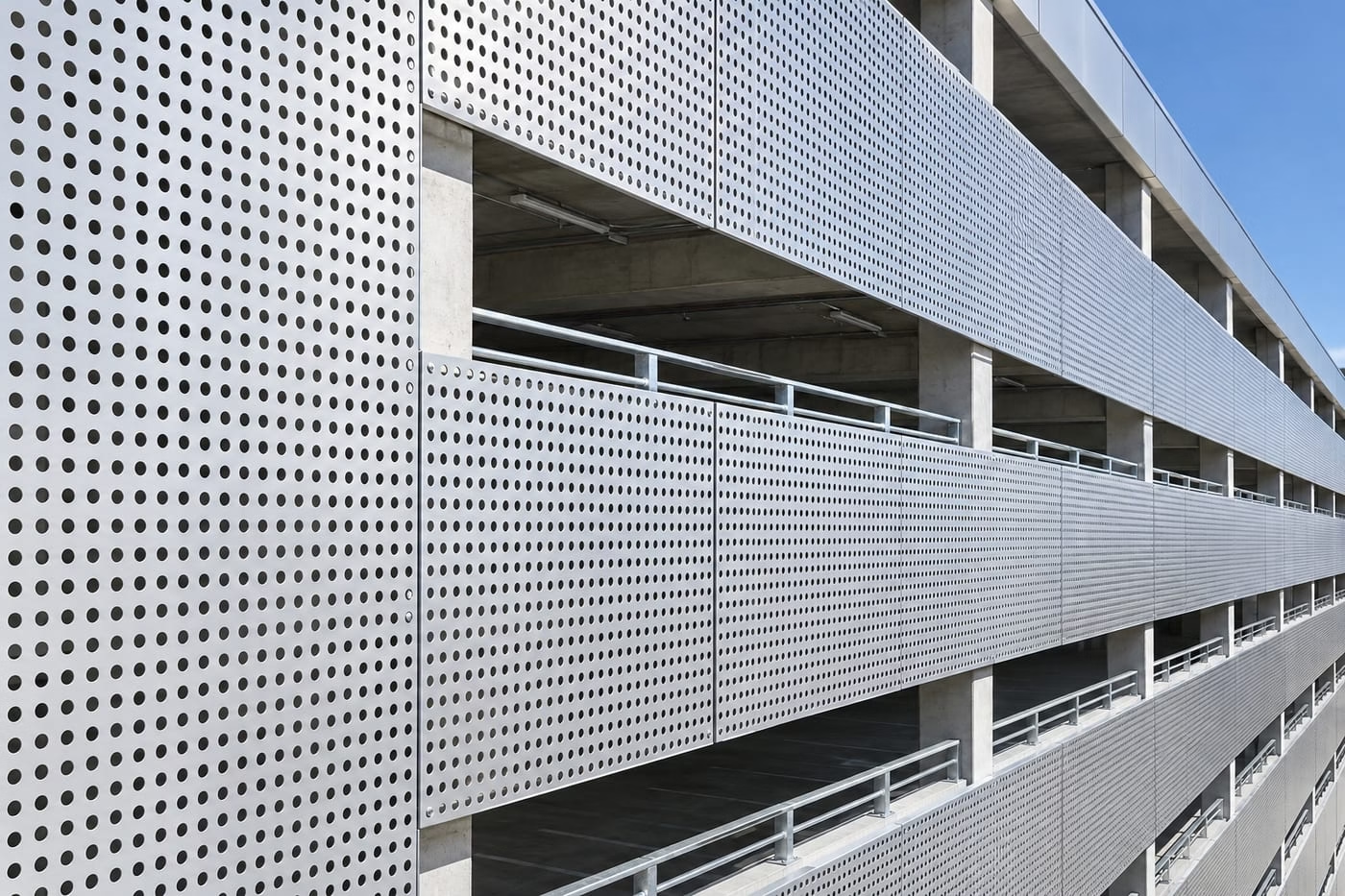
Pannelli in alluminio forato cURL Too many subrequests by single Worker invocation. To configure this limit, refer to https://developers.cloudflare.com/workers/wrangler/configuration/#limits
cURL Too many subrequests by single Worker invocation. To configure this limit, refer to https://developers.cloudflare.com/workers/wrangler/configuration/#limits
cURL Too many subrequests by single Worker invocation. To configure this limit, refer to https://developers.cloudflare.com/workers/wrangler/configuration/#limits
cURL Too many subrequests by single Worker invocation. To configure this limit, refer to https://developers.cloudflare.com/workers/wrangler/configuration/#limits
cURL Too many subrequests by single Worker invocation. To configure this limit, refer to https://developers.cloudflare.com/workers/wrangler/configuration/#limits cURL Too many subrequests by single Worker invocation. To configure this limit, refer to https://developers.cloudflare.com/workers/wrangler/configuration/#limits
cURL Too many subrequests by single Worker invocation. To configure this limit, refer to https://developers.cloudflare.com/workers/wrangler/configuration/#limits
cURL Too many subrequests by single Worker invocation. To configure this limit, refer to https://developers.cloudflare.com/workers/wrangler/configuration/#limits
cURL Too many subrequests by single Worker invocation. To configure this limit, refer to https://developers.cloudflare.com/workers/wrangler/configuration/#limits cURL Too many subrequests by single Worker invocation. To configure this limit, refer to https://developers.cloudflare.com/workers/wrangler/configuration/#limits
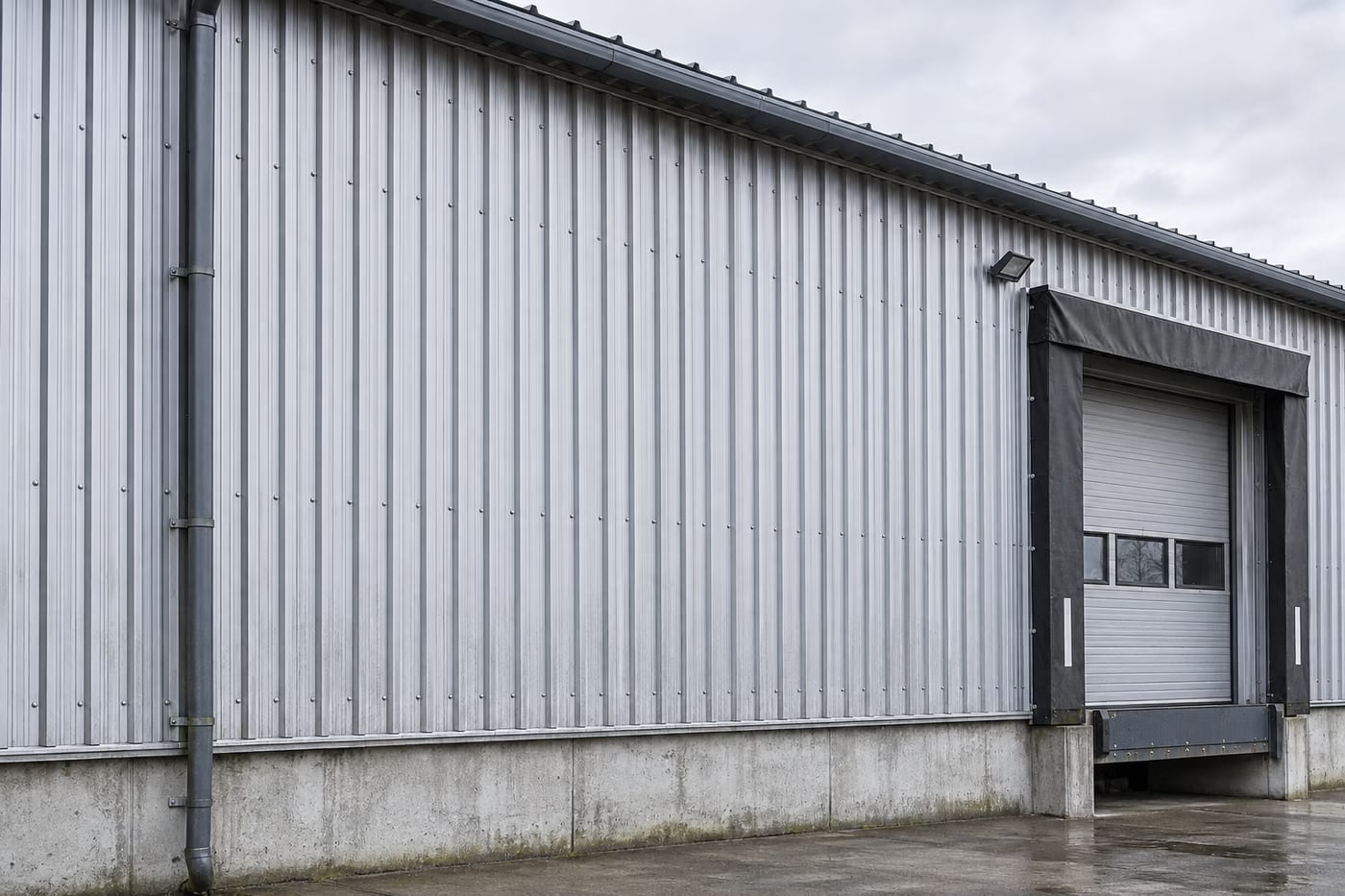
This is a sheet system, not a cassette system. Joints lap and fix through the face with self-drilling screws and EPDM washers, which is fast, cheap and visible. It reads industrial because it is: warehouses, plant rooms, factories. Specifying it for a feature elevation usually disappoints, since the lapped joints and exposed fasteners are what the design was avoiding.
7. Aluminum Louvers and Extruded Facade Panels
Extruded louvre profiles in 6063-T5 or T6 are formed into louvre blades, fins, sunshade blades and trims. Extrusion gives tolerances and section complexity that sheet cannot match, and a blade can shed rain as well as shade.
Performance is described by free area, blade pitch, pressure drop and rain defence class, and those four numbers decide whether a louvre works: a blade that looks right at 100 mm pitch may pass almost no air. Extrusion size is bounded by the die, and 6063 cannot be folded into a panel.
Comparison of Different Types of Aluminum Facade Panels
| Tipo di pannello | Main Structure | Key Advantages | Applicazioni tipiche |
|---|---|---|---|
| Solid Aluminum Panel | Single aluminum sheet | Durable, flexible fabrication | Facciate commerciali |
| Aluminum Composite Panel | Aluminum skins + core | Lightweight, flat surface | Retail and building facades |
| Honeycomb Panel | Aluminum skins + honeycomb core | High stiffness-to-weight ratio | Airports, large facades |
| Perforated Panel | Punched aluminum sheet | Ventilation and shading | Parking, sunshade systems |
| Expanded Aluminum Panel | Stretched metal mesh | Open structure, decorative | Screens and building facades |
| Corrugated Aluminum Panel | Formed aluminum sheet | Profile rigidity, visual texture | Industrial buildings |
| Aluminum Louvers | Profili in alluminio estruso | Sun control and ventilation | Offices and commercial buildings |
The table says what each panel is good at. It does not say that material cost per square metre broadly rises from composite through solid plate and perforated sheet to honeycomb, before fabrication and framing, or that honeycomb and solid plate need a fabricator with folding and welding equipment while composite can be cut and folded on site. Those two facts decide more projects than the advantages column.
What Materials Are Used in Aluminum Facade Panels?
Common Aluminum Alloys Used in Facade Panels
Four alloys cover most of the market. The choice follows how much forming the panel needs, how corrosive the site is, and whether the finish is paint or anodising.
| Leghe | cURL Too many subrequests by single Worker invocation. To configure this limit, refer to https://developers.cloudflare.com/workers/wrangler/configuration/#limits | cURL Too many subrequests by single Worker invocation. To configure this limit, refer to https://developers.cloudflare.com/workers/wrangler/configuration/#limits | Resistenza alla trazione | cURL Too many subrequests by single Worker invocation. To configure this limit, refer to https://developers.cloudflare.com/workers/wrangler/configuration/#limits | cURL Too many subrequests by single Worker invocation. To configure this limit, refer to https://developers.cloudflare.com/workers/wrangler/configuration/#limits |
|---|---|---|---|---|---|
| 3003 | cURL Too many subrequests by single Worker invocation. To configure this limit, refer to https://developers.cloudflare.com/workers/wrangler/configuration/#limits | H14 | cURL Too many subrequests by single Worker invocation. To configure this limit, refer to https://developers.cloudflare.com/workers/wrangler/configuration/#limits | cURL Too many subrequests by single Worker invocation. To configure this limit, refer to https://developers.cloudflare.com/workers/wrangler/configuration/#limits | cURL Too many subrequests by single Worker invocation. To configure this limit, refer to https://developers.cloudflare.com/workers/wrangler/configuration/#limits |
| 5005 | cURL Too many subrequests by single Worker invocation. To configure this limit, refer to https://developers.cloudflare.com/workers/wrangler/configuration/#limits | cURL Too many subrequests by single Worker invocation. To configure this limit, refer to https://developers.cloudflare.com/workers/wrangler/configuration/#limits | cURL Too many subrequests by single Worker invocation. To configure this limit, refer to https://developers.cloudflare.com/workers/wrangler/configuration/#limits | cURL Too many subrequests by single Worker invocation. To configure this limit, refer to https://developers.cloudflare.com/workers/wrangler/configuration/#limits | cURL Too many subrequests by single Worker invocation. To configure this limit, refer to https://developers.cloudflare.com/workers/wrangler/configuration/#limits |
| 5052 | cURL Too many subrequests by single Worker invocation. To configure this limit, refer to https://developers.cloudflare.com/workers/wrangler/configuration/#limits | cURL Too many subrequests by single Worker invocation. To configure this limit, refer to https://developers.cloudflare.com/workers/wrangler/configuration/#limits | cURL Too many subrequests by single Worker invocation. To configure this limit, refer to https://developers.cloudflare.com/workers/wrangler/configuration/#limits | cURL Too many subrequests by single Worker invocation. To configure this limit, refer to https://developers.cloudflare.com/workers/wrangler/configuration/#limits | cURL Too many subrequests by single Worker invocation. To configure this limit, refer to https://developers.cloudflare.com/workers/wrangler/configuration/#limits |
| 6063 | cURL Too many subrequests by single Worker invocation. To configure this limit, refer to https://developers.cloudflare.com/workers/wrangler/configuration/#limits | cURL Too many subrequests by single Worker invocation. To configure this limit, refer to https://developers.cloudflare.com/workers/wrangler/configuration/#limits | cURL Too many subrequests by single Worker invocation. To configure this limit, refer to https://developers.cloudflare.com/workers/wrangler/configuration/#limits | cURL Too many subrequests by single Worker invocation. To configure this limit, refer to https://developers.cloudflare.com/workers/wrangler/configuration/#limits | cURL Too many subrequests by single Worker invocation. To configure this limit, refer to https://developers.cloudflare.com/workers/wrangler/configuration/#limits |
Specification source: EN 485-2 for aluminium sheet, strip and plate, and EN 755-2 for extruded bar, tube and profile; figures are typical minimum tensile values for the tempers named, checked 19 November 2026.
Two rules carry most of the weight. Where a panel must fold to a tight radius, 3003 goes further before cracking than 5052. Where the site is coastal or the wind load is high, 5052 earns its price in retained section. Temper matters as much as alloy: the same 3003 annealed folds almost anywhere and dents under a fist, which is why panels ship in H14 or H32.
Core Materials Used in Aluminum Composite Panels
| Core | Composizione | Nominal density | Typical EN 13501-1 class | Where it is acceptable |
|---|---|---|---|---|
| PE | Polyethylene | 0.94 g/cm³ | Class D or lower, product-specific | Interior, signage, low-risk work |
| FR | About 70% mineral filler in polymer | 1.4–1.6 g/cm³ | B-s1,d0 | Mid-rise where B class is permitted |
| Mineral | Above 90% mineral filler | 1.8–2.0 g/cm³ | A2-s1,d0 | High-rise, institutional, regulated facades |
Polyethylene has a gross calorific value in the 43 to 46 MJ/kg range and melts around 110 to 120 °C. In a fire it delaminates from the skins and burns as a liquid fuel, which is why PE-core composite is excluded from external walls above the height thresholds in most regulated markets.
Fire-retardant cores hold roughly 70% aluminium hydroxide in a polymer binder. Above about 180 °C the hydroxide decomposes endothermically, releasing water vapour that cools the surface and dilutes flammable gas. The residual polymer still burns under sustained heat load, which is why the class stops at B.
Mineral cores pass 90% filler and reach A2-s1,d0, the highest class available to a composite with any polymer content. Denser, stiffer, less forgiving to fold, and usually the only version a high-rise specification will accept.
Regulation source: EN 13501-1 reaction-to-fire classification, including the s (smoke) and d (droplet) sub-classes. Classes shown are typical of each core family; the class that applies to your project is the one on the specific panel’s classification report, checked 19 November 2026.
“FR” on a quotation is a marketing word, not a classification. Two panels both sold as fire-retardant can sit in different Euroclasses, and the difference shows at the submittal rather than at the loading bay. Ask for the full classification string with the s and d suffixes, and the test report number.
Factors That Affect Aluminum Panel Material Selection
Strength requirements. Design wind pressure drives thickness and stiffener spacing long before aesthetics do. A panel sized for 1.0 kPa will not perform at 4.0 kPa, and that figure is a structural engineer’s calculation rather than a supplier’s recommendation.
Corrosion resistance. Inland temperate sites tolerate 3003 with a good coating. Coastal sites, de-icing salt and industrial atmospheres call for 5052, and the coating system matters more than the alloy.
Formability. Deep folds, tight radii and curved work point to 3003 in a softer temper. Flat cassette work in 5052 is fine, but the fold radius has to grow with the strength.
Weight requirements. On retrofit the existing frame often sets a hard ceiling. A 4 mm composite at 5.5 kg/m² may be the only option that avoids strengthening the structure.
Fire performance. Core chemistry sets the class, and the class decides whether the building can use the panel at all. Establish it first, because it eliminates options instead of ranking them.
Aluminum Facade Panel Finishes and Surface Treatments
The coating is what the client sees at year fifteen. Panel grade decides whether the facade stands; coating grade decides whether it still matches the drawings.
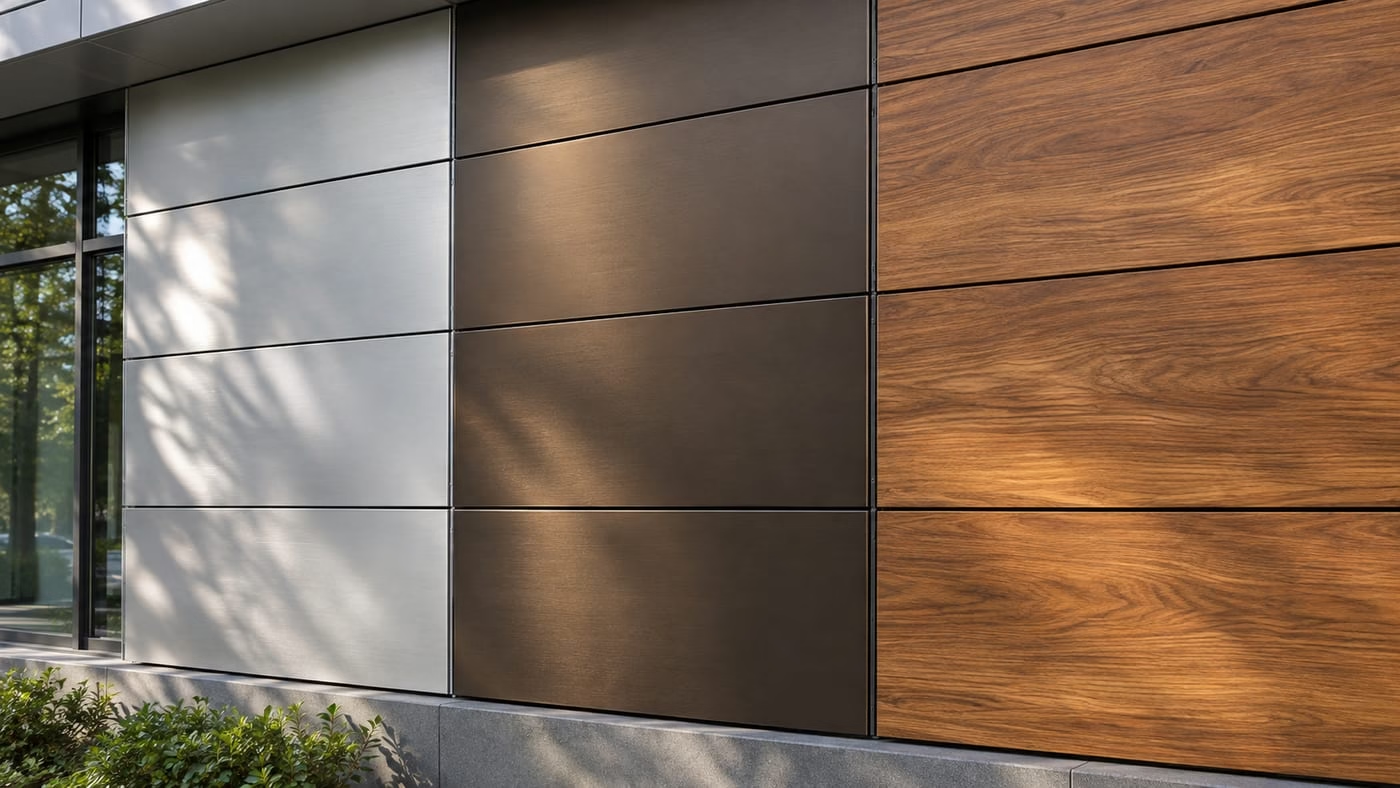
Rivestimento in PVDF
cURL Too many subrequests by single Worker invocation. To configure this limit, refer to https://developers.cloudflare.com/workers/wrangler/configuration/#limits
cURL Too many subrequests by single Worker invocation. To configure this limit, refer to https://developers.cloudflare.com/workers/wrangler/configuration/#limits
cURL Too many subrequests by single Worker invocation. To configure this limit, refer to https://developers.cloudflare.com/workers/wrangler/configuration/#limits
cURL Too many subrequests by single Worker invocation. To configure this limit, refer to https://developers.cloudflare.com/workers/wrangler/configuration/#limits
Rivestimento in polvere
cURL Too many subrequests by single Worker invocation. To configure this limit, refer to https://developers.cloudflare.com/workers/wrangler/configuration/#limits
cURL Too many subrequests by single Worker invocation. To configure this limit, refer to https://developers.cloudflare.com/workers/wrangler/configuration/#limits
Anodizzazione
cURL Too many subrequests by single Worker invocation. To configure this limit, refer to https://developers.cloudflare.com/workers/wrangler/configuration/#limits
cURL Too many subrequests by single Worker invocation. To configure this limit, refer to https://developers.cloudflare.com/workers/wrangler/configuration/#limits
cURL Too many subrequests by single Worker invocation. To configure this limit, refer to https://developers.cloudflare.com/workers/wrangler/configuration/#limits
cURL Too many subrequests by single Worker invocation. To configure this limit, refer to https://developers.cloudflare.com/workers/wrangler/configuration/#limits
cURL Too many subrequests by single Worker invocation. To configure this limit, refer to https://developers.cloudflare.com/workers/wrangler/configuration/#limits
cURL Too many subrequests by single Worker invocation. To configure this limit, refer to https://developers.cloudflare.com/workers/wrangler/configuration/#limits
cURL Too many subrequests by single Worker invocation. To configure this limit, refer to https://developers.cloudflare.com/workers/wrangler/configuration/#limits
cURL Too many subrequests by single Worker invocation. To configure this limit, refer to https://developers.cloudflare.com/workers/wrangler/configuration/#limits
cURL Too many subrequests by single Worker invocation. To configure this limit, refer to https://developers.cloudflare.com/workers/wrangler/configuration/#limits
cURL Too many subrequests by single Worker invocation. To configure this limit, refer to https://developers.cloudflare.com/workers/wrangler/configuration/#limits
cURL Too many subrequests by single Worker invocation. To configure this limit, refer to https://developers.cloudflare.com/workers/wrangler/configuration/#limits
cURL Too many subrequests by single Worker invocation. To configure this limit, refer to https://developers.cloudflare.com/workers/wrangler/configuration/#limits
cURL Too many subrequests by single Worker invocation. To configure this limit, refer to https://developers.cloudflare.com/workers/wrangler/configuration/#limits
Industrial Buildings and Warehouses
Profiled and corrugated sheet at 0.7 mm to 1.2 mm, fixed through the face, chosen on cost per square metre and speed of enclosure. The mistake is mixing systems: a through-fixed corrugated wall detailed like a rainscreen, with a cavity and open joints, leaks at every penetration and every lap.
Public Buildings and Educational Facilities
Durability, vandal resistance and low maintenance over a long horizon, with cleaning access often worse than assumed. Impact damage concentrates between 0.8 m and 1.5 m above floor level, so that band is where the specification should thicken, add a backing panel, or move to a perforated screen with a replaceable inner leaf.
How to Choose the Right Aluminum Facade Panels for Your Project?
Consider the Building Type and Design Requirements
Start with geometry, because it eliminates panel families faster than any other criterion. Flat elevations accept anything. Single curvature wants roll forming or three-dimensional bending on solid plate, or a post-formed composite. Double curvature needs stretch forming or a moulded honeycomb, and both carry a cost step that surprises people.
If the design has a curve and the budget does not, facet it. A twelve-sided approximation of a 3 m radius reads as a curve from 20 m away and costs a fraction of a formed panel, and the joint grid can make the facets look deliberate.
Evaluate Thickness, Strength, and Panel Size
Design wind pressure sets the spessore del pannello. Typical facade pressures run 1.0 kPa to 2.5 kPa on low and mid-rise work and 4.0 kPa to 5.0 kPa in cyclonic regions, and those figures belong to the structural engineer. A supplier who quotes 3 mm without asking for design pressure and fixing centres has not designed anything.
Stiffener spacing follows, commonly 500 mm to 600 mm on 3 mm panels, with deflection around L/90 between supports in many specifications. Visual flatness usually governs before structural deflection does, which is why a mock-up matters more than the calculation. Size is bounded by coil width, normally 1250 mm, 1500 mm or 1550 mm, and by handling: a 1500 mm by 4000 mm cassette needs a vacuum lifter and two operators.
Choose the Right Surface Finish
Match the coating to the exposure, not the budget line:
- Inland temperate: PVDF two-coat, or super-durable polyester powder at AAMA 2604.
- Coastal within 1 km of open sea: 5052 substrate, PVDF three-coat, salt spray evidence at 4,000 hours.
- Industrial and acid atmospheres: PVDF with an acid-resistant primer, and a cleaning regime that actually happens.
- High altitude, desert, high UV: PVDF three-coat in a light colour, since surface temperature drives degradation as much as UV dose.
Check Fire Safety and Building Code Requirements
Three things have to line up: the core class, the assembly test and the jurisdiction. Getting one wrong is how a compliant panel ends up on a non-compliant wall.
In the United States, IBC 2021 Section 1406 governs metal composite materials by construction type, height above grade plane and percentage of wall area, and Section 1406.10.3 requires NFPA 285 compliance where MCM walls on Type I to IV construction rise more than 40 feet (12.2 m) above grade plane. NFPA 285 tests an assembly rather than a panel: substrate, insulation, air barrier, cavity depth and fixing system are all part of the tested configuration, and changing one can void the result.
In England, Regulation 7 of the Building Regulations 2010 as amended, and the Approved Document B guidance behind it, require materials in external walls of relevant buildings to meet A2-s1,d0 or A1 where a floor sits more than 18 m above ground. That threshold took effect on 21 December 2018 and was extended in 2022 to hotels, hostels and boarding houses. A consultation on lowering it to 11 m opened on 25 March 2026 and closed on 1 July 2026, with a stated target implementation date of 2 September 2029. As of 19 November 2026, 18 m remains the operative threshold.
Regulation source: IBC 2021 Sections 1406.10.3 and 1405 with NFPA 285; SI 2018/1230 amending Regulation 7 of the Building Regulations 2010; MHCLG and Building Safety Regulator consultation on Approved Document B opened 25 March 2026. Checked 19 November 2026.
Across the EU the mechanism is EN 13501-1 plus national rules, and those rules differ more than the classes suggest: Germany’s model high-rise code and several member states set their own height triggers, so the same A2-s1,d0 panel can be acceptable on one project and not on the next. The compliance question is never “is this panel fire rated”. It is whether this assembly, at this height, in this jurisdiction, holds the class the code names, with a report that matches the build-up on the drawings.
Consider Installation and Maintenance Costs
Panel price is the smallest part of the number most buyers compare. Frame density is the larger one: a 600 mm joint grid needs roughly 40% more rail and brackets than a 1200 mm grid, before labour.
Access drives the rest. A 1200 mm by 2400 mm cassette can be handled by two people from a mast climber; a 1500 mm by 4000 mm honeycomb panel needs a vacuum lifter, a crane and a day of crane time, and none of that appears in the panel quotation. Replacement cost is a design decision too: concealed fixings look better and cost more to swap, exposed fasteners are visible and take ten minutes. Cleaning is an access cost rather than a labour cost, and it belongs at the design stage alongside the BMU strategy.
Aluminum Facade Panels vs. Other Cladding Materials
| Materiale | Densità | Typical panel weight | cURL Too many subrequests by single Worker invocation. To configure this limit, refer to https://developers.cloudflare.com/workers/wrangler/configuration/#limits | cURL Too many subrequests by single Worker invocation. To configure this limit, refer to https://developers.cloudflare.com/workers/wrangler/configuration/#limits | cURL Too many subrequests by single Worker invocation. To configure this limit, refer to https://developers.cloudflare.com/workers/wrangler/configuration/#limits | cURL Too many subrequests by single Worker invocation. To configure this limit, refer to https://developers.cloudflare.com/workers/wrangler/configuration/#limits |
|---|---|---|---|---|---|---|
| cURL Too many subrequests by single Worker invocation. To configure this limit, refer to https://developers.cloudflare.com/workers/wrangler/configuration/#limits | 2,70 g/cm³ | cURL Too many subrequests by single Worker invocation. To configure this limit, refer to https://developers.cloudflare.com/workers/wrangler/configuration/#limits | cURL Too many subrequests by single Worker invocation. To configure this limit, refer to https://developers.cloudflare.com/workers/wrangler/configuration/#limits | cURL Too many subrequests by single Worker invocation. To configure this limit, refer to https://developers.cloudflare.com/workers/wrangler/configuration/#limits | Medio | cURL Too many subrequests by single Worker invocation. To configure this limit, refer to https://developers.cloudflare.com/workers/wrangler/configuration/#limits |
| cURL Too many subrequests by single Worker invocation. To configure this limit, refer to https://developers.cloudflare.com/workers/wrangler/configuration/#limits | cURL Too many subrequests by single Worker invocation. To configure this limit, refer to https://developers.cloudflare.com/workers/wrangler/configuration/#limits | cURL Too many subrequests by single Worker invocation. To configure this limit, refer to https://developers.cloudflare.com/workers/wrangler/configuration/#limits | cURL Too many subrequests by single Worker invocation. To configure this limit, refer to https://developers.cloudflare.com/workers/wrangler/configuration/#limits | cURL Too many subrequests by single Worker invocation. To configure this limit, refer to https://developers.cloudflare.com/workers/wrangler/configuration/#limits | cURL Too many subrequests by single Worker invocation. To configure this limit, refer to https://developers.cloudflare.com/workers/wrangler/configuration/#limits | cURL Too many subrequests by single Worker invocation. To configure this limit, refer to https://developers.cloudflare.com/workers/wrangler/configuration/#limits |
| cURL Too many subrequests by single Worker invocation. To configure this limit, refer to https://developers.cloudflare.com/workers/wrangler/configuration/#limits | cURL Too many subrequests by single Worker invocation. To configure this limit, refer to https://developers.cloudflare.com/workers/wrangler/configuration/#limits | cURL Too many subrequests by single Worker invocation. To configure this limit, refer to https://developers.cloudflare.com/workers/wrangler/configuration/#limits | cURL Too many subrequests by single Worker invocation. To configure this limit, refer to https://developers.cloudflare.com/workers/wrangler/configuration/#limits | cURL Too many subrequests by single Worker invocation. To configure this limit, refer to https://developers.cloudflare.com/workers/wrangler/configuration/#limits | Alto | cURL Too many subrequests by single Worker invocation. To configure this limit, refer to https://developers.cloudflare.com/workers/wrangler/configuration/#limits |
| Fibre cement | 1.4–1.8 g/cm³ | 13–16 kg/m² at 8 mm | Stable; surface staining from runoff | 10–12 × 10⁻⁶/K | Medio | Brittle edges; cannot be folded |
Aluminum Facade Panels vs. Steel Cladding
The weight argument is real but narrower than it sounds. At equal thickness aluminium weighs about a third of steel, but steel is stiffer, so an aluminium section needs more depth or closer supports for the same wind load. The weight saving survives; the “same panel, less weight” claim does not.
Corrosion differs in kind. Steel depends entirely on its coating, and a scratch becomes a corrosion site that grows. Aluminium self-passivates, but it is anodic to steel, so wet contact between an aluminium panel and a bare steel bracket makes the aluminium the sacrificial metal. The panel is rarely the problem; the interface is.
Aluminum Facade Panels vs. Stainless Steel Panels
Stainless wins on homogeneity: the surface is the material, so a scratch exposes the same alloy rather than a bare substrate under a coating, and 316 in marine air outperforms coated aluminium across fifty years.
It loses on cost and weight, both of which compound, and it has a look. Stainless reads heavier and cooler than aluminium, with a directional grain that shows every panel-to-panel rotation, and some clients want that. The honest split is stainless for low-level, high-abuse, coastal work where the brief says fifty years uncoated, and aluminium wherever the budget has to close.
Aluminum Facade Panels vs. Fiber Cement Cladding
Fibre cement is a cementitious sheet with no metal skin, and it takes through-colour and matt texture that aluminium cannot reproduce. For a monolithic, non-reflective surface it is often the better material.
The weight advantage of aluminium is smaller than suppliers claim: an 8 mm fibre cement sheet at roughly 14 kg/m² sits close to a 5 mm solid aluminium panel. The failure modes differ as well. Fibre cement chips at edges during handling and stains below fixings from runoff, and it cannot be folded into a cassette without aluminium edge trims.
Aluminum Facade Panel Installation: What Should You Know?
Common Aluminum Facade Mounting Systems
Cassette. A folded tray with 20 mm to 25 mm returns, hooked onto a rail or clipped to a bracket, with joints of 10 mm to 20 mm. Concealed, flush, the default for a modern flat facade, and tolerance-sensitive because the joint is the visual.
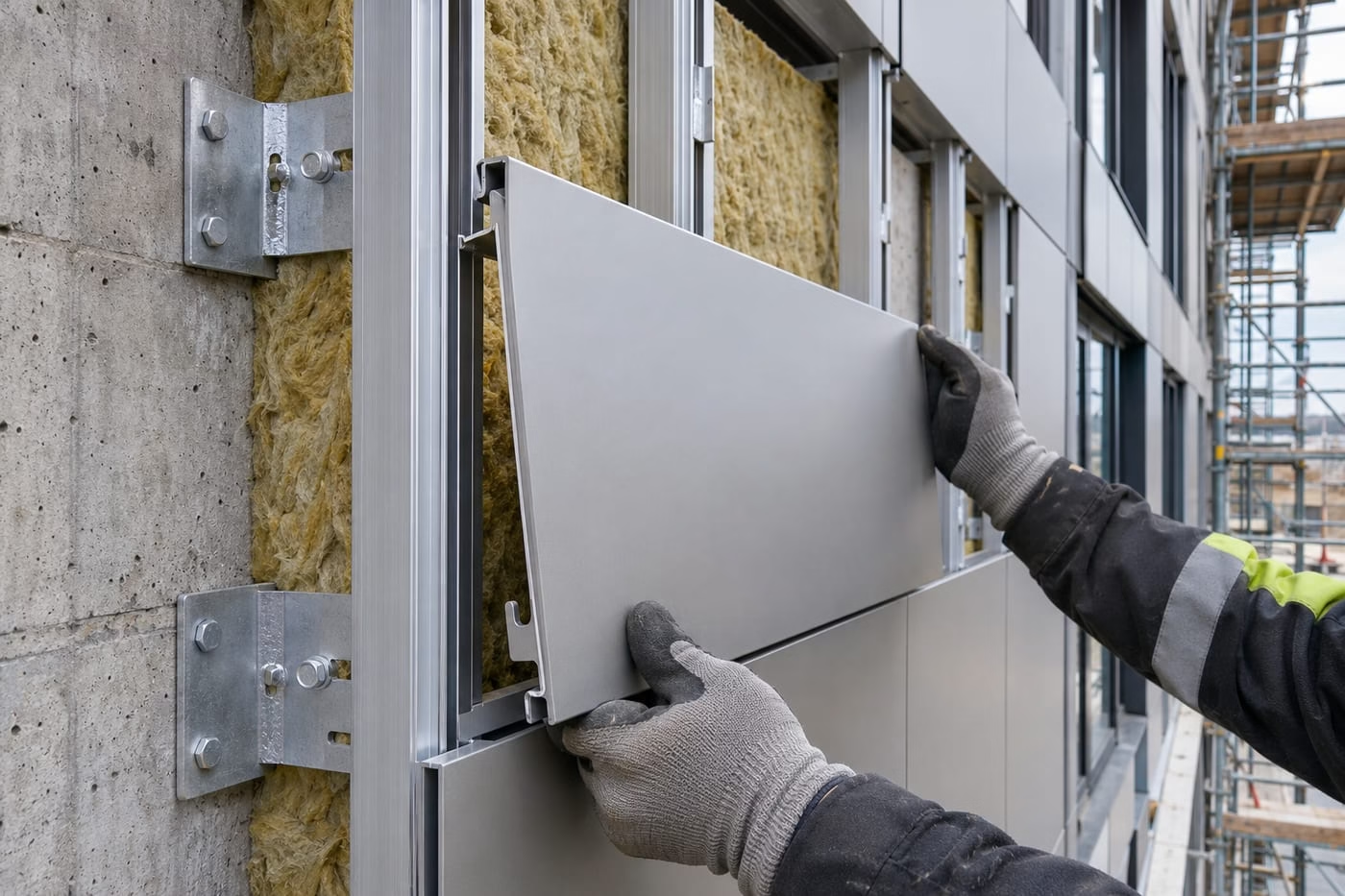
Rainscreen with open joints. Panels on cleats with joints left open at 10 mm to 15 mm for drainage and ventilation, over a drained and compartmented cavity. Forgiving of movement, but it needs a backing designed to be seen and a cavity that actually drains.
Exposed fastening. Rivets or self-drilling screws with EPDM washers through the face. The cheapest and fastest option, standard on profiled sheet, and permanently visible.
Concealed fastening. Undercut anchors, hook systems or adhesive-bonded studs. Best appearance and least forgiving: the panel cannot be adjusted once set, so the subframe has to be right first.
Key Installation Considerations
Subframe and bracket design. Brackets absorb the difference between the structure’s tolerance and the facade’s, usually 20 mm to 30 mm. They also carry thermal break and galvanic isolation: stainless or nylon washers between aluminium and steel, every time, because the one left out is the one that fails.
Thermal expansion and movement joints. Aluminium moves 23 × 10⁻⁶ per K. A 2,400 mm panel through a 60 K swing between a cold night and a sunlit afternoon moves 3.3 mm. Fixed at both ends that becomes buckling or a cracked joint, so the detail needs a fixed point and sliding points.
Drainage and ventilation. A cavity of at least 25 mm, open at the head, drained at the base through weep holes and flashing. Cavity barriers at floor lines do two jobs, fire stopping and pressure compartmentation, and a cavity sealed at both ends will hold water.
Waterproofing and panel alignment. The panel is the outer leaf, not the waterproofing. The barrier behind has to be continuous, with flashing at sills, heads, parapets and every penetration, and the facade set out from the same datum as the glazing or the joints will not line up at the interface.
Specification source: Coefficient of linear thermal expansion for aluminium alloys, 23 × 10⁻⁶ per K, EN 1999-1-1 (Eurocode 9), checked 19 November 2026.
Frequently Asked Questions About Aluminum Facade Panels
What Are the Different Types of Aluminum Facade Panels?
Solid aluminum panels, aluminum composite panels, honeycomb panels, perforated panels, expanded mesh panels, corrugated or profiled sheet, and extruded louvres. They differ mainly in how they achieve stiffness, which drives cost, weight and suitable applications.
cURL Too many subrequests by single Worker invocation. To configure this limit, refer to https://developers.cloudflare.com/workers/wrangler/configuration/#limits
cURL Too many subrequests by single Worker invocation. To configure this limit, refer to https://developers.cloudflare.com/workers/wrangler/configuration/#limits
cURL Too many subrequests by single Worker invocation. To configure this limit, refer to https://developers.cloudflare.com/workers/wrangler/configuration/#limits
cURL Too many subrequests by single Worker invocation. To configure this limit, refer to https://developers.cloudflare.com/workers/wrangler/configuration/#limits
cURL Too many subrequests by single Worker invocation. To configure this limit, refer to https://developers.cloudflare.com/workers/wrangler/configuration/#limits
cURL Too many subrequests by single Worker invocation. To configure this limit, refer to https://developers.cloudflare.com/workers/wrangler/configuration/#limits
cURL Too many subrequests by single Worker invocation. To configure this limit, refer to https://developers.cloudflare.com/workers/wrangler/configuration/#limits
cURL Too many subrequests by single Worker invocation. To configure this limit, refer to https://developers.cloudflare.com/workers/wrangler/configuration/#limits
cURL Too many subrequests by single Worker invocation. To configure this limit, refer to https://developers.cloudflare.com/workers/wrangler/configuration/#limits
cURL Too many subrequests by single Worker invocation. To configure this limit, refer to https://developers.cloudflare.com/workers/wrangler/configuration/#limits
cURL Too many subrequests by single Worker invocation. To configure this limit, refer to https://developers.cloudflare.com/workers/wrangler/configuration/#limits
cURL Too many subrequests by single Worker invocation. To configure this limit, refer to https://developers.cloudflare.com/workers/wrangler/configuration/#limits
cURL Too many subrequests by single Worker invocation. To configure this limit, refer to https://developers.cloudflare.com/workers/wrangler/configuration/#limits
cURL Too many subrequests by single Worker invocation. To configure this limit, refer to https://developers.cloudflare.com/workers/wrangler/configuration/#limits cURL Too many subrequests by single Worker invocation. To configure this limit, refer to https://developers.cloudflare.com/workers/wrangler/configuration/#limits cURL Too many subrequests by single Worker invocation. To configure this limit, refer to https://developers.cloudflare.com/workers/wrangler/configuration/#limits
cURL Too many subrequests by single Worker invocation. To configure this limit, refer to https://developers.cloudflare.com/workers/wrangler/configuration/#limits
cURL Too many subrequests by single Worker invocation. To configure this limit, refer to https://developers.cloudflare.com/workers/wrangler/configuration/#limits
cURL Too many subrequests by single Worker invocation. To configure this limit, refer to https://developers.cloudflare.com/workers/wrangler/configuration/#limits
 Italiano
 English
 Français
 Bahasa Indonesia
 Deutsch
 Español
 العربية
 Español de México
 Nederlands
 香港中文