
What Anodizing Actually Does to an Aluminium Facade Panel
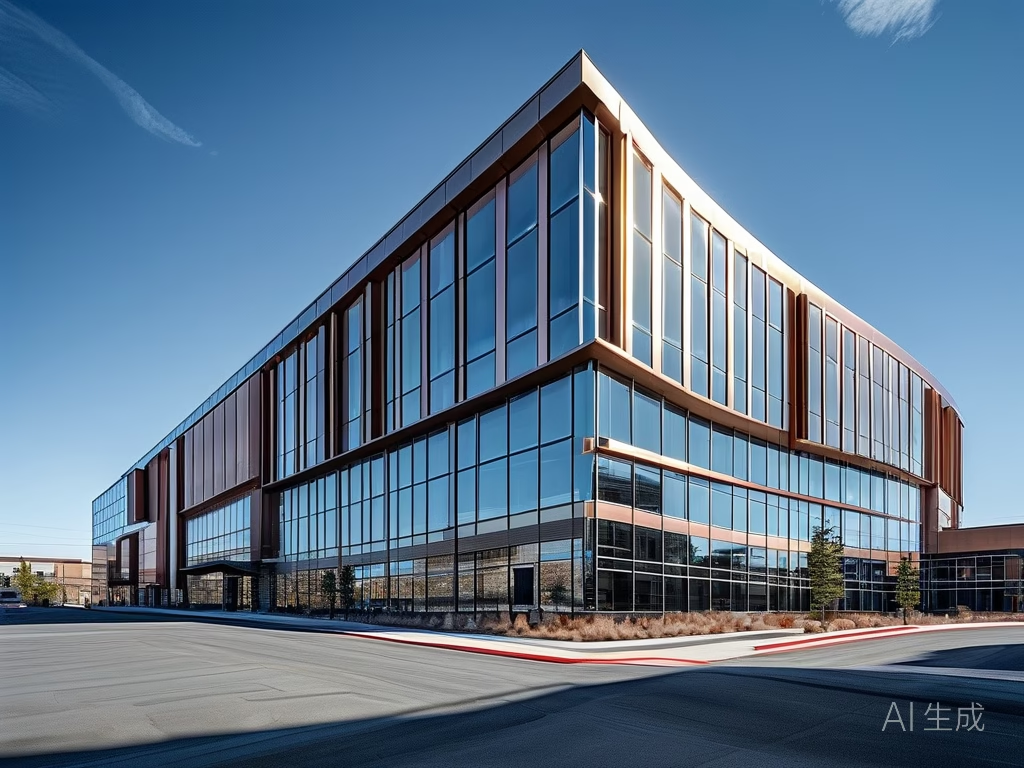
The Electrochemical Process: Controlled Oxide Growth
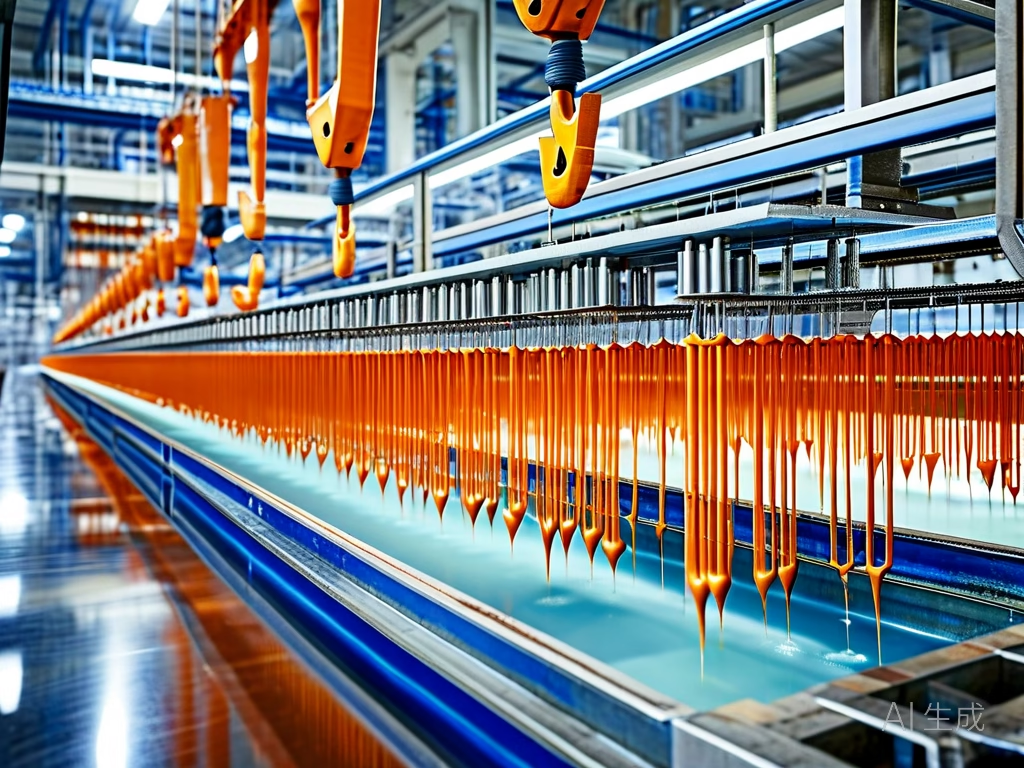
Anodizing is an electrochemical conversion process, not a deposition process. An aluminium extrusion or sheet panel is immersed in an electrolyte — in architectural practice, almost always dilute sulphuric acid at a concentration typically between 150 and 200 g/l — and connected as the anode of a direct current circuit. The tank wall or a separate cathode plate, usually lead or stainless steel, completes the circuit. When current is applied at a controlled cell voltage, typically 15–20 V, oxygen is liberated at the aluminium surface and reacts immediately with the aluminium itself to form aluminium oxide (Al&sub2;O&sub3;).
What distinguishes anodizing from every other surface treatment used on facades is that the reaction consumes the substrate. The oxide is not applied to the metal; it is grown out of it. Faraday’s law governs the amount of oxide produced: the film thickness is a direct function of current density multiplied by time. In practice, a rectifier holds a fixed current density across the load — commonly 1.0 to 1.5 A/dm² for architectural work — and the process runs until the target film thickness is reached, at which point the current is tapered to avoid burning the film at contact points. The whole cycle for a facade-grade film is short, frequently 25 to 45 minutes in the tank, but it is a tightly specified, measured operation with recorded parameters for every rack of profiles.
A critical detail for specifiers: the growing oxide is an electrical insulator. As the film thickens, its electrical resistance rises, and the applied voltage must rise correspondingly to maintain current density. That rising voltage curve is one of the few reliable in-process signatures of correct film growth. Bars that have been poorly racked, contaminated with copper or iron from tooling, or anodized with an interrupted current path will show anomalous voltage traces, and the resulting film may be of the required nominal thickness while still performing badly. Anodizing quality, in other words, is a process-control problem and not simply a thickness measurement.
Why the Oxide Layer Cannot Peel or Flake
The single most consequential property of the anodic film is its address at the substrate interface. Roughly half of the total film thickness lies below the original aluminium surface, and roughly half builds outward. To put this in concrete terms, a 20 µm architectural film consumes approximately 10 µm of the base metal and adds approximately 10 µm above the original profile dimension. The alloy surface becomes a 20 µm oxide layer with a diffuse, interlocking boundary that transitions gradually from metal to oxide over a zone of nanometre-scale roughness.
There is no adhesive bond in this system, because there is no bond line. Compare this with a liquid-applied or powder coating: those systems rely on a pretreated, physically and chemically distinct interface between substrate and film, and every such interface is a potential failure path. Adhesion loss, blistering, undercutting corrosion at scribes, and intercoat delamination all originate at that boundary. An anodic film has no such boundary to fail. It cannot peel in the sense that a paint can peel, because peeling requires two distinguishable materials and a plane of separation between them. The failure modes that do exist for anodizing — chalking, loss of gloss, discolouration from alkali attack, or physical abrasion — occur within the film or at its outermost surface, not at an interface.
This has direct consequences for on-site damage assessment. An anodized panel that has been scratched deeply enough to penetrate the film will expose bare metal at the score line, but there is no mechanism to propagate that damage laterally. Contrast this with a coating, where a scratch typically initiates progressive undercutting as moisture and chloride migrate along the interface beneath adjacent intact film. For coastal facade specifications, that difference is frequently the decisive argument in favour of anodizing rather than paint.
It also has consequences for fabrication sequencing. Because the film is integral, anodized sections can be bent, sawed, and drilled after finishing in many cases without gross film loss at edges, though fabrication after anodizing does expose cut edges of bare aluminium that will weather to a dull grey unless locally protected. Guidance generally favours anodizing as the final operation after all cutting and forming is complete, with fasteners and sealants selected for compatibility with an acidic-to-neutral anodic surface rather than a painted one.
Film Thickness for Architectural Service: BS 3987 and EN ISO 7599
Architectural anodizing is specified by film thickness class, because thickness is the primary determinant of durability once the alloy, finish, and sealing quality are fixed. The relevant standard documents are BS 3987 for architectural anodized wrought aluminium for external applications, and EN ISO 7599, which defines the general designation system for anodic oxidation coatings by film thickness. Both express the specification in micrometres using a class designation equal to the nominal minimum local thickness.
Exterior work is conventionally specified at 15 µm, 20 µm, or 25 µm nominal minimum local thickness, designated Class 15, Class 20, and Class 25 respectively. Interior components may reasonably be specified at 10 µm or even 5 µm, but 15 µm is the practical floor for anything exposed to weather and its abrasion load. The measurement is defined in terms of local thickness using an eddy-current instrument calibrated against standards of similar curvature, with the standard specifying both a minimum local value and, in some cases, a mean and minimum relationship across a batch. A supplier quoting “20 micron” without stating whether it is nominal minimum local thickness or an average is not quoting a specification.
What thickness buys the specifier is mechanical and chemical durability. It buys resistance to abrasion — the film’s hardness is markedly higher than the substrate, close to that of the oxide ceramic, and abrasion resistance scales with film thickness within limits. It buys resistance to weathering, since the greater the film thickness the longer it takes for gradual surface effects such as loss of gloss or slight chalking to become visible. It buys some additional resistance to alkali, though this is limited: aluminium oxide dissolves in strong alkaline conditions regardless of thickness, which is why alkaline mortar, cement slurry, and certain masonry cleaners are incompatible with anodized facades and are a common source of site complaints.
What thickness does not buy is colour. The thickness of the film has no bearing on the hue of a natural anodized finish, which is determined by the alloy composition and the process conditions, or on the colour of an electrolytically coloured finish, which is determined by the amount and type of metal deposited in the pores. A specifier who increases the film from Class 15 to Class 25 to obtain a “deeper” or more consistent colour is misunderstanding the specification. Colour consistency across a project is governed by alloy selection, extrusion or rolling batch control, surface pretreatment, and colouring bath control — not by nominal minimum thickness.
| Anodizing class | Nominal minimum local thickness | Typical service environment | Expected service lifespan |
|---|---|---|---|
| Class 5 | 5 µm | Interior, low-touch, dry-controlled spaces | 10–15 years (interior) |
| Class 10 | 10 µm | Interior commercial, protected atrium, partially sheltered external soffits | 15–20 years |
| Class 15 | 15 µm | Rural to suburban exterior, low pollution, sheltered urban elevations | 20–25 years |
| Class 20 | 20 µm | General urban exterior, moderate industrial and traffic pollution | 25–30 years |
| Class 25 | cURL Too many subrequests by single Worker invocation. To configure this limit, refer to https://developers.cloudflare.com/workers/wrangler/configuration/#limits | cURL Too many subrequests by single Worker invocation. To configure this limit, refer to https://developers.cloudflare.com/workers/wrangler/configuration/#limits | cURL Too many subrequests by single Worker invocation. To configure this limit, refer to https://developers.cloudflare.com/workers/wrangler/configuration/#limits |
cURL Too many subrequests by single Worker invocation. To configure this limit, refer to https://developers.cloudflare.com/workers/wrangler/configuration/#limits
cURL Too many subrequests by single Worker invocation. To configure this limit, refer to https://developers.cloudflare.com/workers/wrangler/configuration/#limits
cURL Too many subrequests by single Worker invocation. To configure this limit, refer to https://developers.cloudflare.com/workers/wrangler/configuration/#limits10 cURL Too many subrequests by single Worker invocation. To configure this limit, refer to https://developers.cloudflare.com/workers/wrangler/configuration/#limits
cURL Too many subrequests by single Worker invocation. To configure this limit, refer to https://developers.cloudflare.com/workers/wrangler/configuration/#limits
cURL Too many subrequests by single Worker invocation. To configure this limit, refer to https://developers.cloudflare.com/workers/wrangler/configuration/#limits
cURL Too many subrequests by single Worker invocation. To configure this limit, refer to https://developers.cloudflare.com/workers/wrangler/configuration/#limits
cURL Too many subrequests by single Worker invocation. To configure this limit, refer to https://developers.cloudflare.com/workers/wrangler/configuration/#limits
cURL Too many subrequests by single Worker invocation. To configure this limit, refer to https://developers.cloudflare.com/workers/wrangler/configuration/#limits
cURL Too many subrequests by single Worker invocation. To configure this limit, refer to https://developers.cloudflare.com/workers/wrangler/configuration/#limits
cURL Too many subrequests by single Worker invocation. To configure this limit, refer to https://developers.cloudflare.com/workers/wrangler/configuration/#limits
cURL Too many subrequests by single Worker invocation. To configure this limit, refer to https://developers.cloudflare.com/workers/wrangler/configuration/#limits
cURL Too many subrequests by single Worker invocation. To configure this limit, refer to https://developers.cloudflare.com/workers/wrangler/configuration/#limits
cURL Too many subrequests by single Worker invocation. To configure this limit, refer to https://developers.cloudflare.com/workers/wrangler/configuration/#limits
cURL Too many subrequests by single Worker invocation. To configure this limit, refer to https://developers.cloudflare.com/workers/wrangler/configuration/#limits
cURL Too many subrequests by single Worker invocation. To configure this limit, refer to https://developers.cloudflare.com/workers/wrangler/configuration/#limits
cURL Too many subrequests by single Worker invocation. To configure this limit, refer to https://developers.cloudflare.com/workers/wrangler/configuration/#limits
cURL Too many subrequests by single Worker invocation. To configure this limit, refer to https://developers.cloudflare.com/workers/wrangler/configuration/#limits
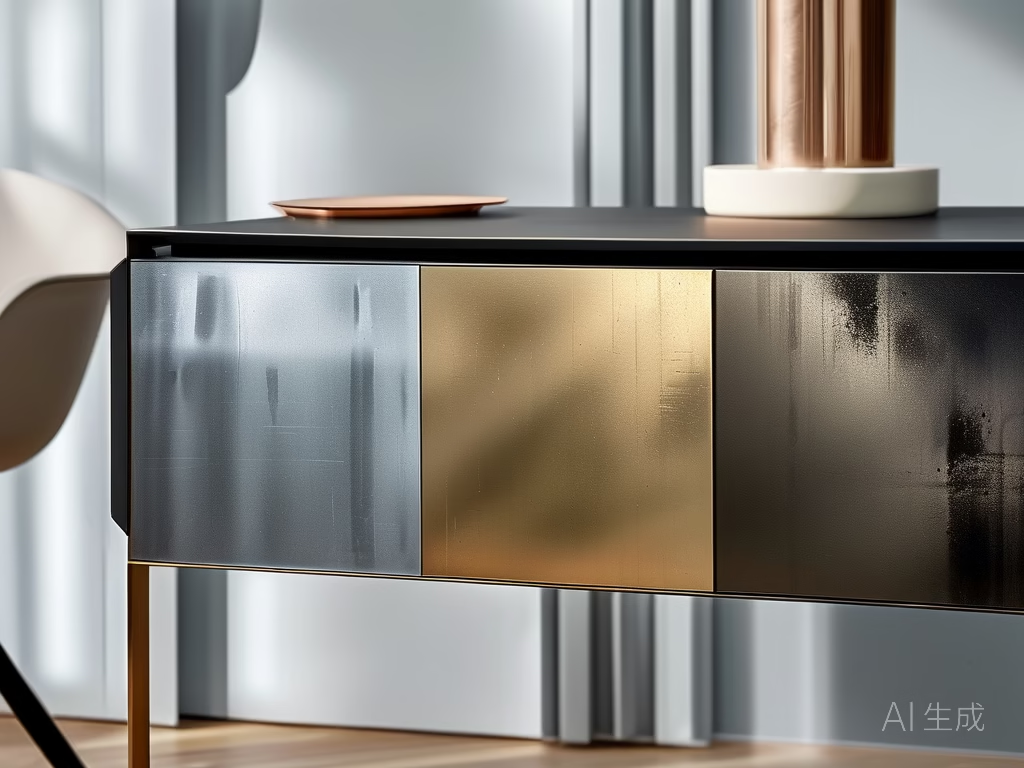
Anodizing and PVDF (polyvinylidene fluoride) coating are the two dominant finishes specified for aluminium curtain wall and rivestimento a rivestimento systems in Europe. They are often presented as interchangeable options in a finish schedule, differentiated only by colour. In practice they are fundamentally different technologies with different failure modes, different maintenance regimes and different implications for the procurement programme. A specifier who selects on colour alone will eventually meet the consequences on site. This section sets out a fair, technically precise comparison across the parameters that actually drive performance and cost.
Appearance and Colour Range
PVDF coating systems are based on a fluoropolymer resin — typically a 70% PVDF resin content such as Kynar 500 or Hylar 5000 — pigmented with inorganic and ceramic pigments and applied as a liquid or powder coating. Because the colour is carried by pigments dispersed in a resin binder, the achievable palette is effectively unlimited. Any RAL, NCS or bespoke colour can be matched, subject only to pigment availability and the limits of the coating line. Critically, colour matching between batches is tight: modern coil and spray lines control film thickness and pigment dispersion to a tolerance that makes adjacent production batches visually indistinguishable. For a project requiring a specific corporate colour, a bright accent shade, or a precise metallic, a PVDF finish is generally the only viable route.
Anodizing is not a coating in the conventional sense. It is an electrochemical conversion of the aluminium surface itself into an aluminium oxide layer, typically 15–25 µm thick for architectural work. Colour is introduced either as an integral dye during the anodizing process or by electrolytic colouring using metallic salts, which deposits colour within the porous oxide structure. The available palette is therefore constrained. Natural or clear anodizing gives the familiar silver-grey metallic appearance. Beyond that, the realistic architectural range is limited to bronze and dark bronze, champagne, mid and dark greys, and near-black tones. Bright whites, saturated reds, blues and greens are not achievable. A specifier working to a specific RAL reference should accept at the outset that anodizing cannot deliver it.
The more serious practical issue is batch-to-batch colour variation. Anodizing colour depends on alloy composition, process chemistry, immersion time, current density and the temperature of the electrolyte bath. Small differences in any of these parameters shift the resulting tone. Two anodizing batches of nominally the same specification can differ perceptibly when viewed side by side in the same facade plane. This is not a manufacturing defect; it is inherent to the process. The consequence for procurement is unequivocal: all anodized panels required for a visually continuous elevation must be produced in a single anodizing batch, or at minimum a batch that has been physically matched and approved as a set. Where this is not possible, the specification should deliberately introduce panel-to-panel variation as a design intent, or accept that colour consistency cannot be guaranteed. Where panels are produced in different batches, an approved sample comparison under the project lighting conditions is essential before fabrication is released.
Colour Stability and Fading
Both finishes perform well over a 20–30 year service life, but their degradation mechanisms are entirely different, and this determines how each should be tested and specified.
PVDF coatings degrade primarily through deterioration of the organic resin binder and pigment breakdown. The visible symptoms are chalking — a powdery surface residue of degraded resin — and fading, where the pigments lose intensity. The presence of 70% PVDF resin is the key reason these coatings resist this degradation far better than polyester or polyurethane systems. For high-performance architectural work the relevant standards are AAMA 2605 in North America and EN 13523 in Europe, with the RAL-GZ 428/620 and Qualicoat Class 3 certification schemes providing equivalent European frameworks. Colour change is quantified as Delta E, the measured colour difference between an exposed sample and an unexposed control. A well-formulated PVDF system meeting AAMA 2605 typically achieves Delta E below 5 after ten years of South Florida exposure, with chalking held to a rating of 8 or better on a scale of 10.
Anodized surfaces cannot fade in the conventional sense, because the colour is integral to the metal and not a pigment in a binder. There is no resin to chalk and no organic dye to bleach out. The colour is, in effect, permanent. This is a genuine and often understated advantage of anodizing. However, anodizing is not entirely stable. The surface can undergo a slight colour shift over time as the oxide layer is affected by weathering, and the underlying alloy may show through differentially in areas of differing exposure. On darker electrolytically coloured finishes, extended UV exposure can produce a measurable but usually minor lightening. Anodized surfaces also show handling and fingerprint marks more readily than coated surfaces, because the oxide layer is relatively receptive to oils and contaminants; these are usually removable with appropriate cleaning, but they can appear alarming on newly installed facades and should be addressed in a defined cleaning regime. In short, anodizing is not a fading risk but it is a marking and handling risk.
Scratch and Abrasion Behaviour
The anodic oxide layer is harder than any organic coating. Anodized architectural surfaces typically reach 200–400 on the Vickers scale depending on alloy and process conditions, against a PVDF film hardness of around 20–40. In pure abrasion terms, anodizing wins. It resists the light mechanical damage of cleaning brushes, airborne grit and normal site contact that would progressively dull a coated surface.
The critical distinction, and the one most often misunderstood, is how each finish looks once it is damaged. On an anodized panel, the colour layer is extremely thin. Electrolytic colour is deposited into only the upper few micrometres of the oxide, and the coloured layer may represent less than 10% of the total oxide depth. When that layer is broken by a scratch or abrasion, the exposed material beneath is bright, uncoloured aluminium. The result is a high-contrast metallic scar that stands out sharply against a dark anodized finish and cannot be disguised. A single deep scratch on a dark bronze or black anodized panel is immediately visible from ground level. On a PVDF coated panel, a scratch removes the coating and exposes either the primer layer or the bare aluminium beneath. The colour contrast depends on the substrate: on a steel-grey or silver PVDF, the exposed metal may be close in tone and the damage relatively inconspicuous; on a dark or saturated colour, the exposed primer or metal will be clearly visible. The important difference is that a PVDF scratch is a candidate for localised repair, whereas an anodized scratch is not.
Corrosion and Marine Performance
Both finishes provide excellent corrosion protection for aluminium, but by different means. The anodic oxide layer is a hard, dense, electrically insulating ceramic barrier that is integral to the metal. It will not delaminate, because there is no interface between coating and substrate to fail. Under the right conditions it is the most durable of all architectural finishes. Its weakness is at cut edges, crevices and fixings, where the barrier is interrupted and where acidic or chloride-rich environments can initiate pitting. Anodized aluminium performs well in marine atmospheres provided the surface is regularly cleaned to remove chloride deposits; where salt accumulates and is not washed off, pitting can develop.
PVDF coatings protect aluminium by sealing the substrate and keeping moisture and chloride ions away from the metal surface. The resin itself is highly resistant to chemical attack and UV degradation, and the coating will tolerate the same marine and industrial environments. The principal vulnerabilities are at cut edges — where the coating does not fully wrap the section — and at fixings and joints, where mechanical damage can breach the film. Where coating integrity is maintained, PVDF performs excellently in coastal and industrial atmospheres. Where coatings are specified for these environments, a minimum film thickness of 40–60 µm for a three-coat system and careful specification of edge coverage and touch-up procedures are essential. Neither finish should be specified for a severe marine environment without a defined cleaning regime, and neither is a substitute for correct drainage, isolation of dissimilar metals and avoidance of crevice conditions in the detail design.
cURL Too many subrequests by single Worker invocation. To configure this limit, refer to https://developers.cloudflare.com/workers/wrangler/configuration/#limits
On a like-for-like basis, anodizing is generally less expensive per square metre than a three-coat PVDF system applied to the same extruded or sheet panel. The process has fewer stages, fewer material inputs and a lower rejection rate on colour matching. For a large, single-colour, standard-profile project in a bronze or grey anodized finish, the saving can be material and the finish is a commercially rational choice.
However, the headline cost comparison is misleading unless the whole life of the project is included. The limitations of anodizing carry their own costs. If the project design calls for a specific RAL colour, an accented elevation, or a bright metallic, anodizing cannot deliver it and the specification must change. If the design cannot be fabricated within a single anodizing batch, the procurement strategy must absorb the cost of staged fabrication, extended programme and batch matching. If the facade will be subject to heavy site traffic or is likely to require localised damage repair during construction, the inability to repair anodizing on site becomes a real cost, not a theoretical one. On a PVDF facade, a scratched panel can often be touched up in situ; on an anodized facade, the same scratch requires the panel to be replaced, which means remobilising access, ordering a replacement from a matched batch, and accepting the risk that the replacement panel does not match its neighbours. The total cost of ownership therefore depends heavily on the design intent and the site environment, not simply on the coating price.
Touch-Up and Repair
PVDF coatings can be repaired on site, within limits. Shallow scratches can be touched up with a matching air-drying repair paint, which is normally supplied by the coater as part of the finish package. The repair is not a perfect match to a factory-applied, oven-cured fluoropolymer film — the touch-up material does not achieve the same cross-linking or the same durability — but for minor damage at height, or on an isolated panel in a large installation, a well-executed touch-up is a practical and visually acceptable solution. Deeper damage to the substrate requires panel replacement, but the routine scratches and scuffs that occur during installation and service life can usually be managed without removing panels.
Anodizing essentially cannot be spot-repaired. The finish is an integral conversion layer; there is no paint to apply and no way to rebuild the oxide, colour and seal on site. Localised mechanical repair, chemical repair or overpainting will all be visible because an anodized surface is a single continuous metallic finish with no tolerance for patch repair. The practical consequence is that a damaged anodized panel is a replacement item. The specifier should therefore consider, at design stage, whether the project is likely to suffer installation damage or later physical damage — on high-traffic elevations, low-level cladding, or building entrances — and whether the client is willing to accept the replacement cost and the risk of a colour mismatch on replacement panels. Where these risks are significant, a PVDF finish offers a materially better repair proposition.
Lead Time and Minimum Order Quantity
Both finishes are produced to order and both are subject to lead times of several weeks, but their scheduling constraints differ. PVDF coating is typically carried out on a continuous coil line or in a batch spray line. Once a colour is set up, panels of that colour can be produced across multiple runs and the finish remains consistent, which gives the coater flexibility to stage production without colour risk. The minimum order quantity is generally driven by the practical setup of the line rather than by colour-matching concerns, and repeat orders can be made at intervals with confidence that the colour will match.
Anodizing is more sensitive to batch scheduling. Because colour varies between batches, and because a visually continuous facade requires a single batch, the anodizing programme becomes a critical path item. The specifier must ensure that the anodizer is briefed on the total panel quantity and the visual continuity requirement, and that the full quantity is reserved within one batch. If the project is phased, if quantities are increased mid-project, or if replacement panels are required later, the later material will not match the original batch precisely. Anodizing batches also have a practical minimum, and small quantities of a specific colour, particularly a dark or electrolytically coloured finish, may be uneconomic or unavailable unless they are combined with a larger run. For a phased project, an anodized finish demands a far more disciplined procurement approach and a willingness to accept either a single-batch commitment or a deliberate variation strategy. Where programme flexibility matters, PVDF is the more forgiving specification.
Summary Comparison
| Parametro | Anodizzato | PVDF Coated |
|---|---|---|
| Appearance / colour range | Natural, clear, bronze, champagne, grey and black tones; no bright or saturated colours; batch-to-batch variation is a real risk | Effectively unlimited RAL, NCS and bespoke palette; tightly matched batches |
| Colour stability | Cannot fade; colour is integral to the metal. May shift slightly with weathering; susceptible to fingerprint and handling marks | Excellent; degrades via resin chalking and pigment fade, measured as Delta E under AAMA 2605 / EN 13523 |
| Hardness | Very hard (typically 200–400 Vickers); most abrasion-resistant finish | Soft relative to anodic oxide (approx. 20–40 Vickers); abrasion dulls the surface over time |
| cURL Too many subrequests by single Worker invocation. To configure this limit, refer to https://developers.cloudflare.com/workers/wrangler/configuration/#limits | cURL Too many subrequests by single Worker invocation. To configure this limit, refer to https://developers.cloudflare.com/workers/wrangler/configuration/#limits | cURL Too many subrequests by single Worker invocation. To configure this limit, refer to https://developers.cloudflare.com/workers/wrangler/configuration/#limits |
| cURL Too many subrequests by single Worker invocation. To configure this limit, refer to https://developers.cloudflare.com/workers/wrangler/configuration/#limits | cURL Too many subrequests by single Worker invocation. To configure this limit, refer to https://developers.cloudflare.com/workers/wrangler/configuration/#limits | cURL Too many subrequests by single Worker invocation. To configure this limit, refer to https://developers.cloudflare.com/workers/wrangler/configuration/#limits |
| cURL Too many subrequests by single Worker invocation. To configure this limit, refer to https://developers.cloudflare.com/workers/wrangler/configuration/#limits | cURL Too many subrequests by single Worker invocation. To configure this limit, refer to https://developers.cloudflare.com/workers/wrangler/configuration/#limits | cURL Too many subrequests by single Worker invocation. To configure this limit, refer to https://developers.cloudflare.com/workers/wrangler/configuration/#limits |
| cURL Too many subrequests by single Worker invocation. To configure this limit, refer to https://developers.cloudflare.com/workers/wrangler/configuration/#limits | cURL Too many subrequests by single Worker invocation. To configure this limit, refer to https://developers.cloudflare.com/workers/wrangler/configuration/#limits | cURL Too many subrequests by single Worker invocation. To configure this limit, refer to https://developers.cloudflare.com/workers/wrangler/configuration/#limits |
| cURL Too many subrequests by single Worker invocation. To configure this limit, refer to https://developers.cloudflare.com/workers/wrangler/configuration/#limits | cURL Too many subrequests by single Worker invocation. To configure this limit, refer to https://developers.cloudflare.com/workers/wrangler/configuration/#limits | cURL Too many subrequests by single Worker invocation. To configure this limit, refer to https://developers.cloudflare.com/workers/wrangler/configuration/#limits |
cURL Too many subrequests by single Worker invocation. To configure this limit, refer to https://developers.cloudflare.com/workers/wrangler/configuration/#limits
cURL Too many subrequests by single Worker invocation. To configure this limit, refer to https://developers.cloudflare.com/workers/wrangler/configuration/#limits
cURL Too many subrequests by single Worker invocation. To configure this limit, refer to https://developers.cloudflare.com/workers/wrangler/configuration/#limits
cURL Too many subrequests by single Worker invocation. To configure this limit, refer to https://developers.cloudflare.com/workers/wrangler/configuration/#limits
cURL Too many subrequests by single Worker invocation. To configure this limit, refer to https://developers.cloudflare.com/workers/wrangler/configuration/#limitscURL Too many subrequests by single Worker invocation. To configure this limit, refer to https://developers.cloudflare.com/workers/wrangler/configuration/#limitscURL Too many subrequests by single Worker invocation. To configure this limit, refer to https://developers.cloudflare.com/workers/wrangler/configuration/#limits
The oxide thickness class drives both durability and cost, and the class must be matched to exposure. Class 15 (minimum 15 µm local thickness) is a reasonable minimum for internal or fully sheltered applications. Class 20 is the usual default for exterior curtain wall in temperate European conditions. Class 25 should be specified for severe exposure — marine atmospheres with significant chloride loading, industrial or heavily polluted environments, and any elevation where the surface will be cleaned aggressively or handled frequently. The distinction between local thickness and average thickness matters commercially: EN ISO 7599 measures local thickness at defined points, and a supplier quoting an average figure can pass a class on paper while delivering thin patches at edges and low-current-density zones. Require the specification to state local minimum, not average.
Two further coating properties belong in the same clause. The coating must be uniform in appearance, free from visible defects such as blotches, streaks, pitting, and burn marks, and it must meet a specified abrasion resistance where the panels are subject to regular contact cleaning. Film hardness and abrasion resistance are separate from thickness and do not follow automatically from it; a correctly thick but poorly formed coating can still chalk and scratch.
Specify the Alloy and Temper, Not Just the Finish
Anodizing quality is dominated by metallurgy, and alloy selection is the single most common source of disappointing colour. The anodic film grows from the aluminium substrate and is transparent; what the observer sees is largely the substrate beneath it, together with the light-scattering characteristics of the film. Consequently, alloying elements that form coarse second-phase particles or that dissolve preferentially during anodizing produce a dark, muddy, uneven appearance that no amount of process control can correct.
For sheet panels, the classic anodizing alloys are 5005 and 5657. Both are low-magnesium, low-iron, low-silicon alloys produced specifically for bright, clear anodizing, and both give the clean metallic appearance expected on a visible facade. 5657 offers the higher clarity of the two and is the appropriate choice for the most visually demanding flat panel work. 5005 is more widely available, marginally more robust in handling, and is the pragmatic default for large facade runs. For extrusions — mullions, transoms, cappings, and framing members — 6063 is the standard anodizing extrusion alloy and anodizes to a consistent, acceptable appearance provided the billet chemistry is controlled and the extrusion surface is not damaged.
Alloys to avoid for visible work include the high-copper 2xxx series (notably 2024) and the high-silicon 4xxx series and cast alloys. Copper is the most damaging common addition: even a few tenths of a percent produces a distinctly grey, dull coating, and copper-rich phases promote uneven film growth and localised darkening. High-silicon alloys behave similarly, and silicon-containing castings anodize to an unattractive grey-brown. 6061, common in structural extrusions, contains magnesium and silicon with a copper allowance and will anodize noticeably darker and less clear than 6063 — acceptable where the member is not visually exposed, unacceptable where it is. Where painted and anodized components meet on the same element, the alloy difference must be resolved at the mock-up stage; a 6061 bracket anodized alongside 6063 framing will read as a different colour.
The temper also matters. Specify the temper explicitly (typically H14, H24, or H112 depending on the product) because mechanical properties, flatness, and surface response to anodizing all vary with temper, and because a supplier substituting a different temper to meet a delivery date is a common and avoidable source of variation.
Manage Batch Colour
Anodized colour is a function of alloy chemistry, film thickness, electrolyte composition and temperature, current density, and sealing. It is not a paint colour and cannot be matched by mixing pigment. Two anodizing batches of the same alloy on the same line to the same nominal specification can differ perceptibly, and the difference is most evident on large areas viewed at an angle.
The specification must therefore control batching contractually. The requirement is straightforward: all panels for a single facade elevation, and preferably for the whole project, must be anodized in one continuous batch or in batches produced consecutively from the same electrolyte under the same process parameters. Where the quantity exceeds the capacity of one batch, the buyer should require that batch boundaries fall at construction joints, spandrel zones, or elevation changes, so that any residual difference is concealed by architecture rather than exposing itself. A written batch-consistency guarantee should be a condition of the order, not a courtesy.
The colour reference must be a physical master sample agreed at the mock-up stage. Catalogue swatches are printed, coated, or drawn from an unrelated production run, and they are the wrong artefact on which to base a facade approval. The correct sequence is: manufacture a full-scale mock-up panel from the specified alloy and temper, anodize it as production will be anodized, seal it, and have the architect and client approve that physical panel. That panel then becomes the contract reference, and panels may be rejected by comparison against it. Retaining the approved master sample under controlled conditions, and keeping it available for comparison at delivery, is essential; an unretained master sample is an unenforceable one.
Specify the Seal Type and Require a Sealing-Quality Test
Sealing closes the porous structure of the anodic film and is the step that determines long-term weathering performance. An inadequately sealed coating retains the open columnar pore structure, which allows moisture, pollutants, and cleaning agents to penetrate to the substrate, producing corrosion, staining, and chalking of the film itself. Sealing failures are not visible at delivery and are typically discovered years later, at which point they are irremediable other than by removal of the panels.
The specification should state the sealing method permitted (hot sealing in deionised water, or cold sealing with a nickel-fluoride seal, with hot sealing generally preferred for exterior architectural work) and should require a sealing-quality test on the production batch. The recognised tests are the acid dissolution test (also known as the loss-of-mass test, in which the coating mass loss after immersion in a phosphoric acid and chromic acid solution must fall below a defined limit) and the dye stain test, in which an acid dye is applied to the surface and residual staining indicates incomplete sealing. EN ISO 7599 includes the acid dissolution method and the dye stain method in its annexes, and the specification should cite the applicable test and the acceptance criterion by reference to the standard. A sealing test report per batch, not per project, is the correct requirement: a single report covering a whole order can conceal the one poorly sealed batch that causes the problem.
Handle the “Natural Variation” Expectation Before Approval
Anodized surfaces are metallic and anisotropic. Because the film is transparent and light interacts with the substrate microstructure, the apparent colour and brightness change with viewing angle, with the direction of incident light, and with panel orientation relative to the rolling direction of the sheet. This is not a defect; it is the visual character of the finish, and it is the principal reason that clients who expected a uniform painted appearance reject anodized facades.
The only reliable way to manage this expectation is a full-scale mock-up. A small swatch cannot reproduce the effect, because viewing angle and reflected area scale with size, and because the angular read of a small sample under showroom lighting bears no relation to the appearance of a two-metre panel viewed from ground level. The mock-up should be the full panel size and construction actually specified, ideally mounted on site or in a representative orientation, and it should be viewed in a range of daylight conditions, including low sun angles where anisotropic effects are most pronounced. Approval should be given against the mock-up on this basis, with the expectation of natural directional variation explicitly acknowledged in writing so it cannot later be treated as non-conformance.
Protect and Handle the Panels Through Fabrication and Installation
The anodic film is hard but thin and can be damaged by mechanical impact, abrasion, and chemical attack. Protective peel film applied by the anodizer should be specified for visible surfaces, with a defined film type and a maximum permitted adhesion time, since some films leave residue or become difficult to remove if left in place beyond the manufacturer’s stated period, particularly in sunlight. Removal should be instructed to occur promptly after installation and not after weeks of site exposure.
Alkaline attack is the most common chemical damage. Cement, mortar, and lime-based materials are alkaline, and wet mortar or mortar splash will etch the oxide film, leaving permanent dull patches and, in severe cases, removing the coating. Panels must be masked or otherwise protected during brickwork and rendering, and any mortar contact must be removed immediately with copious clean water, not with acid cleaners, which attack the film from the opposite direction. Acidic cleaners, strong alkalis, abrasive pads, and chloride-containing cleaning agents should be prohibited. Where cleaning is required, the specification should state a pH-neutral cleaning regime and a method of test for cleaning products on a sample panel before site use.
Galvanic corrosion requires attention wherever anodized aluminium comes into contact with dissimilar metals, and this is a critical issue in coastal environments. Direct contact with stainless steel, copper, brass, or galvanised steel in the presence of moisture and chlorides drives galvanic attack that damages both the film and the substrate. The specification should require isolation at every dissimilar-metal interface using insulating tape, gaskets, nylon washers, or coated fasteners, and should require that fixings and brackets in contact with the aluminium be compatible or isolated. In coastal locations, fixings should be stainless steel of an appropriate grade, isolated from the aluminium, and consideration given to the chloride exposure class when the coating thickness class is set.
What to Require in the Inspection Documents
Documentation is the mechanism by which the specification is verified. The buyer should require the following to be supplied before shipment, and should make payment or delivery against their receipt:
Mill certificates for the aluminium sheet and extrusions, stating alloy and temper and demonstrating conformity with the specified designations. These confirm that the correct metallurgy was used and are the first check against substitution of a cheaper, poorer-anodizing alloy.
Coating thickness readings taken in accordance with the standard, reported as local values at defined measurement points across each panel, not as a single average per batch. Eddy-current gauges are typically used; the report should state the instrument, the number of readings, and the acceptance criterion.
Sealing test reports for each anodizing batch, citing the test method and the measured result against the acceptance limit. Acid dissolution results should be reported as mass loss per unit area with the limit stated.
Batch records linking each delivered panel to its anodizing batch, so that any panel can be traced back to the process parameters under which it was produced and so that batch boundaries within the delivery are known and can be checked against the agreed elevation divisions.
Appearance conformance against the approved master sample, with a statement that the delivered panels have been compared to the retained master sample under defined illumination.
Requiring these documents costs little and converts a series of unverifiable verbal assurances into an auditable record. Where a supplier resists providing batch-level sealing data or local thickness readings, that resistance is itself informative.
Specification Items and the Cost of Leaving Them Vague
| cURL Too many subrequests by single Worker invocation. To configure this limit, refer to https://developers.cloudflare.com/workers/wrangler/configuration/#limits | cURL Too many subrequests by single Worker invocation. To configure this limit, refer to https://developers.cloudflare.com/workers/wrangler/configuration/#limits | cURL Too many subrequests by single Worker invocation. To configure this limit, refer to https://developers.cloudflare.com/workers/wrangler/configuration/#limits |
|---|---|---|
| cURL Too many subrequests by single Worker invocation. To configure this limit, refer to https://developers.cloudflare.com/workers/wrangler/configuration/#limits | cURL Too many subrequests by single Worker invocation. To configure this limit, refer to https://developers.cloudflare.com/workers/wrangler/configuration/#limits | cURL Too many subrequests by single Worker invocation. To configure this limit, refer to https://developers.cloudflare.com/workers/wrangler/configuration/#limits |
| cURL Too many subrequests by single Worker invocation. To configure this limit, refer to https://developers.cloudflare.com/workers/wrangler/configuration/#limits | cURL Too many subrequests by single Worker invocation. To configure this limit, refer to https://developers.cloudflare.com/workers/wrangler/configuration/#limits | cURL Too many subrequests by single Worker invocation. To configure this limit, refer to https://developers.cloudflare.com/workers/wrangler/configuration/#limits |
| cURL Too many subrequests by single Worker invocation. To configure this limit, refer to https://developers.cloudflare.com/workers/wrangler/configuration/#limits | cURL Too many subrequests by single Worker invocation. To configure this limit, refer to https://developers.cloudflare.com/workers/wrangler/configuration/#limits | cURL Too many subrequests by single Worker invocation. To configure this limit, refer to https://developers.cloudflare.com/workers/wrangler/configuration/#limits |
| cURL Too many subrequests by single Worker invocation. To configure this limit, refer to https://developers.cloudflare.com/workers/wrangler/configuration/#limits | cURL Too many subrequests by single Worker invocation. To configure this limit, refer to https://developers.cloudflare.com/workers/wrangler/configuration/#limits | cURL Too many subrequests by single Worker invocation. To configure this limit, refer to https://developers.cloudflare.com/workers/wrangler/configuration/#limits |
| cURL Too many subrequests by single Worker invocation. To configure this limit, refer to https://developers.cloudflare.com/workers/wrangler/configuration/#limits | cURL Too many subrequests by single Worker invocation. To configure this limit, refer to https://developers.cloudflare.com/workers/wrangler/configuration/#limits | cURL Too many subrequests by single Worker invocation. To configure this limit, refer to https://developers.cloudflare.com/workers/wrangler/configuration/#limits |
| cURL Too many subrequests by single Worker invocation. To configure this limit, refer to https://developers.cloudflare.com/workers/wrangler/configuration/#limits | cURL Too many subrequests by single Worker invocation. To configure this limit, refer to https://developers.cloudflare.com/workers/wrangler/configuration/#limits | cURL Too many subrequests by single Worker invocation. To configure this limit, refer to https://developers.cloudflare.com/workers/wrangler/configuration/#limits |
| cURL Too many subrequests by single Worker invocation. To configure this limit, refer to https://developers.cloudflare.com/workers/wrangler/configuration/#limits | Written acknowledgement of natural metallic directional variation; approval against full-size panel viewed in daylight, not a small swatch. | Client rejects the facade for a characteristic inherent to anodizing; contractual dispute; retrofit solution impossible without recoating or replacement. |
| Surface protection | Peel film type and maximum adhesion time specified; removal instructed promptly after installation. | Mechanical scratching and abrasion in transit and on site; adhesive residue or difficult removal after prolonged exposure. |
| Chemical exposure | Prohibition of alkaline mortar contact; immediate clean-water removal; pH-neutral cleaning regime only. | Mortar and render etch the oxide producing permanent dull patches and coating loss; acid cleaning compounds the damage. |
| Dissimilar metals | Isolation at all dissimilar-metal interfaces; compatible or isolated fasteners; grade stated for coastal exposure. | Galvanic corrosion at fixings and brackets, accelerated in chloride environments; localised coating and substrate damage, structural fixings affected. |
| Inspection documents | Mill certificates, local coating thickness readings, per-batch sealing test reports, batch traceability records, master-sample comparison statement. | No means of verifying compliance; substitution and process failures go undetected; no audit trail when defects appear later. |
The pattern across every row of that table is the same: the items that cost nothing to specify are the items whose omission is most expensive. An anodizing specification is not a statement of intent about a finish. It is a set of measurable requirements, a physical reference against which delivery is judged, and a documentary trail that makes the requirements enforceable. Buyers who state the standard, the class, the alloy, the batch rule, the seal, and the test — and who approve a full-size mock-up rather than a swatch — remove essentially all of the commercial risk that anodized facade work otherwise carries.
Where Anodized Facades Perform Best: Applications and Project Types
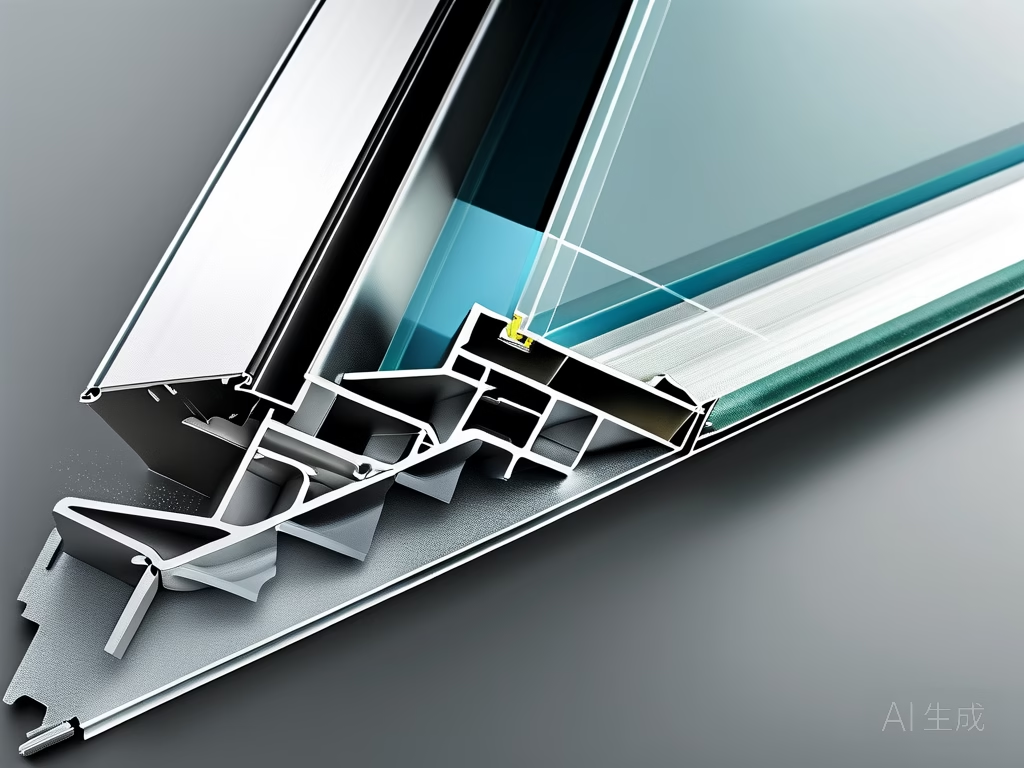
Finish selection on aluminium curtain wall is rarely decided by appearance alone. It is decided by the exposure class of the building, the maintenance regime the owner will actually operate, the colour tolerance the design demands, and the constructability of the system on site. Anodizing and PVDF (polyvinylidene fluoride) coil coating are both durable, both well established, and both capable of delivering service lives measured in decades. They are nevertheless not interchangeable, and the projects where one clearly outperforms the other can be identified with reasonable precision before a specification is written.
Where Anodizing Is the Strongest Choice
The defining characteristic of anodizing is that the protective layer is not applied to the aluminium — it is grown from it. The anodic oxide is formed by electrolytic conversion of the substrate itself, integrally bonded to the metal with no polymer interface and no distinct coating thickness that can be separated from the base material. The consequences of that structure drive nearly every application advantage.
In marine and coastal projects, this integral structure is decisive. A PVDF coating is an organic resin system, and organic resins are progressively attacked by ultraviolet radiation, airborne salt and chloride deposition. Degradation is slow and is normally expressed as chalking, gloss loss and colour drift rather than catastrophic failure, but it is progressive and irreversible. An anodic oxide contains no organic resin to be attacked by UV, salt or chloride; the oxide is an inorganic ceramic-like layer that is not subject to the same photochemical breakdown pathway. Equally important on a coast is mechanical damage. A coated panel that is scratched through the full coating thickness exposes bare aluminium at the defect, and because the coating is a barrier rather than a conversion layer, corrosion can propagate laterally beneath the film edge, causing blistering and lifting that spreads well beyond the original damage. An anodized surface has no coating to chip and expose bare metal, so localised abrasion produces a mark rather than an initiation site for filiform or undercutting corrosion. For buildings within roughly one kilometre of the shoreline, exposed to wind-driven salt spray, anodizing is frequently the more robust specification.
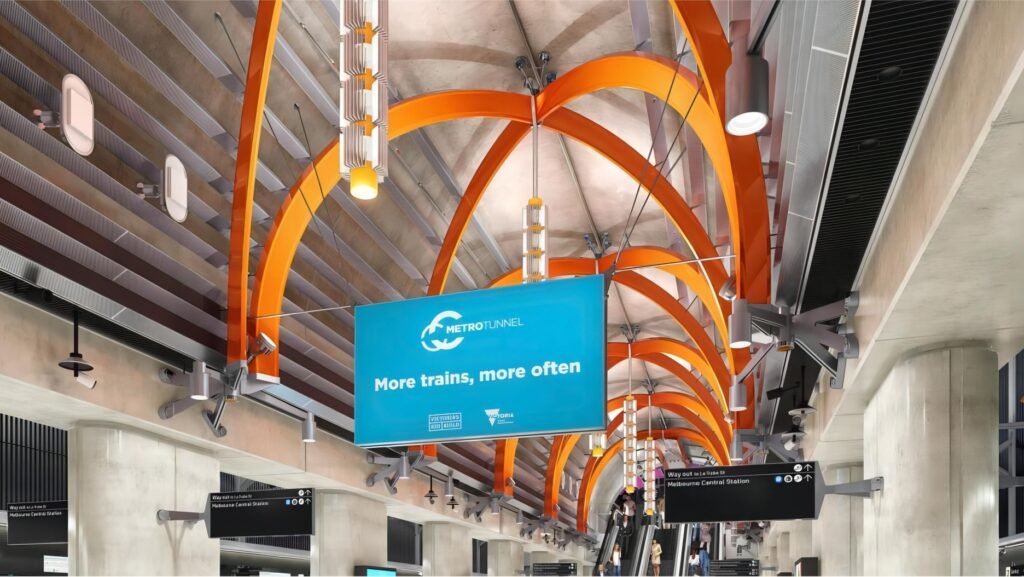
High-traffic ground-floor elevations and transport hubs present a different but related case. The lower three to four metres of a facade are subjected to pedestrian contact, trolley and luggage impact, cleaning abrasion and, in some locations, deliberate scratching. Anodized aluminium is a hard surface with good abrasion resistance, and its appearance is a function of the metal structure rather than a sacrificial film. Repeated cleaning does not thin a coating because there is no coating thickness to remove. In railway stations, metro concourses, bus interchanges and airport terminals, where the ground-level envelope is cleaned aggressively and frequently, this property translates into a facade that still reads as designed twenty years after handover rather than one with polished-through edges and visible wear patterns at contact height.
Interiors and covered atria exploit a different advantage. Where direct UV exposure is low, the principal argument for PVDF — its superior colour and gloss retention under solar radiation — largely disappears. What remains is the visual character of the material. Anodized aluminium has a metallic depth that a pigmented organic coating cannot replicate: the oxide is transparent, the light penetrates to the metal surface and returns through the layer, and the result is a satin or brushed metallic appearance with genuine directional response to light. For internal linings, atria soffits, covered circulation spaces, entrance halls and lift lobbies, this depth is frequently the reason anodizing appears in the specification at all. In these locations the finish is also protected from the weathering that would otherwise dominate the maintenance calculation.
Finally, anodizing is the appropriate specification whenever the project brief prioritises a long low-maintenance service life without repainting. A correctly specified anodized facade requires no decorative repainting cycle; maintenance is reduced to periodic cleaning with a suitable neutral or mildly acidic agent. Where a coated system might reasonably require a decorative refurbishment at fifteen to twenty-five years, anodizing does not. For owners of publicly funded assets, transport infrastructure and institutional buildings, the elimination of a repainting liability over the life of the building is a material whole-life cost benefit, not a marginal one.
Where PVDF Is the Better Call
This is not an argument that anodizing is universally superior. There are well-defined project conditions under which a PVDF coating is the correct and, in some cases, the only workable specification.
The first is colour. Anodizing colour is generated by the oxide structure and by dyes or pigments that are deposited within it. The achievable range is inherently narrower and less saturated than that of organic coatings, and it is dominated by the natural tones through champagne, bronze and black in their various depths. Where a project must match a precise corporate colour, or reproduce brand colours that are also carried on signage, wayfinding, cladding to a different substrate, vehicle livery or interior finishes, PVDF is generally the only route to a defensible match. RAL and other standard references can be specified in PVDF; they cannot be reproduced in anodic colour with equivalent precision. Where the design intent depends on the facade being the same colour as an adjacent element in a dissimilar material, the specification should be PVDF from the outset rather than left to a late-stage compromise.
The second is scale over time. Anodizing is a batch process, and colour within a batch is influenced by alloy composition, extrusion or rolling condition, electrolyte chemistry and process control. Batch-to-batch consistency is good under competent process control, but it is not perfect, and the variability is more perceptible in anodized finishes than in a pigmented coating because the appearance depends on the optical properties of the oxide layer rather than on a fixed pigment dispersion. On a very large multi-phase project where Building A is installed in one year and Building D three or four years later, precise colour matching across that interval becomes genuinely difficult, particularly in the mid-range bronzes and champagnes where small differences in oxide thickness and colour depth are readily visible at facade scale and in raking light. On such projects PVDF offers a much more stable basis for cross-phase consistency, because the coating system and pigment formulation can be held constant.
The third is repairability. Transport damage is a practical reality on any substantial project. PVDF-coated panels can be touched up on site with a matching air-drying repair material, and a competent operative can make a minor transit or installation mark visually acceptable within the constraints of a normal site visit. An anodized surface cannot be repaired in this way: there is no comparable site-applied material that reproduces the anodic finish, and a damaged panel must generally be replaced. Where the project is logistically difficult, where access for future replacement is constrained, or where the client’s operational requirements make intrusive panel replacement expensive, the availability of on-site remedial repair can be the deciding factor.
Anodized Panels in High-Rise and Unitized Systems
Anodized aluminium is fully compatible with unitized curtain wall construction, and the interaction between finish and system type is worth stating explicitly. In a unitized system, the panel is the visible outer skin of a factory-assembled cassette: the frame, glazing, gaskets, thermal breaks and the aluminium facing panel are combined into a sealed unit under factory conditions, with glazing and weather sealing completed before the unit leaves the plant. The panel itself may be a flat or profiled sheet, a pressure-equalised cassette, or a solid aluminium element; in each case the anodized surface is the outermost, visible layer of an assembly whose drainage and ventilation path lies behind it.
Because the unit is fabricated under factory control, the level of quality assurance that can be applied to the anodized skin is substantially higher than on a stick-built system, where aluminium members arrive on site and are assembled and sealed in the open. The anodized surface is protected through handling and packing, the panel geometry and its relationship to gaskets and sealant lines are controlled to tight tolerance, and there is no site cutting or drilling of the visible face that could damage the oxide or expose unprotected metal. Factory-controlled anodizing and fabrication is therefore not a preference but a requirement on high-specification unitized work: an anodized finish that is correct in the plant can be compromised by careless on-site modification, and once the oxide is cut through at a face or edge, there is no site remedy.
The oxide layer also plays a role in the performance of the drained and ventilated cavity behind the panel. The cavity is designed to manage incidental water penetration by draining it out and ventilating it to equalise pressure and allow drying. Aluminium in that cavity is wet intermittently and may be exposed to water that has carried contaminants from the outer face. The anodic oxide provides a coherent, chemically stable, electrically insulating surface on the metal, which limits the development of localised corrosion on what are often concealed and uninspectable components. Oxide continuity at cut edges and on fixings matters considerably here, which is why the specification should address whether concealed and cut surfaces are anodized or otherwise protected, and why fabrication practice — not only the finish on the visible face — should be written into the specification.
Coastal and High-Humidity Environments
Coastal specification deserves more specific guidance than a general instruction to use anodizing. Where the building is within the salt-spray zone, the higher oxide classes — Class 20 and Class 25 in the European designation, corresponding to nominal anodic oxide film thicknesses of 20 µm and 25 µm — should be specified for external exposed surfaces. Class 20 is the practical minimum for external exposure in normal urban and inland conditions; Class 25 is appropriate for severe marine exposure, for surfaces that will not be readily accessible for cleaning, and for high-value facades where the additional film thickness provides a greater reserve against progressive thinning and environmental attack. Film thickness should be specified as a minimum average value with a stated minimum local value, and verified by eddy-current measurement, rather than accepted as a nominal figure.
Cleaning practice is a common and avoidable cause of premature degradation on coastal anodized facades. Alkaline cleaning agents attack the anodic oxide and should not be used on anodized surfaces. Abrasive cleaners, scouring pads and strong acids produce similar damage. The specification and the building’s maintenance manual should both require cleaning with a neutral or mildly acidic agent, followed by thorough rinsing with clean water — on a coastal site, rinsing is the operation that actually removes the chloride deposit, and a cleaning regime that does not rinse adequately leaves the contaminants in place. Cleaning frequency on a marine site should be higher than the inland default, both to remove chloride deposits and to prevent the accumulation of atmospheric grime that holds moisture against the surface.
The third coastal requirement is galvanic isolation. Aluminium has a strongly negative position in the galvanic series, and when it is in direct metallic contact with steel or stainless steel in the presence of an electrolyte — which, on a coastal site, is effectively always — a galvanic couple is formed and the aluminium becomes the anode and corrodes preferentially. Fixings, brackets, cleats and any contact between aluminium framing and steel structure must be isolated with an appropriate isolating washer, gasket or separating tape, and the correct grade of fastener and any required barrier coating must be specified. Cavity surfaces where aluminium components are in permanent or intermittent contact with dissimilar metals are particularly vulnerable, because the joint retains moisture and is not accessible for inspection.
cURL Too many subrequests by single Worker invocation. To configure this limit, refer to https://developers.cloudflare.com/workers/wrangler/configuration/#limits
cURL Too many subrequests by single Worker invocation. To configure this limit, refer to https://developers.cloudflare.com/workers/wrangler/configuration/#limits
cURL Too many subrequests by single Worker invocation. To configure this limit, refer to https://developers.cloudflare.com/workers/wrangler/configuration/#limits
cURL Too many subrequests by single Worker invocation. To configure this limit, refer to https://developers.cloudflare.com/workers/wrangler/configuration/#limits
cURL Too many subrequests by single Worker invocation. To configure this limit, refer to https://developers.cloudflare.com/workers/wrangler/configuration/#limits
cURL Too many subrequests by single Worker invocation. To configure this limit, refer to https://developers.cloudflare.com/workers/wrangler/configuration/#limits
cURL Too many subrequests by single Worker invocation. To configure this limit, refer to https://developers.cloudflare.com/workers/wrangler/configuration/#limits
| cURL Too many subrequests by single Worker invocation. To configure this limit, refer to https://developers.cloudflare.com/workers/wrangler/configuration/#limits | cURL Too many subrequests by single Worker invocation. To configure this limit, refer to https://developers.cloudflare.com/workers/wrangler/configuration/#limits | cURL Too many subrequests by single Worker invocation. To configure this limit, refer to https://developers.cloudflare.com/workers/wrangler/configuration/#limits | cURL Too many subrequests by single Worker invocation. To configure this limit, refer to https://developers.cloudflare.com/workers/wrangler/configuration/#limits |
|---|---|---|---|
| cURL Too many subrequests by single Worker invocation. To configure this limit, refer to https://developers.cloudflare.com/workers/wrangler/configuration/#limits | cURL Too many subrequests by single Worker invocation. To configure this limit, refer to https://developers.cloudflare.com/workers/wrangler/configuration/#limits | cURL Too many subrequests by single Worker invocation. To configure this limit, refer to https://developers.cloudflare.com/workers/wrangler/configuration/#limits | cURL Too many subrequests by single Worker invocation. To configure this limit, refer to https://developers.cloudflare.com/workers/wrangler/configuration/#limits |
| cURL Too many subrequests by single Worker invocation. To configure this limit, refer to https://developers.cloudflare.com/workers/wrangler/configuration/#limits | cURL Too many subrequests by single Worker invocation. To configure this limit, refer to https://developers.cloudflare.com/workers/wrangler/configuration/#limits | Class 20 | cURL Too many subrequests by single Worker invocation. To configure this limit, refer to https://developers.cloudflare.com/workers/wrangler/configuration/#limits |
| cURL Too many subrequests by single Worker invocation. To configure this limit, refer to https://developers.cloudflare.com/workers/wrangler/configuration/#limits | Anodizzato | cURL Too many subrequests by single Worker invocation. To configure this limit, refer to https://developers.cloudflare.com/workers/wrangler/configuration/#limits | cURL Too many subrequests by single Worker invocation. To configure this limit, refer to https://developers.cloudflare.com/workers/wrangler/configuration/#limits |
| cURL Too many subrequests by single Worker invocation. To configure this limit, refer to https://developers.cloudflare.com/workers/wrangler/configuration/#limits | cURL Too many subrequests by single Worker invocation. To configure this limit, refer to https://developers.cloudflare.com/workers/wrangler/configuration/#limits | Class 15 to 20 | Low UV exposure allows metallic depth to be exploited without colour-retention penalty |
| Corner or feature with precise corporate or signage-matched colour | PVDF | Not applicable | Anodic colour range cannot reproduce a specified brand colour to acceptable tolerance |
| Multi-phase development, phases separated by several years | PVDF | Not applicable | Batch consistency across long intervals is not achievable in anodizing at facade scale |
| Project requiring on-site repair of transport or installation damage | PVDF | Not applicable | Coated panels accept site touch-up; anodized damage requires panel replacement |
| High-rise unitized curtain wall, factory-assembled cassettes | cURL Too many subrequests by single Worker invocation. To configure this limit, refer to https://developers.cloudflare.com/workers/wrangler/configuration/#limits | Class 20 to 25 per exposure | Factory control protects face, edges and cut surfaces; oxide provides stable cavity surface |
| Refurbishment matching an existing aged anodized facade | Anodized, matched by mock-up | Match existing class, minimum Class 20 | Colour match to weathered oxide is only defensible through full-scale mock-up approval |
| Parking structure, multi-storey car park | Anodizzato | cURL Too many subrequests by single Worker invocation. To configure this limit, refer to https://developers.cloudflare.com/workers/wrangler/configuration/#limits | Aggressive chloride and exhaust exposure with low cleaning frequency; no repainting possible |
The pattern that emerges is straightforward. Anodizing is strongest where exposure is chemically aggressive or mechanically abusive, where the metallic character of the material is the design intent, and where the owner has committed to a low-maintenance, no-repaint operating model. PVDF is strongest where colour precision, cross-phase consistency or site repairability are the binding constraints. Where two or more of those constraints apply simultaneously — a coastal multi-phase development requiring an exact brand colour, for example — the specification should resolve the conflict explicitly and early, because it cannot be resolved by compromise after the panel order is placed.
Getting a Verifiable Anodized Panel Quotation from a Supplier
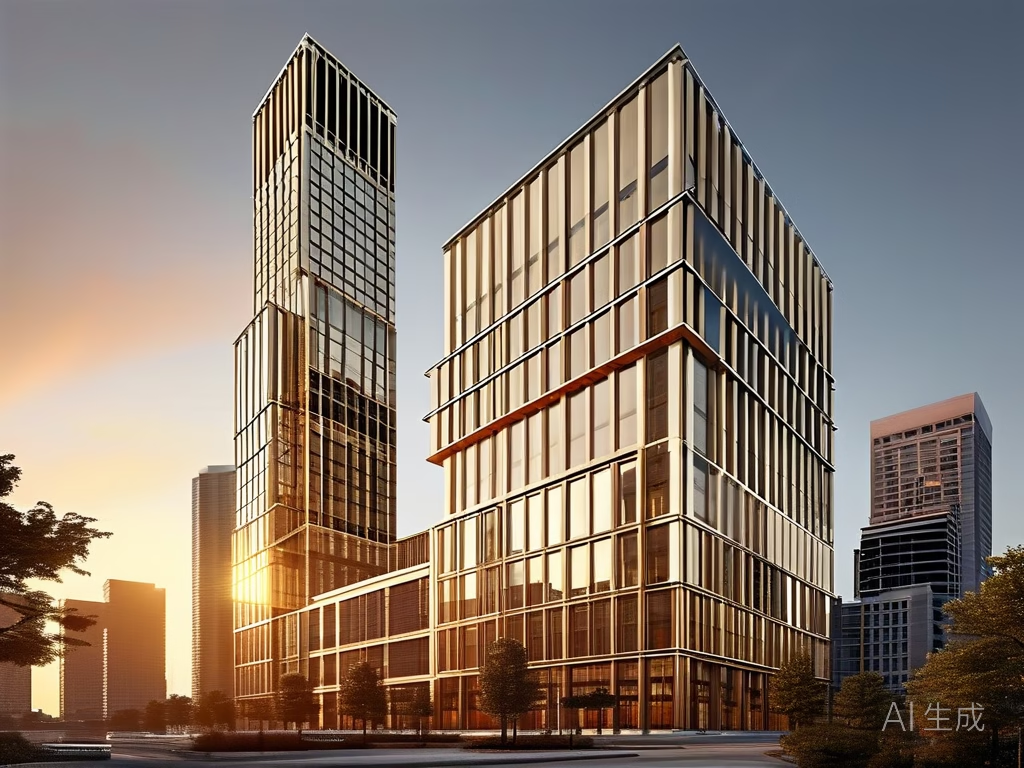
Anodized aluminium facades are sold on tolerance, not on colour charts. By the time a project reaches the procurement stage, the visual intent is usually settled — a warm champagne, a deep bronze, a near-black dark grey — and the conversation shifts to commercial comparison. This is exactly where the process most often goes wrong. Buyers receive a set of per-square-metre figures, line them up in a spreadsheet, and select the lowest. Six months later the delivered panels sit thinner than specified, seal quality is unproven, colour varies across the elevation, and the saving has been consumed by remediation. The remedy is procedural rather than technical: define the finish completely, then require every supplier to quote against that definition and to document it. What follows is a working method for obtaining an anodized panel quotation that can actually be verified.
Why a Price per Square Metre Without a Finish Specification Is Meaningless
Anodizing is an electrolytic conversion of the aluminium surface into an aluminium oxide layer grown from the metal itself. That layer is not decoration applied on top of the substrate; it is integral to it, which is why anodized facades resist chipping and flaking in a way that paint systems cannot. But the layer is grown, not poured, and its thickness is a process variable. The same extrusion profile, from the same alloy, at the same dimensions, can be anodized to a 10 µm cosmetic film intended for interior trim, or to a 25 µm architectural film classified for exterior exposure. Between those two processes sit material differences in rectifier time, chemical consumption, racking density, sealing treatment and reject rate. Those differences are real, they are measurable, and they are reflected in price.
When a supplier quotes a single per-square-metre figure and labels it only “anodized”, the buyer has no way of knowing which process is being priced. Marketed at the cosmetic end of the range, the number will look competitive against a Class 25 offer, and the comparison will appear to favour the wrong supplier. Worse, a low per-square-metre figure may specify a 25 µm average without any minimum local thickness requirement, or without a sealing quality requirement at all, leaving the buyer with a quote that reads correctly on paper and fails on the elevation. A genuine quotation therefore begins with an oxide thickness class stated as a number and a standard, not as an adjective. Until the finish is defined, the price is not a price; it is a placeholder.
The Information a Buyer Should Send With Every Enquiry
Comparable quotations come from comparable enquiries. The following details allow a supplier to price the actual process rather than guess at it, and they allow the buyer to hold competing offers to the same baseline.
Panel size and thickness. Give the cut panel dimensions and the substrate thickness, not only the finished facade area. Width and length determine racking, jigging and handling; very long or very wide panels may require specialised line capacity or horizontal processing, which affects both price and lead time. Thickness affects heat and current distribution during anodizing and the stiffness of the panel during transport.
Alloy and temper. Architectural anodizing is commonly executed on 6063 with T5 or T6 temper, or on 5005 and 5052 where sheet rather than extrusion is used. Alloys anodize differently: the same process on two alloys will not produce the same colour, because the alloying elements and, in the case of recycled input, the trace chemistry alter the oxide’s appearance. Crucially, colour and alloy are locked together. If a supplier is asked to match a master sample on a different alloy than the one that produced the sample, expect a mismatch.
Oxide thickness class and standard. State the class explicitly — Class 15 or Class 20 for exterior architectural use, Class 25 for severe or coastal exposure — together with the governing standard, for example the relevant EN or ISO anodizing standard, and specify whether the requirement is an average thickness across the batch or a minimum local thickness at any point on any significant surface. The distinction between average and minimum is the single most common gap in anodized panel quotations.
Sealing type. Anodized film is porous when it leaves the tank. Sealing closes the pore structure and governs resistance to staining, corrosion and colour shift. Hot water sealing and cold sealing differ in performance, in durability of appearance and in process cost, and cold sealing in particular must be explicitly characterised and tested rather than assumed. Ask for the sealing method to be named on the quotation.
Colour reference. Supply either a physical master sample retained by the buyer, or an agreed designation. Hand over the sample in person or by courier, keep a duplicate from the same production batch against which delivery will be compared, and record the lighting conditions under which the reference was validated. A colour name on its own is not a specification.
Batch-uniformity requirement. State plainly whether all panels for the elevation must come from one anodizing batch. Anodized colour is influenced by bath chemistry, temperature, current density and alloy; panels processed in different batches can differ noticeably in tone. On a single elevation, that variation is far more visible than the absolute colour value, because the eye reads adjacency rather than absolute reference.
cURL Too many subrequests by single Worker invocation. To configure this limit, refer to https://developers.cloudflare.com/workers/wrangler/configuration/#limits cURL Too many subrequests by single Worker invocation. To configure this limit, refer to https://developers.cloudflare.com/workers/wrangler/configuration/#limits
cURL Too many subrequests by single Worker invocation. To configure this limit, refer to https://developers.cloudflare.com/workers/wrangler/configuration/#limits cURL Too many subrequests by single Worker invocation. To configure this limit, refer to https://developers.cloudflare.com/workers/wrangler/configuration/#limits
cURL Too many subrequests by single Worker invocation. To configure this limit, refer to https://developers.cloudflare.com/workers/wrangler/configuration/#limits cURL Too many subrequests by single Worker invocation. To configure this limit, refer to https://developers.cloudflare.com/workers/wrangler/configuration/#limits
cURL Too many subrequests by single Worker invocation. To configure this limit, refer to https://developers.cloudflare.com/workers/wrangler/configuration/#limits cURL Too many subrequests by single Worker invocation. To configure this limit, refer to https://developers.cloudflare.com/workers/wrangler/configuration/#limits
cURL Too many subrequests by single Worker invocation. To configure this limit, refer to https://developers.cloudflare.com/workers/wrangler/configuration/#limits
cURL Too many subrequests by single Worker invocation. To configure this limit, refer to https://developers.cloudflare.com/workers/wrangler/configuration/#limits
cURL Too many subrequests by single Worker invocation. To configure this limit, refer to https://developers.cloudflare.com/workers/wrangler/configuration/#limits
cURL Too many subrequests by single Worker invocation. To configure this limit, refer to https://developers.cloudflare.com/workers/wrangler/configuration/#limits
cURL Too many subrequests by single Worker invocation. To configure this limit, refer to https://developers.cloudflare.com/workers/wrangler/configuration/#limits
cURL Too many subrequests by single Worker invocation. To configure this limit, refer to https://developers.cloudflare.com/workers/wrangler/configuration/#limits
cURL Too many subrequests by single Worker invocation. To configure this limit, refer to https://developers.cloudflare.com/workers/wrangler/configuration/#limits
cURL Too many subrequests by single Worker invocation. To configure this limit, refer to https://developers.cloudflare.com/workers/wrangler/configuration/#limits
cURL Too many subrequests by single Worker invocation. To configure this limit, refer to https://developers.cloudflare.com/workers/wrangler/configuration/#limits
cURL Too many subrequests by single Worker invocation. To configure this limit, refer to https://developers.cloudflare.com/workers/wrangler/configuration/#limits
cURL Too many subrequests by single Worker invocation. To configure this limit, refer to https://developers.cloudflare.com/workers/wrangler/configuration/#limits
cURL Too many subrequests by single Worker invocation. To configure this limit, refer to https://developers.cloudflare.com/workers/wrangler/configuration/#limits
cURL Too many subrequests by single Worker invocation. To configure this limit, refer to https://developers.cloudflare.com/workers/wrangler/configuration/#limits
cURL Too many subrequests by single Worker invocation. To configure this limit, refer to https://developers.cloudflare.com/workers/wrangler/configuration/#limits
Request for Quotation Checklist
| Item to supply | Why it matters |
|---|---|
| Panel size, cut dimensions and substrate thickness | Determines racking, handling and line capacity, and influences both price and lead time. |
| cURL Too many subrequests by single Worker invocation. To configure this limit, refer to https://developers.cloudflare.com/workers/wrangler/configuration/#limits | Alloy chemistry governs achievable colour; a mismatch with the master sample alloy causes visible colour deviation. |
| Oxide thickness class and governing standard | Class 15, 20 or 25 represent different process costs; naming the standard makes the requirement enforceable. |
| Average or minimum local thickness requirement | Prevents a quotation that meets the average while leaving thin areas on the panel surface. |
| Sealing method | Hot and cold sealing differ in performance and cost; an unnamed sealing method makes quotes incomparable. |
| Colour reference (master sample or agreed designation) | Provides the physical baseline against which pre-shipment colour verification is performed. |
| Batch-uniformity requirement | Establishes whether the elevation must come from a single anodizing batch, controlling visible tone variation. |
| Total quantity, phasing and batch structure | Allows the supplier to plan line slots and confirm whether the order fits one batch. |
| Required test reports | Thickness, sealing and alloy certificates are the evidence that delivery can be checked against specification. |
| Surface protection and film specification | Prevents adhesive residue and shadowing during transport and site storage. |
| Destination port | Enables accurate freight, packaging and container loading to be priced into the offer. |
| Mock-up panel and sample requirement | Confirms colour on the specified alloy before production, rather than relying on a catalogue swatch. |
 Italiano
  English
  Français
  Bahasa Indonesia
  Deutsch
  Español
  العربية
  Español de México
  Nederlands
  香港中文
香港中文