
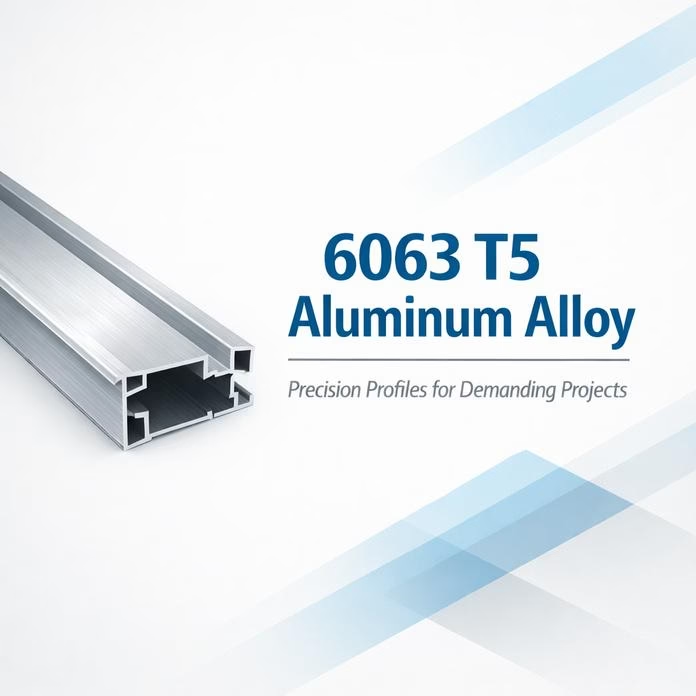
When deadlines bite and specs won’t budge, 6063 T5 Aluminum Alloy keeps its cool—sleek, strong, and ready for your next big build.
Big projects don’t fall apart because of vision—they fall apart because the materials can’t keep up. 6063 T5 Aluminum Alloy is the quiet overachiever in that story: light on its feet, tough under pressure, and polished enough to look sharp on a storefront or factory floor. When timelines are tight and specs are non‑negotiable, you need extruded profiles that slide into place like they were born there.
From standard 20×20 frames to custom CNC cuts and anodized finishes, this is where precision meets practicality. Less waste. Fewer headaches. Profiles that work as hard as you do.
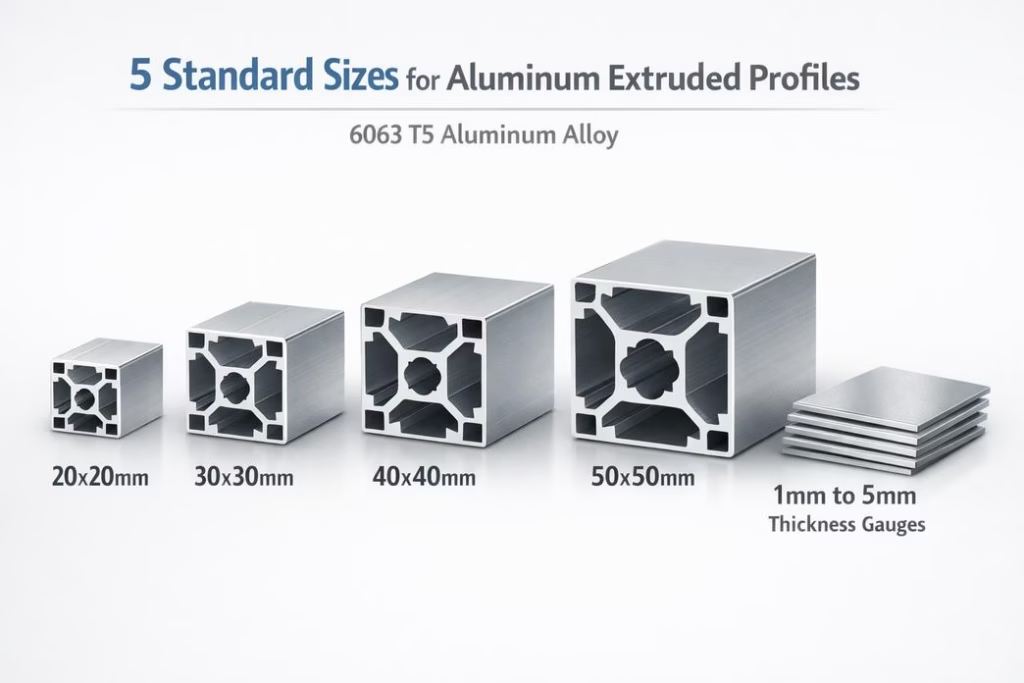
5 Standard Sizes for Aluminum Extruded Profiles
Aluminum framing doesn’t need to be complicated. These five standard sizes built with 6063 T5 Aluminum Alloy keep things practical, clean, and reliable. From compact frames to large structural panels, each format balances strength, weight, and finish—exactly what fabricators and designers look for today.
20 × 20 mm Profile Widths in 6063 T5 Aluminum Alloy
The 20×20 mm format is compact but surprisingly capable. Built from 6063 T5 Aluminum Alloy, this profile width works well in tight layouts where space matters.
- Core material foundation
- 6063: magnesium–silicon aluminum blend for smooth extrusion
- T5: air-cooled and artificially aged for balanced strength
- Aluminum alloy matrix: stable, corrosion resistant
- Structural characteristics of extruded profiles
- Lightweight frame geometry
- Ideal for light-duty enclosures
- Clean edges for modular assembly
- Dimensional control
- Accurate standard dimensions
- Consistent slot tolerances
- Lightweight frame geometry
- Application match
- Decorative panels
- Small automation frames
- Compact retail displays
Within aluminum extrusions, this size keeps fabrication simple. The smooth surface typical of 6063 T5 alloy also supports anodizing without drama.
30 × 30 mm Standard Sheet Sizes for Extrusions
The 30×30 mm configuration sits right in the sweet spot.
- Balanced load support
- Flexible sheet sizes compatibility
- Efficient machining on common saws
Fabricators like this standard extrusions option because it handles mid-level loads without overbuilding. In many projects, 6063 T5 Aluminum Alloy in this size gives enough stiffness while keeping weight manageable.
Why it works:
- Stronger cross-section than 20×20 mm
- Stable dimensional standards across batches
- Compatible with modular fasteners
Architectural cladding frames and medium equipment guards often rely on this aluminum alloy grade. wallnova frequently supplies this format for modular builds that need clean alignment and repeatable cuts.
40 × 40 mm Profiles with Mill Finish
For higher loads, 40×40 mm profiles in 6063 T5 Aluminum Alloy offer added stability. The mill finish keeps cost down before surface treatment.
Mechanical Snapshot of 40×40 mm (Typical 6063 T5 Aluminum Alloy Data)
| Property | Typical Value | Test Standard |
|---|---|---|
| Tensile Strength | 160–190 MPa | ASTM B221 |
| Yield Strength | 110–130 MPa | ASTM B221 |
| Elongation | ≥8% | ASTM E8 |
| Density | 2.70 g/cm³ | EN 573 |
Structural layout advantages:
- Load handling
- Thicker wall options
- Reduced deflection in spans
- Surface pathway
- Raw mill finish
- Ready for anodizing
- Ready for powder coat
- Raw mill finish
In transportation framing and façade grids, this extruded sections size made from 6063 T5 aluminum keeps weight lower than steel while staying stiff enough for code-driven designs.
50 × 50 mm Large Format Panels Option
The 50×50 mm dimension shifts into heavy-duty territory. These large format panels and structural frames reduce joint counts and speed up assembly.
Key traits:
- Wider profile dimensions
- Better span performance
- Stronger corner rigidity
For industrial enclosures, fewer connectors mean less labor. That’s money saved. Using 6063 T5 Aluminum Alloy here keeps weldability practical while still maintaining corrosion resistance.
Custom fabrication shops appreciate how this aluminum alloy flows smoothly during extrusion, forming precise internal cavities for wiring or reinforcement rods. wallnova supports bulk orders in this size for factories upgrading structural systems.
Custom Thickness Gauges from 1 mm to 5 mm
Not every build fits a fixed wall thickness. That’s where custom thickness control comes in.
- Gauge flexibility
- 1 mm for lightweight skins
- 5 mm for reinforced frames
- Process compatibility
- Bending
- Punching
- Shearing
Material breakdown within extruded material options:
- 6063 base aluminum
- T5 temper strengthening
- Uniform grain structure
- Thickness specifications
- Thin wall
- Lower weight
- Faster heat transfer
- Heavy wall
- Increased rigidity
- Higher load tolerance
- Thin wall
Across all these gauges, 6063 T5 Aluminum Alloy remains the backbone. The mix of 6063 chemistry and T5 temper keeps performance steady from slim decorative trims to solid structural supports. For brands like wallnova, that consistency means fewer surprises on-site and smoother fabrication every time.
How to Customize 6063 T5 Aluminum Profiles?
Working with 6063 T5 Aluminum Alloy isn’t just about picking a standard extrusion and calling it a day. Break the phrase into 6063 + T5 + aluminum + alloy, and you’re really talking about chemistry, temper, and performance all rolled into one solid profile.
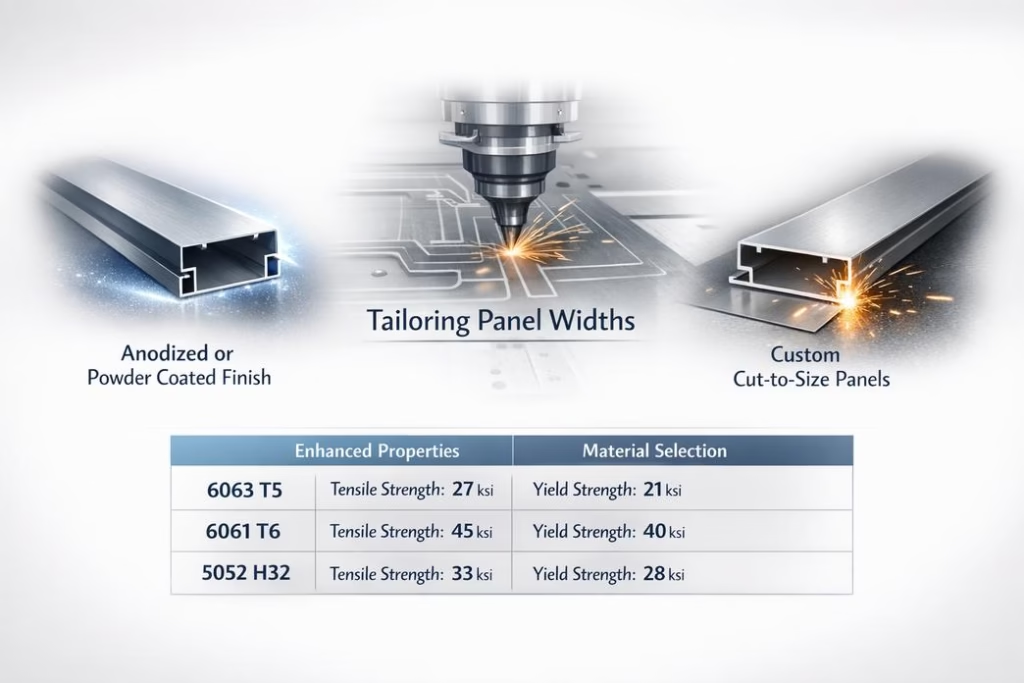
Achieving Anodized or Powder Coated Finish
When customizing 6063 T5 Aluminum Alloy, surface finish often drives the final look and lifespan.
- Surface Goals
- Protection
- anodizing builds an oxide layer that boosts corrosion resistance.
- Ideal for outdoor façades using 6063 T5 aluminum.
- Style
- powder coating expands color options far beyond raw aluminum tones.
- Adds impact resistance and stronger aesthetic appeal.
- Protection
- Performance Comparison
- Surface treatment thickness control
- UV stability
- Scratch tolerance
According to the International Aluminium Institute’s 2025 industry outlook, global demand for anodized architectural aluminum continues to rise alongside green building standards.
“Architectural applications remain a primary growth driver for treated aluminum products in 2025, especially in energy-efficient façades.”
For 6063 T5 Aluminum Alloy profiles, the right finish turns a basic extrusion into a weather-ready building component.
Tailoring Panel Widths with CNC Machining
Custom widths matter. A stock 6063 T5 aluminum profile rarely fits complex assemblies without refinement.
Using CNC machining, fabricators can adjust panel width and create grooves with tight dimensional accuracy. Typical workflow looks like this:
- Confirm required custom dimensions from design files.
- Program toolpaths for precision cutting.
- Execute milling and slotting operations.
- Inspect tolerance, often within ±0.1 mm.
Key advantages of professional machining services include:
- Clean edges
- Repeatable accuracy
- Minimal material waste
For 6063 T5 Aluminum Alloy, controlled machining preserves structural stability while adapting to transport or enclosure frames.
Integrating Laser Cutting for Custom Cut-to-Size Panels
When projects demand exact cut-to-size results, laser cutting becomes the go-to tool for aluminum alloy sheets and extrusions.
- Fabrication Planning
- Material prep
- Verify thickness of 6063 T5 Aluminum Alloy panels.
- File conversion
- CAD to machine-ready format.
- Material prep
- Execution Stage
- High-speed precise cuts
- Low heat distortion
- Clean kerf edges
- Output Control
- Measure custom lengths
- Inspect surface integrity
This method improves panel fabrication efficiency and supports detailed architectural cladding without heavy secondary processing.
Selecting 6061 T6 or 5052 H32 for Enhanced Properties
Material choice affects strength, formability, and lifespan. While 6063 T5 Aluminum Alloy works great for extrusion and finishing, other aluminum alloys may suit tougher demands.
| Alloy | Tensile Strength (MPa) | Yield Strength (MPa) | Elongation (%) |
|---|---|---|---|
| 6063 T5 | 145–186 | 110–160 | 8–12 |
| 6061 T6 | 260–310 | 240–275 | 8–10 |
| 5052 H32 | 210–260 | 130–160 | 12–20 |
| 6063 T6 | 200–245 | 170–200 | 8–10 |
- If higher strength is critical
- Choose 6061 T6
- Stronger mechanical properties
- Better for load-bearing frames
- Choose 6061 T6
- If bending and shaping dominate
- Choose 5052 H32
- Improved durability in marine air
- Excellent corrosion performance
- Choose 5052 H32
Smart material selection keeps your aluminum alloy solution aligned with real-world stress, not just specs on paper.
Section Modulus and Moment of Inertia
Getting the math right keeps metal from bending like a soda can. For Industrial Enclosures built with 6063 T5 Aluminum Alloy, strength is not guesswork. It comes down to clean numbers, smart profiles, and solid engineering choices.
Calculating Section Modulus for Industrial Enclosures
In heavy-duty Industrial Enclosures, bending resistance is controlled by Section Modulus and the Cross-sectional Properties of the profile. When using 6063 T5 Aluminum Alloy, also written as 6063-T5 aluminum alloy or simply 6063 T5 alloy, designers balance weight, cost, and Structural Integrity.
- Core Variables in Section Modulus Calculation1.1 Geometry Factors
- Width (b)
- Height (h)
- Wall thickness (t)
- Yield strength of 6063 T5 Aluminum Alloy
- Allowable Bending Stress
- Practical Comparison of Typical Aluminum Extrusions
| Profile Type | Moment of Inertia (cm⁴) | Section Modulus (cm³) | Weight (kg/m) |
|---|---|---|---|
| Solid Bar 40×40 | 85 | 4.25 | 4.32 |
| Hollow Tube 40×40×3 | 62 | 3.10 | 2.10 |
| Reinforced Channel | 74 | 3.85 | 2.65 |
| Ribbed Extruded Profile | 91 | 4.60 | 2.95 |
- Design Logic for Aluminum Extrusions3.1 If enclosure panels face lateral wind load
- Increase height to raise Section Modulus
- Maintain wall efficiency for material savings
- Select ribbed Extruded Profiles
- Optimize neutral axis placement
Using 6063 T5 Aluminum Alloy gives stable mechanical properties and clean surface finish. That is why wallnova often specifies 6063 T5 aluminum alloy for custom Aluminum Extrusions, keeping bending stress under control without overbuilding the frame.
Moment of Inertia: Impact on Strength-to-Weight Ratio
The Moment of Inertia shapes stiffness. In 6063 T5 Aluminum Alloy structures, it directly affects Deflection and overall Structural Performance.
- Relationship Between Geometry and Stiffness1.1 Height Increase Effect
- Doubling profile height can raise Moment of Inertia by nearly four times.
- Smart cavity design reduces weight while protecting the Strength-to-Weight Ratio.
- Application in Aluminum Alloy Systems2.1 Transportation Components
- Lower deflection improves fatigue life.
- Higher inertia reduces panel vibration.
- Material Efficiency Strategy3.1 For 6063 T5 Aluminum Alloy
- Maintain balanced wall thickness.
- Avoid unnecessary solid cores.
- Integrate ribs instead of bulk mass.
- Achieve better Material Efficiency with stable Aluminum Alloy performance.
When inertia rises without adding too much mass, the Strength-to-Weight Ratio improves naturally. That is the sweet spot wallnova targets—strong frames, lighter loads, and smarter use of 6063 T5 Aluminum Alloy in real-world builds.
Scenario: Industrial Framing with Extrusions
Industrial framing today is not just metal and bolts—it’s timing, finish, and fit. From Architectural Cladding on high-rise towers to tight assembly tolerances, 6063 T5 Aluminum Alloy keeps showing up. The mix of strength, surface polish, and easy forming just makes life simpler on-site.
Architectural Cladding Frames with 6063 T5 Alloy
When designing Frame Construction for modern Building Facades, material choice drives everything. 6063 T5 Aluminum Alloy stands out because the balance of 6063, T5 temper, aluminum, and alloy chemistry gives consistent extrusion flow and a clean anodized look.
- Material foundation1.1 Aluminum Alloy grade: 6063 T5 Aluminum Alloy1.2 Smooth finish for exposed Architectural Cladding1.3 Reliable corrosion resistance in coastal cities
- Profile engineering2.1 Precision Extruded Profiles for curtain wall grids2.2 Tight dimensional control2.3 Easy cutting and on-site fitting
- Structural behavior3.1 Lightweight load distribution3.2 Good weld response3.3 Stable performance under thermal expansion
| Property | 6063 T5 Aluminum Alloy | 6005A-T5 | Mild Steel |
|---|---|---|---|
| Tensile Strength (MPa) | 160–190 | 260–300 | 370–500 |
| Density (g/cm³) | 2.70 | 2.71 | 7.85 |
| Surface Finish | Excellent | Good | Requires coating |
| Corrosion Resistance | High | High | Moderate |
Compared with generic aluminum grade 6063 options, 6063 T5 Aluminum Alloy offers that sweet spot between formability and final hardness. For façade contractors working with wallnova, that balance often means fewer touch-ups and smoother installation days.
Just-in-Time Delivery for Large-Scale Projects
Big builds move fast. Just-in-Time Delivery keeps Large-Scale Projects from drowning in stockpiles of 6063 T5 Aluminum Alloy extrusions.
- Reduced yard storage
- Lower capital tied in raw 6063 aluminum stock
- Cleaner workflow for Construction Logistics
In practice, it works like this:
- Forecast demand from design drawings.
- Align mill production of 6063 T5 Aluminum Alloy with Project Timelines.
- Coordinate shipping windows through Supply Chain Management teams.
Add real-time tracking, and Manufacturing Efficiency improves without drama. The result? Crews get the right aluminum alloy 6063 profiles right when cranes are ready.
Combining Bending and Punching in Assembly Lines
Efficiency in Assembly Lines often comes down to smart sequencing of Fabrication Processes using 6063 T5 Aluminum Alloy.
- Process integration1.1 CNC Bending Operations for curved enclosures1.2 Servo-driven Punching Operations for slots and vents1.3 Inline inspection for dimensional checks
- Automation layer2.1 Sensors for position accuracy2.2 Tool-change systems reducing downtime2.3 Data feedback into Manufacturing Automation software
- Output alignment3.1 Clean edge quality for Component Integration3.2 Repeatable geometry across batches3.3 Lower scrap rates of 6063 T5 Aluminum Alloy stock
Using 6063 T5 Aluminum Alloy in synchronized bending and punching keeps profiles straight, holes crisp, and rework low. For transportation shells or industrial cabinets, that consistency saves time and keeps production teams in a good mood.
FAQs about 6063 T5 Aluminum Alloy
What makes 6063 T5 Aluminum Alloy ideal for architectural and industrial use?
6063 T5 Aluminum Alloy balances beauty and performance in a way designers appreciate:
- Excellent Corrosion Resistance for humid sites and outdoor exposure
- Smooth surface ready for Anodized Finish or Powder Coated Finish
- Reliable Weldability and Formability for complex frames
- Efficient Strength-to-Weight Ratio for Industrial Enclosures and Architectural Cladding
Compared with 6061 T6 Aluminum Alloy, it favors surface quality over peak strength, making it a favorite for visible structures and Decorative Panels.
How does 6063 T5 compare with other aluminum alloys?
A quick material contrast helps decision-making:
1) 6063 T5 Aluminum Alloy – refined surface, easy shaping, ideal for Building Facades
2) 6061 T6 Aluminum Alloy – higher structural strength for load-bearing parts
3) 5052 H32 Aluminum Alloy – strong corrosion resistance in marine settings
4) 3003 H14 Aluminum Alloy – economical for general sheet work
5) 7075 T6 Aluminum Alloy – extreme strength for aerospace-grade demands
When appearance and extrusion precision matter most, 6063 T5 often wins.
What panel dimensions and thickness options are available?
Projects rarely share the same measurements. Supply typically includes:
- Standard Sheet Sizes for routine fabrication
- Custom Cut-to-Size Panels for precise installations
- Large Format Panels to reduce joint lines
- Flexible Thickness Gauges and controlled Panel Widths
For Transportation Components or Building Facades, choosing the right thickness directly affects rigidity and installation speed.
Which surface finishes enhance 6063 T5 Aluminum Alloy panels?
Surface treatment defines both mood and durability.
- Mill Finish – clean industrial base
- Anodized Finish – improved corrosion protection and color stability
- Powder Coated Finish – strong, decorative layer for exterior walls
- Brushed Finish / Polished Finish – expressive textures for high-visibility Decorative Panels
In façade design, the finish often carries as much emotional weight as the structure itself.
What fabrication services are commonly used for 6063 T5 panels?
From raw extrusion to final installation, processing shapes performance:
- Precision Shearing for clean edges
- Controlled Bending for frames and trims
- Accurate Punching for assembly points
- Fine-detail Laser Cutting
- High-tolerance CNC Machining
Its stable Formability ensures fewer cracks and cleaner lines during production.
How does supply chain management affect large 6063 T5 projects?
Material flow can decide success or delay. Effective systems include:
- Strategic Bulk Material Sourcing
- Coordinated Just-in-Time Delivery
- Smart Inventory Management
- Protective Packaging Requirements
- Reliable Global Shipping
For large Architectural Cladding orders, timing and material consistency protect both budget and reputation.

 English
  Français
  Bahasa Indonesia
  Deutsch
  Italiano
  Español
  العربية
  Español de México
  Nederlands
  香港中文
香港中文